Articles

by Rodrigo Pinto Rodrigo Pinto No Comments

Agility Chapter: Importance of creating one in your company

In 2012, Henrik Kniberg, a consultant at Spotify, along with another consultant, designed and executed the organizational structure called the “Spotify Model”. This concept is nothing more than the organizational culture that the company would start to apply internally.

To better understand the famous “Spotify Model”, check out this content here and also this one from our Training area, the Agile School.

In order to arrive at the model we know today, Henrik enumerated four fundamental elements for the structure to work. They are:

  • The heart of this model, which are the Squads;
  • The Tribes, which are nothing more than sets of Squads, directed to a single theme;
  • Chapters and Guilds, which are the support and horizontal structures.

It may seem that the structure that Henrik describes is a matrix structure, in which companies have been doing and organizing themselves for many years… However, the way this format was applied within Spotify was vertically, that is, it was an organizational culture focused on the format of Squads – where the structure is oriented to values and autonomy.

It is also interesting to point out within this theme that Squads are inspired by Scrum teams, and Scrum teams themselves are inspired by “The New New Development Product Game” – an article from the 80s that talks about innovative companies like 3M, Epson, Honda, among others that, at that time, already organized their teams in cross-functional ways, with a clear and specific mission, among other characteristics.

But how are the Chapters structured?

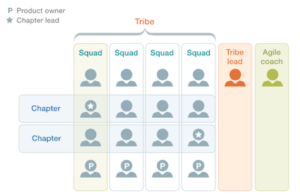
The chapters are nothing more than the sum of people in similar roles and their main objective is to support that function. For example, if each Squad has a developer, as shown in the chapter below, there will be different developers in that tribe. With this you create a chapter of developers so that people can support each other, help, exchange experiences and knowledge.

To be clearer what each of these structures really is, check out the image below.
Agility Chapter: Importance of creating one in your company

The benefits of Chapters in companies

We can understand that it is in the Squads that the work is, in fact, being applied daily, right? But to make this work even more in tune and standardized, Henrik used the Chapters format to help all people who play a certain role within the teams to grow within that specific knowledge.

The main benefits of the Chapter structure within organizations are:

  • Exchange of information, excellence in knowledge and focus on growth and quality;
  • Creation of standards for the creation, planning and execution processes;
  • Assistance in solving problems, bugs, failures, etc;

It is important to emphasize that within this Chapter there must be a leader (Chapter Lead) to guide, designate and assist the rest of the members of this structure. In addition to making career plans, planning bonuses, dismissals or hiring, this leadership will understand the needs in general, support professionals on a daily basis and develop their capabilities.

Why create an Agility chapter in organizations?

Companies that are working on their digital transformation processes and are looking to become more agile can adopt the Agility chapter format for their organizations precisely to leverage the adoption of agile practices in the organization as a whole.

This is all because the Agility specialist usually works alone, that is, he does not have people within his team and/or squad acting in the same role as him to discuss situations or to support himself when something needs help. A chapter becomes indispensable to raise the level of knowledge and application of Agility in everyday life.

The chapter can also help in systemic situations, that is, in complexities that are outside that Agilist’s team, for example, in more strategic and less operational situations. This happens a lot in companies that are starting to apply agile methods and need greater support in expanding this culture within the company.

To finish…

Now that we understand why creating and maintaining an Agility Chapter, it’s time to put it into practice. There are a few steps you can take to have a successful chapter.

  • Have a chapter leader who supports and facilitates the day to day of the teams;
  • Have a specific communication channel for the chapter to share information and learning, in addition to periodic meetings;
  • It is a structure that observes each one’s career and this growth plan, whether with follow-up and mentoring, and/or training and study groups.

Taking advantage of the beginning of the year to set strategic goals for your company is essential. To help you in this process of better understanding how to innovate within your business model, it is essential to have experts as qualified partners and experts in this subject.

Whether to improve processes in your Technology and Products area, to implement management tools or even to create a personalized training trail for your employees, we at Agile.Inc can help you.

We work with consulting for agile and digital transformation, in addition to providing experts to work in your company, focusing on growth and giving traction in your transformation process.

In addition, as mentioned above, training is essential to raise your company’s level of knowledge and give you more competitive advantage in the market. Our custom tracks range from leadership to frameworks for team operation.

Click here and schedule a conversation with our consultants and have a quick diagnosis of the best transformation model for your company.


by Agile.Inc Agile.Inc No Comments

Technology and Innovation Trends for 2022

Check out important data and the opinion of great experts on these subjects

Confira dados importantes e a opinião de grandes especialistas sobre as principais tendências de tecnologia e inovação para 2022

It is not news that more and more technology and innovation are advancing rapidly and making our routine (work and personal) much more practical and functional. Even with the advent of the pandemic caused by Covid-19, it is noticeable how much these areas could be transformed and continue to grow even more, changing a lot the way we communicate, work, live, walk, among other activities.

With that in mind, we gathered the main technology and innovation trends for this year and brought surprising data and great experts to talk about the topic. In this live meeting, Ivan Santos (CEO of Agile.Inc and Agile School), Roberto Hengist (CPTO at Cogna Educação) and Luis Gama (Director of Innovation at Oba Hortifruti) addressed the technological innovations for various sectors.

Click here and watch the Agile Meeting now

Top technology and innovation trends for this year

Increasingly hybrid work formats

A survey of more than 30,000 workers from 31 countries, commissioned by Microsoft for The Work Trend Index study, showed that 73% of people want flexible remote work options to continue. But, on the other hand, the same survey indicated that 67% of respondents missed face-to-face meetings.

So for this year, work environments will need to be much more flexible and hybrid. With this scenario, it becomes increasingly important to invest in people’s culture, motivation, physical and mental health and in technologies that help make this new situation much more beneficial for everyone.

Also read: 5 tips to successfully join remote work

Education and Retail increasingly digitized

Despite having several segments that were greatly affected by the pandemic, the Education and Retail sectors, for example, suffered major impacts and had to quickly reformulate to meet the new consumption formats in the last two years.

The main highlights for innovation in this sector in 2022 are the formats of consumption and education, which will be much more dynamic during these virtual interactions – which we have seen a lot in recent months.

Artificial Intelligence and Hyperautomation

An IDC survey predicts that global spending on artificial intelligence will double in four years, reaching $110 billion by 2024. As such, the main trend is to utilize the benefits of these technologies in a personalized way for customers.

Increasingly technological means of payment and finance

There is a sector that only grows exponentially every day! Open banking, blockchain, more decentralized finance, virtual currencies, more means of payment and digital wallets emerging, the fintech boom, among other movements…

Check out all the details cited by experts here!

Data Security and Privacy

We can say that 2021 was a very challenging year when we talk about data privacy and information security. Many cyber attacks, a lot of lack of security and data control… Even the decentralization and flexibility of remote work is something that can still cause many weaknesses and security flaws, which can result in several cyber attacks.

A survey by Forrester Consulting showed that 72% of business-impacting cyber attacks target remote workers. That is, in addition to the focus on improving data security as intrusions are increasingly far-fetched, it is also important to invest in a safer structure and leave legacy and vulnerable systems behind.


Hyperconnectivity? 5g? Metaverse? What else can we expect? 

This growing virtual universe will really transform the way we live and will definitely impact the way we work. Check out the opinions of Ivan Santos, Luis Gama and Roberto Hengist and more doubts and trends worth analyzing.


WATCH THE FULL WEBINAR AND SEE ALL TRENDS

Do not leave it for later

Taking advantage of the beginning of the year to set strategic goals for your company is essential. To help you in this process of better understanding how to innovate within your business model, it is essential to have experts as qualified partners and experts in this subject.

Whether to improve processes in your Technology and Products area, to implement management tools or even to create a personalized training trail for your employees, we at Agile.Inc can help you.

We work with agile and digital transformation consulting, in addition to providing experts to work in your company and training ranging from leadership to frameworks for the operation. Click here and schedule a conversation with our consultants and have a quick diagnosis of the best transformation model for your company.

 

by Agile.Inc Agile.Inc No Comments

5 Tips To Join Hybrid Work Successfully

Find out how to make your organization safer, more sustainable and more productive for this new way of working.

The sudden shift to the home office caused by the Covid-19 pandemic has caused many companies to rethink their work formats. Nowadays – in which many people have already been able to return to offices, it has been realized how satisfactory a hybrid model can be. In other words, some days in the office in person and others working from anywhere, remotely and online.

However, with all these adaptations and news, this subject still divides many opinions. A survey of more than 30,000 workers from 31 countries, commissioned by Microsoft for The Work Trend Index study, showed that 73% of people want the continuation of flexible teleworking options. But, on the other hand, the same survey indicated that 67% of respondents missed the face-to-face meetings.

As such, it is remarkable that most people want this flexibility for their work hours. This, in fact, is a current desire of leaders, as 82% of leaders plan to continue allowing their employees to work remotely, at least part of the time, according to a survey by Gartner.

Therefore, to be a sustainable and safe model, some points need a lot of attention. We list some of the main changes needed to start doing now and your organization to have a more competitive advantage in the market. Check out:

Invest in technologies for safe and effective hybrid work

Decentralization and flexibility will be part of daily business as 43% of leaders indicated they will give employees flexible days and 42% will provide flexible hours. However, it is increasingly common to find weaknesses and security flaws, causing several cyber attacks.

A survey by Forrester Consulting showed that 72% of cyber attacks with a business impact target remote workers. In other words, it is increasingly important to invest in a more secure structure and leave legacy and vulnerable systems behind.

Discover our solutions to modernize your IT structure and work format

Provide adequate tools and improve people tracking

When we talk about a hybrid work format, it is important to emphasize that cloud storage tools, for online and live communication and even for managing teams and demands, are indispensable and, in the last two years, they have been used exorbitantly and will continue in this way in this work model.

Microsoft said its Teams platform, for example, had more than 200 million single-day meeting attendees in April 2020, totaling what CEO Satya Nadella described as “two years of digital transformation in two months.”

Empower employees, especially the leadership

In addition to the importance of promoting a digital culture, preparing professionals to implement these changes is essential for the work in a hybrid way to be positive and sustainable. Training focused on developing skills for this new scenario, some of which are:

  • Soft Skills: Communication, Narrative and Emotional Intelligence;
  • Management Skills: Management 3.0, Conflict Management, Time Management, Agile Leadership;
  • Agile Methods: Scrum, Kanban, Digital Product practices;
  • Technology: Programming, Data Analysis, Artificial Intelligence, Information Security.

Another important point in this process is to train leaders! Every cultural and digital transformation in an organization gains much more body and strength when changes start from the top down.

Enhance your indoor and outdoor digital experience

Finally, it is worth mentioning that the digital experience is more than essential from now on! According to Forrester, the forecast is that in 2022 US$10 billion will be directed to the area of design and customer experience, so that these capabilities can generate a positive impact on the user and customer experience.

In other words, both in interaction channels with employees, as in the entire experience that a user has when being impacted by your brand, it is important to develop personalized journeys that add value and generate enchantment.

Get started now!

To help you in this process of adapting to the hybrid work, it is essential to have experts as strategic partners. Whether to improve your IT processes, to implement management tools or even to build a personalized training path for your employees, we at Agile.Inc can help you.

We work with agile consulting and digital transformation, in addition to providing specialists to work in your company and training ranging from leadership to frameworks for the operation. Click here and schedule a conversation with our consultants and get a quick diagnosis of the best transformation model for your company.
by Matheus Reis Matheus Reis No Comments

The importance of a Product person in organizations

Every day we see people working and working hard to achieve goals or the agreed scope for a project. I rarely see people and teams wondering why that project and delivery is important to the company.

The vision of the strategic level created with a future objective is quickly broken so that the team that executes the demands on a day-to-day basis no longer knows the reason why it was hired.

This scenario is seen in small, medium and large companies, inside and outside Brazil, of different sizes and segments. Due to these needs, the figure of a Product Owner or Product Manager is essential in some companies.

This figure, regardless of its branch or context, is responsible for bringing the company’s vision of value to the different levels of the company.

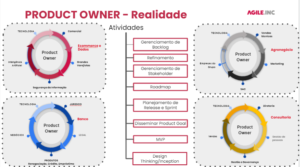
This role, even in different situations, requires techniques to help you in your daily life, as shown in the example below (figure):

A importância de uma pessoa de Produto nas organizações

Regardless of the framework, techniques or tools that this specialist uses on a daily basis, a good Product Manager must know how to say no to people, prioritize and organize demands and have a clear view of their Product Backlog – which is visible and communicated to all as a roadmap.

Taking care of Products, above all, is communicating correctly so that stakeholders and different teams are aligned with your vision, even if they don’t agree with it.
For this there are backlog prioritization techniques, categorization, breaking your backlog, design thinking and a host of other ways to turn ideas into tangible increments for the organization.

Thus, as we see in many literatures, the product manager is largely responsible for disseminating the product’s vision and value. Added to this, this producer must constantly seek to learn about their product in order to innovate.

To innovate the PO/PM needs to be serving the market, looking for success cases and benchmarks that apply in your context, in a way you need to be someone creative, or as we can say, co-creative because in many cases it is necessary to carry out co-creative processes. – creation like design thinking to be able to suggest experiments that can generate success for your product.

In summary we can say that:

– A good product manager has a vision of what is going on with his product and is able to communicate clearly.
– Has a lot of technical knowledge and manages to prioritize according to the organization’s objectives.
– Makes the team feel engaged to collaborate, create together and constantly seek to improve the value of your product.

Product management techniques help you accomplish the above points and more. A good producer must know their backlog and have a logical solution for it.
And in your organization, how do you see your product manager?

To understand even more about this subject, contact us here.

by Matthew Reis

by Agile.Inc Agile.Inc No Comments

Customer Centric: The Importance of the User Experience in Retail

How user experience and customer focus help you truly satisfy the consumer in an increasingly volatile and uncertain era

If there is something that is constantly desired by any business these days it is to achieve customer satisfaction, whether in a product or service. And do you know what the real reason for this great dispute is? It is that a satisfied and happy customer, with a good shopping experience, is much more likely to become a loyal customer – and this is one of the most valuable types of consumers for any company, especially in the digital world.

Retail is no different! As mentioned in another post here on the blog, according to a study by the Brazilian Electronic Commerce Association (Abcomm), in this period of pandemic caused by Covid-19, 150 thousand new online sales channels were created, while the monthly average was 10 thousand . In other words, most potential customers throughout the retail are ready to buy in this format.

But as the use of social networks increases, with paid content and content appearing in different forms, a multitude of mobile applications, streaming for all tastes, how are you getting your customer’s attention and satisfaction? Is the experience you are providing for him positive? Has this journey been continuously improved?

If you don’t have answers to these questions or if these questions didn’t even cross your mind at some point, we’re sure this article will help you better understand this topic and rethink your future strategies.

The importance of being customer centric 

Before understanding what the term user experience is in practice, it is important to know what is customer centric and its impact on truly modern and digital businesses. The term customer centric (in free translation means customer at the center) is used to denominate the concept of putting the customer really at the center of all decisions and planning of a company/product. 

From the first moment a potential consumer has contact with the brand, through the different stages of the purchase journey, after-sales and even the way you use the product, all strategies for these processes are developed by putting the customer at the center of that plan. 

This way of thinking, which has been gaining more and more space with the digital transformation that companies have been undergoing, is directly related to user experience practices, which we will explain below. 

Also Read: You Look Agile But Not Customer Focused? You’re probably losing the game!

Practical user experience 

The term User Experience (UX), that is, User Experience is the real experience that the consumer has when having contact with a product and/or service. The objective of UX practices is to make businesses more attractive, intuitive and desirable, of course, always striving for efficiency, in order to make that user a customer, in the best possible way. 

This positive experience can be created in any user contact channels. On websites and mobile apps, for example, the focus is on making the navigation much more fluid so that the customer can quickly find the information they are looking for, without having difficulties in solving what they need in that particular channel. 

To ensure this journey focused on the customer and their needs, User Experience specialists work with functional and practical issues, but also with all the emotional side of the experience, thus promoting better results for a company, since the chances of conversion grow with these practices.

This planning, focused on the user experience, can also save effort and money, and increase your company’s profits. According to Robert Pressman’s book, “Software Engineering: A Professional Approach”, for every $1 spent in UX to solve a problem during product planning, $10.00 would be spent to solve the same problem in development and $100 or more for the issue to be resolved after the product was released.

In other words, in addition to avoiding problems, this user-focused planning can also direct and facilitate the path between the customer and your product. It’s also worth noting that a recent study by Forrester Research revealed that a well-designed user interface can increase a website’s conversion rate by up to 200%, and a good user experience can raise conversion rates by 400%.

How to make this transformation?

Being more digital and more agile is not just about being in a digitized environment and being ready to respond quickly to change. To be prepared for these constant changes, a company must, first, evolve its mentality and culture.

Okay, but what are the characteristics of organizations that are really customer centric and care about user and customer experience? These are:

  • Teams start solving situations by the customer’s need to define the best viable solution;
  • People know the journey of users and personas clearly;
  • Business and Information Technology areas, for example, work together daily in a collaborative way;
  • Deliveries are focused on actually creating value;
  • Similar experiences across all channels (omnichannel), whether digital or physical;
  • Teams work in short cycles to gather feedback from customers;
  • Data-based analytics;
  • Focus on the customer and also on their emotions;
  • Company goals focused on business or customer, that is, to generate value and not just goals for project delivery;

Get started now!

Finally, it is important to remember that any change in mindset is a long journey, but full of benefits for your company and your customers. Therefore, look for qualified specialists to co-create with you this map of the transformation of your business, to be more agile and digital in the right way.

See how we transformed the user experience of the Sem Parar app, one of the main payment services for tolls, parking, drive-thrus, gas stations and other accredited establishments, which had a 315% increase in the user base with our consultancy. Schedule a chat with one of our consultants and understand how we can help you get better results.

by Agile.Inc Agile.Inc No Comments

The future of retail is digital

The world is changing and it’s becoming more technological and digital. With this, it is already a fact that people are really adapting and adhering to new ways of consuming any type of product and/or service.

According to the Brazilian Electronic Commerce Association (Abcomm), between January and November 2020, online purchases grew 70.3% compared to 2019.

Invoicing reached R$115.32 billion, 69.6% more than the previous year.

And one of the leverage points of all this movement, caused especially by this period of pandemic (caused by Covid-19), was the closure of physical stores.

Companies had to adapt and migrate their businesses to e-commerces and those who were already selling online had to scale and expand their operations.

According to this Abcomm study, 150,000 new online sales channels were created in this pandemic period, while the monthly average was 10,000. In other words, these data indicate that the sector has undergone a major transformation.

Speaking of online commerce, if this was already a growing market, both the pandemic and the growing wave of digital transformation only accelerated this movement.

The invoicing buying and selling products online, grew 41% in 2020, with more than 194 million orders made by Brazilian consumers in the year.

According to data from the Webshoppers study (Ebit/Nielsen & Bexs Bank), this was the highest percentage increase since 2007 and sales totaled around R $87.4 billion in the period.

But if you are in this sector or have a business impacted by it, you must be asking yourself now: what’s next? What is the future of post pandemic retail?


Go digital or die!

That’s right! Regardless of what your retail business is, from fashion to supermarket, digitization is the thing!

During the first quarter of 2021, Neotrust data show that there was a continuity in the growth of online sales in Brazil.

According to the study published in Exame, digital retail had revenues of R$ 35.2 billion in the first quarter of 2021 – an increase of 72.2% over the same period of the year past.

This year alone, 78.5 million online purchases were made in the period (volume 57.4% higher than in 2020), with an average ticket of R$ 447.90, 9.4% higher than that registered in the same period of the previous year.

All this increase makes businesses increasingly digital and more secure, focused on consumer needs and with a more flexible and adaptable operating model.

And this goes far beyond adopting new and better technologies!

Being a digitized organization is using digital technologies to enhance business models . For example, new and more new service channels, services through mobile applications, updates that help to improve the relationship with the customer.

Already a process of digital transformation goes far beyond the adoption of the best technologies. It encompasses several practices, tools and, above all, a new organizational culture.

The change companies that want to have a competitive advantage today need to make is much more about people than technology. This process is guided by:

    • Customer-centric organizational changes;
    • Supported by a servant leadership;
    • Along with a new corporate culture;
    • By leveraging technologies that enable people’s autonomy.


In other words, if this whole process of digitization and digital culture is still not happening in your organization, you are losing money!


How to initiate these changes in practice

To be truly digital, it is important to understand that some pillars are the main ones to start this digital transformation process:


Culture

As mentioned before, it is very important that there is a change in the organization’s culture, as this is one of the main areas that show if a company is truly digital.

After all, it all boils down to a change of culture and mindset.

In this pillar, the main changes that we see in the day-to-day work here at Agile.Inc helping companies are:

  • Really put the customer at the center of your business;
  • Having a culture of applied innovation;
  • Empower teams, but with high alignment;
  • Create a culture of “not being afraid of failure” and
  • be more transparent in actions, decisions and plans 


Internal Capabilities

Your company teams need to start solving more complex issues, so they will need to have new skills and be able to follow the transformation.

It is important that the professionals in your organization:

  • Know how to work with new technologies (Big Data, Blockchain, Machine Learning, among others);
  • Have agility in product development,
  • Have a lean management in product design;
  • Make use of design strategically.


These are some of the skills professionals need to develop to be more digital, depending on the context of each business.

When it comes to buying and selling online, for example, there will be several other specific skills that are important to adopt.


Structure and Governance

How is your company organized? The way your company’s structure and governance is composed shows whether it is still in a traditional or digital paradigm.

To find this out, you need to raise some questions, such as:

  • How are the areas of the company structured?
  • How to break the organization’s silos?
  • How is the budget defined?
  • How are initiatives prioritized?
  • How is work tracking done transparently?
  • How to create greater operational efficiency, for example with automation?


These are just a few examples of issues that are addressed during this transition from companies that work in a traditional way, to those that are already suited for the digital age.

That’s why it’s important to have the right experts helping you in this process of change, pointing you to the best oneway of structuring your company to be more modern and technological.


People

Do all members of your teams know their roles and responsibilities? In an organization with a digital culture, it is important to have these issues resolved clearly, to have more engaged people.

  • Roles and responsibilities (noting that it’s no use just being defined, but must be followed and monitored in a natural way by everyone involved),
  • How are people motivated;
  • And which leadership model to apply.


Business Models

The fifth pillar that we believe is essential for a process of digital transformation is to think of new business models for these new forms of consumption – which are increasingly adaptable.

As we mentioned earlier in this text, the way people buy services and products is changing and companies need to adapt as quickly as possible.

Your business may already have some of these pillars already well developed, others less so…

For us at Agile.Inc, there is no rule of thumb as to which area needs to be worked on first, however, we strongly believe that some points are driving levers for a company’s transformation, such as :

  • Develop and empower leadership;
  • Develop and empower teams in a custom way;
  • Apply and implement Agility concepts to work more efficiently and effectively.


In closing, it is worth noting that the entire process of change, especially a digital transformation and the implementation of new technologies and/or a new way of working, is complex and full of uncertainties .

But it is in an environment like this where the best innovations emerge, with simple solutions that generate much more value for an organization and its customers.


Our final tip is to gather the best experts you can to help you with this digital transformation and we can help you with that! Talk to one of our consultants and understand how we help large Brazilian companies to modernize their businesses.

by Thiago Fregni Thiago Fregni No Comments

How digital transformation is helping to retain and hire talent in an increasingly competitive market

Hiring Information Technology professionals is increasingly difficult.

According to data from the Brazilian Association of Information Technology and Communication Companies (Brasscom), by the year 2024, Brazil will need 420 one thousand Information Technology (IT) professionals.

Brasscom also warns that the country trains approximately 46 thousand professionals a year.

With these data, it is clear that the capacity to train professionals will not be enough to supply all the existing positions in the labor market.

In addition, during the pandemic caused by Covid-19, the possibilities expanded as many companies adopted the home office and allowed the hiring of professionals in other cities, states and even same countries.

All this makes attracting talent more difficult. With a heated and constantly evolving market, candidates currently look not only at the salary and benefits package offered, but what the company has to offer in relation to the work environment, culture, flexibility and growth.


And what does this have to do with digital transformation?

During the consultations I’ve been doing, I’ve come to realize that one of the most common motivations  among my clients for digital transformation has been the need to have a more digital, agile environment with technologies more recent, because when it comes to hiring or even retaining professionals, this has counted and made a lot of difference.

Phrases like “Is your work model agile?”, “Does the team have a Product Owner and Scrum Master?”, “Do you use DevOps practices?” and “Post pandemic, will the home office continue?” have been constant during interviews with candidates and candidates.

If for most of these questions the answers are “no”, combined with an old technology stack, people prefer to look for an opportunity that brings this type of scenario mentioned in the questions above.

Working in a collaborative environment, where people can bring new ideas and work with cutting edge technology, has been a great motivator for these professionals.

And it is with these pains that technology executives have increasingly used digital transformation as a possible way to address these issues.


Transformation is organizational and cultural

How to build a work model that is collaborative, use the agile culture, engineering practices and digital product management, without losing the essence of the organization, is what our customers have searched.

Where, before, companies that wanted to be agile or digital to be at the forefront of the market, today this is seen as a need to attract and retain their talents, to be there really prepared and ensuring competitive advantage.

Have you seen this scenario too? How has this been in your organization?


By Thiago Fregni

by Ivan Santos Ivan Santos No Comments

Team chemistry is more important than individual skills

During the consulting and even leadership training processes, I see that managers who are building new teams – whether hiring a new employee or relocating internally, they often have an individualized thought about that particular professional.

– What’s the curriculum?
– Where did you go to school? Has worked?
– Courses? Certifications?


It all makes a lot of sense, it’s super important and necessary. However, one point that may be off the radar of many contractors is:

How will this candidate interact with other team members?
How will they work together?

It may seem simple, but it’s really impactful on the day-to-day of a team and the organization as a whole, consequently.


“To manage effectively, you must focus on people’s INTERACTIONS, rather than their behavior separately.” (Russell Ackoff, modified)


To further illustrate the theme, I will use the Barcelona football team, one of the most winning teams in history and a famous example coming from team sports.

The principles behind Barcelona’s winning philosophy were, not having the best players (as good as they were), but the best “arrangement”, rapport, connection, team synergy…

In football, there is no secret: to dominate the game, first of all, possession of the ball is necessary. For this to happen, each player must have the ability to quickly catch and touch the ball to whoever is ahead.

However, for this to happen successfully, we do not rely exclusively on the individual skills of those who have the ball. The positioning of who is without the ball is more than essential.

In other words, for the player with the ball to have the possibility of passing, the other players must participate and position themselves in relation to their teammate. It is not an isolated action of one, but the entire movement of the group.

By establishing a fast, continuous and involving touch of the ball, the Barcelona team managed to maintain its attack possibilities, disarming the opposing defense’s positions.

And as an opposite tool, the same Barcelona smothered the game in the enemy’s field, leaving no room for the opponent’s ball touch. This style of play was given the name of tic-tac, symbolizing fast and continuous tapping, as well as a clock hand.

The football example makes it clear that the way people interact with each other is most responsible for the results of a team, not the individual actions of a single player.

If so, a single player would have to catch the ball and pass through all opponents towards the goal. Not the most brilliant of all would be able to do it consistently.


Individuals and INTERACTIONS more than processes and tools.
(Agile Manifesto)


At the end of the day, this is yet another agile principle being put into practice. So when managers are hiring or scheduling relocations, they should think about how the resulting team will play together.

In the same way, when we are thinking about a winning company, the “touch of the ball” between departments/teams must be fluid to increase the chances of winning the match.

Good week! #BeAgile

by Rodrigo Pinto Rodrigo Pinto No Comments

Design Thinking: How a Thinking Model Can Help Solve Problems

The search of companies for innovative solutions to complex and common problems in the day-to-day of modern business is enormous.

Therefore, most leaders and those responsible for taking certain types of decisions are formed by people who have creative, critical and quick thinking.

However, at some point the blockage arrives and the difficulty of solving problems increases more and more.

With this in mind, it is necessary to structure new working conditions and models to resolve these issues.

Among them, the Design Thinking process is essential for companies that need more innovation and competitive advantage.


What is Design Thinking?

Design Thinking is the name given to a process of critical and creative thinking that allows the organization of ideas that help in decision making.

It is important to make it clear that it is not a method to be followed, like a cake recipe, but rather a way of approach to better help with solutions.

This model can increase insights and how to apply them.

The main concept of Design Thinking is that the process is carried out in a collaborative and collective way, gathering as much information and perspectives as possible.

There are different moments and actions where companies apply Design Thinking, one of them is in solving problems independent of their size and magnitude.

Through different perspectives it is possible to have a bigger vision and a clearer solution.

Another common way to use this process is in the design and creation of new products and services.

With the participation of all areas of the organization, it is possible to add value to the items that are being created, increasing the chances of success.

Let’s make it clear that each case is different, the important thing is for the company to follow the process in the way that best suits its way of working, there is no correct formula to follow and implement Design Thinking, but there are some steps that can help you in this process.


The 4 Steps of Design Thinking

As we said before, there is no process to be faithfully followed for you to start applying Design Thinking in your company, however there are some steps that if you follow can facilitate the implementation and the results.


Immersion

This first step can be considered one of the most important because it is through it that you will go deeper into everything that happens within the company.

We suggest you carry out a SWOT analysis, which maps your business’ strengths and weaknesses, threats and opportunities, in addition to presenting an internal view referring to outside perspectives, ie, how people are seeing your business.

Thinking about having this perspective, always collect feedback from customers, employees, non-customers and prospects, delve into the company’s organizational policy.

With all this vision of your business, it will be possible to create more accurate solutions to the problems they used to face.

But don’t forget to NEVER forget to analyze behavioral scenarios in the region and in the country, this influences many aspects of the points you will analyze.


Ideation

After the immersion, you and your team will have already been able to see which points need urgent attention and change, which ones can stay longer in the future and which ones do not need to be moved.

By identifying this part, you are already able to start with the ideation that is nothing more than putting into practice the ideas you had regarding the conflicts identified in step 1.

When it comes to bringing out ideas, it is important to use techniques such as big data to increase the chances of success for ideas and reach the desired goal.


Prototyping

After joining ideas, it’s time for the team to get together and define which of these ideas can bring more results for the business.

For the main idea to have a good result, it is necessary to create prototypes and go on testing, so as the results delivered, it is possible to improve at each stage and in the delivery, there will be few or no flaws that will have to be adjusted.

If it is a service, your prototype can be something more visual and theoretical, such as graphics, images that represent the expected result of that service.


Development

The last step is the time to get everything off the paper, have done all the tests and put it into practice!

It is at this stage that you will launch your product or service and you will need to use all methods to draw the public’s attention to it, such as marketing actions, actions with existing customers, presenting to employees, and so on.

However, it is not because this stage has reached the end that the whole process has come to an end, quite the contrary, it is necessary to continue measuring and monitoring the performance of this new merchandise or service.


The benefits of investing in Design Thinking

We all know that a company evaluates its profits and investments through the return it gets for me. io of its sales, costs, and so on.

This is where Design Thinking comes in, as its implementation cost is extremely low and the result it brings to your business in the face of competition is enormous.

And this can actually be a differential for your company to put itself ahead of its main competitors, resulting in greater profit, a stronger brand.

In addition to benefits in terms of money and image in the market, design thinking manages to aggregate and engage employees from all areas and the result becomes very positive.

Because, employees will feel valued by the company and this motivates them to increasingly embrace the organization’s purpose, making the journey to the main objective even faster and more efficient.


What Design Thinking Provides for Your Company

Currently, this theme is widespread, especially among companies that have a product vision.

With this article, we now know what Design Thinking is and what it works for, but if you are still in doubt about how this process can help your company, it is worth highlighting some benefits:


Understanding customers: Design Thinking allows the business to be seen from the outside in, that is, the view of those who are being impacted from outside the company. With this, you can understand the types of customers you have and attract, in addition to being able to create a greater experience for them and deliver more value.


Understanding the business: Understanding the people inside the business/company is essential to map work processes and thus be able to understand what can or cannot be done and improved.


Co-create solutions: This is where it is possible to suggest process improvements along the company’s culture in collaboration with internal and external business teams.


3 tools that can be used in the Design Thinking process

To finish the topic, still talking about how to structure this Design Thinking process, it is important to define the tools that best suit the reality of each product to be used at this time:


Brainstorm

Brainstorming is a group dynamic that consists of sharing ideas and solutions to a problem the team is facing.

These are sessions without any kind of judgment of what is right or wrong, as the literal translation says “brainstorm”.


Mental Maps

Mind maps are very effective in organizing, developing ideas and thoughts. The goal is to make the whole creation process visibly, as clear as possible, and it can be very useful for new insights along this Design Thinking process;


Co-creation with Clients

It has become increasingly common for users and consumers to participate in the creative process of the project, whether it is a product or a service.

This is because you will have a view of your brand from the outside world of your business. In addition, your customers can bring great insights into the evolution of your project, as their vision is completely different from that formed by the organization’s stakeholders.


And if you still have difficulty finding the ideal model to improve the results of your business or digital product, make an appointment with us.

In a brief diagnosis, we help you draw up a concrete action plan to give you more results and a competitive advantage. Come and chat with us!

by Lucas Mucheroni Lucas Mucheroni No Comments

What is it, what is it for and how to apply DevOps?

The term DevOps emerged in 2008 in a talk by Patrick Debois, at the Agile Conference in Toronto and its main objective was to simplify and reduce the difficulty of interaction between the areas of </span >development, IT operations, quality engineering and security.

However, even before this culture was created (yes, DevOps is a culture), some companies already practiced the application in their teams, especially those seeking higher quality in deliveries and reduction of rework and communication failures.

As this culture grew, the name DevOps took shape and became more and more common. According to Gartner, in 2016, 38% of companies were already applying DevOps to their company’s internal teams and 50% said they would implement it internally by the end of that year.


What is DevOps anyway?

Before DevOps, the Developer, Operations and IT teams were separate and caused different friction between teams communication and tremendous failures in product delivery.

With the advent of DevOps, teams that worked separately became one, increasing delivery improvements and adding even more value to customers’ products.

“Everyone sees DevOps as a 7-headed bug, but it’s nothing out of this world.”

DevOps is a culture whose main objective is to facilitate practices within IT teams, improve communication between team members and bring continuous improvements such as the use of tools, best practices in the flows of deploys, with the intention of deliver more value to customers.

In a survey conducted by Gitlab, 83% of development professionals are getting their code out much faster and about 60% are getting a lot of implementation. more code in a single day after DevOps adoption.


The pillars of DevOps 

The DevOps culture is supported by 3 pillars, without applying them your strategy with the methodology can go wrong.

  • Icontinuous integration: transparency and sharing knowledge and experience between the Development and Operations teams.
  • Continuous deployment: faster and more continuous release of new versions of projects, products and services< /li>
  • Continuous feedback: frequent feedbacks with teams involved in all phases of project/product production</span >


Why have DevOps on the team?

There are numerous benefits of implementing the DevOps culture in teams, especially in teams that develop digital products and businesses. However the main ones are: 


Security

Tools applied with the DevOps culture make actions get defined and completed faster so production happens immediately. After the tests performed, it is possible to guarantee operational safety with the processes.


Facility in proactive intervention

By starting to work together, teams find it easier to communicate and follow the project process from start to finish, giving team members the opportunity to collaborate on improvements in the process.


Collaboration between teams

As mentioned above, collaboration becomes one to the other and not just between a developer or an operator. The team starts to work together to improve deliveries and add more value to the customer’s product.


Simple and automated processes

The practices adopted by the DevOps culture aim to transform processes into something simpler and more automated, without a lot of bureaucracy, to make it easier for the team as a whole to work. You can see the stages of the project according to what the team does.


More speed and quality delivery

The DevOps culture comes with the intention of automating certain processes so that the professional can dedicate his time and energy to other demands of the project. As a result, the quality of the final product improves and the team is able to deliver more deliveries to the customer.


The Role of DevOps in Digital Transformation

Increasingly, companies that want to be more innovative and ahead in the market, are seeking and undergoing transformation processes to be more digital.

This is because this transformation aims at the growth of organizations through technology, to be more modern, more innovative and more connected with their customers, having automated and agile processes.

With that in mind, DevOps is an essential tool for digital businesses to achieve their goals and improve their bottom line.

Therefore, the role of DevOps is super important in this process to help the development, operations and IT teams so that there are better deliveries and more evolution in their daily work.


Article Produced by Lucas Mucheroni – DevOps at Agile Inc

Top