Author: Rodrigo Pinto

by Rodrigo Pinto Rodrigo Pinto No Comments

Agility Chapter: Importance of creating one in your company

In 2012, Henrik Kniberg, a consultant at Spotify, along with another consultant, designed and executed the organizational structure called the “Spotify Model”. This concept is nothing more than the organizational culture that the company would start to apply internally.

To better understand the famous “Spotify Model”, check out this content here and also this one from our Training area, the Agile School.

In order to arrive at the model we know today, Henrik enumerated four fundamental elements for the structure to work. They are:

  • The heart of this model, which are the Squads;
  • The Tribes, which are nothing more than sets of Squads, directed to a single theme;
  • Chapters and Guilds, which are the support and horizontal structures.

It may seem that the structure that Henrik describes is a matrix structure, in which companies have been doing and organizing themselves for many years… However, the way this format was applied within Spotify was vertically, that is, it was an organizational culture focused on the format of Squads – where the structure is oriented to values and autonomy.

It is also interesting to point out within this theme that Squads are inspired by Scrum teams, and Scrum teams themselves are inspired by “The New New Development Product Game” – an article from the 80s that talks about innovative companies like 3M, Epson, Honda, among others that, at that time, already organized their teams in cross-functional ways, with a clear and specific mission, among other characteristics.

But how are the Chapters structured?

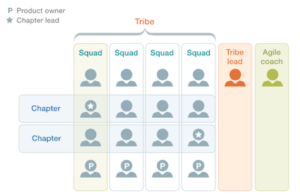
The chapters are nothing more than the sum of people in similar roles and their main objective is to support that function. For example, if each Squad has a developer, as shown in the chapter below, there will be different developers in that tribe. With this you create a chapter of developers so that people can support each other, help, exchange experiences and knowledge.

To be clearer what each of these structures really is, check out the image below.

Agility Chapter: Importance of creating one in your company

The benefits of Chapters in companies

We can understand that it is in the Squads that the work is, in fact, being applied daily, right? But to make this work even more in tune and standardized, Henrik used the Chapters format to help all people who play a certain role within the teams to grow within that specific knowledge.

The main benefits of the Chapter structure within organizations are:

  • Exchange of information, excellence in knowledge and focus on growth and quality;
  • Creation of standards for the creation, planning and execution processes;
  • Assistance in solving problems, bugs, failures, etc;

It is important to emphasize that within this Chapter there must be a leader (Chapter Lead) to guide, designate and assist the rest of the members of this structure. In addition to making career plans, planning bonuses, dismissals or hiring, this leadership will understand the needs in general, support professionals on a daily basis and develop their capabilities.

Why create an Agility chapter in organizations?

Companies that are working on their digital transformation processes and are looking to become more agile can adopt the Agility chapter format for their organizations precisely to leverage the adoption of agile practices in the organization as a whole.

This is all because the Agility specialist usually works alone, that is, he does not have people within his team and/or squad acting in the same role as him to discuss situations or to support himself when something needs help. A chapter becomes indispensable to raise the level of knowledge and application of Agility in everyday life.

The chapter can also help in systemic situations, that is, in complexities that are outside that Agilist’s team, for example, in more strategic and less operational situations. This happens a lot in companies that are starting to apply agile methods and need greater support in expanding this culture within the company.

To finish…

Now that we understand why creating and maintaining an Agility Chapter, it’s time to put it into practice. There are a few steps you can take to have a successful chapter.

  • Have a chapter leader who supports and facilitates the day to day of the teams;
  • Have a specific communication channel for the chapter to share information and learning, in addition to periodic meetings;
  • It is a structure that observes each one’s career and this growth plan, whether with follow-up and mentoring, and/or training and study groups.

Taking advantage of the beginning of the year to set strategic goals for your company is essential. To help you in this process of better understanding how to innovate within your business model, it is essential to have experts as qualified partners and experts in this subject.

Whether to improve processes in your Technology and Products area, to implement management tools or even to create a personalized training trail for your employees, we at Agile.Inc can help you.

We work with consulting for agile and digital transformation, in addition to providing experts to work in your company, focusing on growth and giving traction in your transformation process.

In addition, as mentioned above, training is essential to raise your company’s level of knowledge and give you more competitive advantage in the market. Our custom tracks range from leadership to frameworks for team operation.

Click here and schedule a conversation with our consultants and have a quick diagnosis of the best transformation model for your company.

by Rodrigo Pinto Rodrigo Pinto No Comments

Design Thinking: How a Thinking Model Can Help Solve Problems

The search of companies for innovative solutions to complex and common problems in the day-to-day of modern business is enormous.

Therefore, most leaders and those responsible for taking certain types of decisions are formed by people who have creative, critical and quick thinking.

However, at some point the blockage arrives and the difficulty of solving problems increases more and more.

With this in mind, it is necessary to structure new working conditions and models to resolve these issues.

Among them, the Design Thinking process is essential for companies that need more innovation and competitive advantage.


What is Design Thinking?

Design Thinking is the name given to a process of critical and creative thinking that allows the organization of ideas that help in decision making.

It is important to make it clear that it is not a method to be followed, like a cake recipe, but rather a way of approach to better help with solutions.

This model can increase insights and how to apply them.

The main concept of Design Thinking is that the process is carried out in a collaborative and collective way, gathering as much information and perspectives as possible.

There are different moments and actions where companies apply Design Thinking, one of them is in solving problems independent of their size and magnitude.

Through different perspectives it is possible to have a bigger vision and a clearer solution.

Another common way to use this process is in the design and creation of new products and services.

With the participation of all areas of the organization, it is possible to add value to the items that are being created, increasing the chances of success.

Let’s make it clear that each case is different, the important thing is for the company to follow the process in the way that best suits its way of working, there is no correct formula to follow and implement Design Thinking, but there are some steps that can help you in this process.


The 4 Steps of Design Thinking

As we said before, there is no process to be faithfully followed for you to start applying Design Thinking in your company, however there are some steps that if you follow can facilitate the implementation and the results.


Immersion

This first step can be considered one of the most important because it is through it that you will go deeper into everything that happens within the company.

We suggest you carry out a SWOT analysis, which maps your business’ strengths and weaknesses, threats and opportunities, in addition to presenting an internal view referring to outside perspectives, ie, how people are seeing your business.

Thinking about having this perspective, always collect feedback from customers, employees, non-customers and prospects, delve into the company’s organizational policy.

With all this vision of your business, it will be possible to create more accurate solutions to the problems they used to face.

But don’t forget to NEVER forget to analyze behavioral scenarios in the region and in the country, this influences many aspects of the points you will analyze.


Ideation

After the immersion, you and your team will have already been able to see which points need urgent attention and change, which ones can stay longer in the future and which ones do not need to be moved.

By identifying this part, you are already able to start with the ideation that is nothing more than putting into practice the ideas you had regarding the conflicts identified in step 1.

When it comes to bringing out ideas, it is important to use techniques such as big data to increase the chances of success for ideas and reach the desired goal.


Prototyping

After joining ideas, it’s time for the team to get together and define which of these ideas can bring more results for the business.

For the main idea to have a good result, it is necessary to create prototypes and go on testing, so as the results delivered, it is possible to improve at each stage and in the delivery, there will be few or no flaws that will have to be adjusted.

If it is a service, your prototype can be something more visual and theoretical, such as graphics, images that represent the expected result of that service.


Development

The last step is the time to get everything off the paper, have done all the tests and put it into practice!

It is at this stage that you will launch your product or service and you will need to use all methods to draw the public’s attention to it, such as marketing actions, actions with existing customers, presenting to employees, and so on.

However, it is not because this stage has reached the end that the whole process has come to an end, quite the contrary, it is necessary to continue measuring and monitoring the performance of this new merchandise or service.


The benefits of investing in Design Thinking

We all know that a company evaluates its profits and investments through the return it gets for me. io of its sales, costs, and so on.

This is where Design Thinking comes in, as its implementation cost is extremely low and the result it brings to your business in the face of competition is enormous.

And this can actually be a differential for your company to put itself ahead of its main competitors, resulting in greater profit, a stronger brand.

In addition to benefits in terms of money and image in the market, design thinking manages to aggregate and engage employees from all areas and the result becomes very positive.

Because, employees will feel valued by the company and this motivates them to increasingly embrace the organization’s purpose, making the journey to the main objective even faster and more efficient.


What Design Thinking Provides for Your Company

Currently, this theme is widespread, especially among companies that have a product vision.

With this article, we now know what Design Thinking is and what it works for, but if you are still in doubt about how this process can help your company, it is worth highlighting some benefits:


Understanding customers: Design Thinking allows the business to be seen from the outside in, that is, the view of those who are being impacted from outside the company. With this, you can understand the types of customers you have and attract, in addition to being able to create a greater experience for them and deliver more value.


Understanding the business: Understanding the people inside the business/company is essential to map work processes and thus be able to understand what can or cannot be done and improved.


Co-create solutions: This is where it is possible to suggest process improvements along the company’s culture in collaboration with internal and external business teams.


3 tools that can be used in the Design Thinking process

To finish the topic, still talking about how to structure this Design Thinking process, it is important to define the tools that best suit the reality of each product to be used at this time:


Brainstorm

Brainstorming is a group dynamic that consists of sharing ideas and solutions to a problem the team is facing.

These are sessions without any kind of judgment of what is right or wrong, as the literal translation says “brainstorm”.


Mental Maps

Mind maps are very effective in organizing, developing ideas and thoughts. The goal is to make the whole creation process visibly, as clear as possible, and it can be very useful for new insights along this Design Thinking process;


Co-creation with Clients

It has become increasingly common for users and consumers to participate in the creative process of the project, whether it is a product or a service.

This is because you will have a view of your brand from the outside world of your business. In addition, your customers can bring great insights into the evolution of your project, as their vision is completely different from that formed by the organization’s stakeholders.


And if you still have difficulty finding the ideal model to improve the results of your business or digital product, make an appointment with us.

In a brief diagnosis, we help you draw up a concrete action plan to give you more results and a competitive advantage. Come and chat with us!

by Rodrigo Pinto Rodrigo Pinto No Comments

What does Data Culture and High Performance Teams have to do?

In an increasingly competitive market, having a strategy that makes you outperform your competitors is amazing, isn’t it?

The data culture together with high performance teams can help you in the organization’s strategies as a whole, promoting exponential results.

When collecting information, the objective of many companies is to convert raw material into useful data, especially in this scenario of constant changes in consumption behavior.

Thus, the data can be used for decision making, strategic planning and even the reformulation of work models.


What is Data Culture?

The data driven culture, that is, data oriented, is one of the examples of a process or tool that helps teams to be more analytical and focused on always putting the user at the center of decisions, making the work to be focused on generating more value for the customer and, consequently, for the organization.

To be data driven is to work with a set of actions, decision making, strategy improvements based on data and not on general guesses or studies.

It is a process made by detailed analysis of the information collected in different ways, such as website and application forms, events, landing pages, mkt email, chatbots, etc.

All user-generated data can be used for analysis, as the purpose of this verification is to acquire references that will help in planning actions and strategies.

According to global data from Gartner, 86% of executives at the world’s largest companies place data and analytics strategy as a priority in their business for the coming years.

Companies that start acting through data responses have a much better chance of increasing their results and achieving good quality delivery to their customers.

For this management to happen efficiently, it is necessary to monitor the most important indicators, and not just collect random data, in addition to having multidisciplinary teams that work from end to end in the initiative, increasing performance and results much more.


How can high performance teams help?

High performance teams are already composed of people who work with the data culture, since it is through metrics that the team can see the results of its team, improving strategies, deliveries and increasing results for the company as a whole.

To learn more about this topic, click here and read our blog post< /a> about high performance team.

What the data culture and high performance teams can bring benefits to your company:

  1. Continuous improvement of company processes: every business always wants to evolve for the better, through the metrics and data collected it is possible to improve and automate processes.
  2. Growth in company profits: teams that deliver good deliveries ensure better results and make the company able to increase its profits.
  3. Identify customer needs in advance: using the right data and analytics will make it easier and faster to see when there is a demand from your customers and understand what their needs are.
  4. Improve process management: Every area can improve its processes and deliver value to its customers, but it is necessary to change the mindset first. With the correct analysis of data – whether from the customer and/or the employee, it is possible to understand what is going wrong and outline a plan of action and improvements.
  5. Evaluate goals for operation management: with captured and filtered data, it is possible to direct new processes and strategies and define new goals so that the company’s objective is achieved.

Therefore, we saw how the data driven culture is essential within an agile and digital work model, turning data into important and essential information for the performance and strategic growth of an organization.

How to do it here at Agile.Inc

If you are already going through a digital transformation process, it is much easier to implement the data culture in your company and stay ahead of your competitors.

For this change to happen, it is necessary to have a multidisciplinary team of high performance that will help you achieve good results with correct metrics, tools, roles and tools.

In our focus, we focus on the characteristics of each company, analyze the conditions and context, and offer all our expertise to build multidisciplinary teams, adapted to each type of product.

Made up of several specialists, our high-performance team assesses – always four-handedly – ​​the current state of the company, analyzes the results prior to changes, implements new methods. to be analyzed, it creates a transformation backlog, which will be implemented and adapted throughout the process, aiming at various changes, such as:

  • Change the mindset and paradigm from a Traditional model (prescriptive and ordered) to an Agile model (adaptive and interactive);
  • Break the status quo, seeking greater productivity;
  • Create a better form of communication and promote full integration between areas, for better decision making;
  • Place the client at the center of all settings and choices;
  • Transforming opportunities and ideas into successful products.

Our team is supported by Scrum.org and will help your company to be more innovative, desirable, viable and feasible for the creation of products and project development. Count on Agile Inc. consulting and assemble a squad that will elevate your company.

by Rodrigo Pinto Rodrigo Pinto No Comments

Why do high performance teams generate more results?

Having a self-managed team is every area leader’s dream, isn’t it? But we know that developing collaborators with different profiles to achieve the product objective is even more challenging.

Thinking about it, companies from different segments have started to look for high-performance employees, but it would be even more interesting if this were developed already in the employees who are part of your company, no and even?

To understand how high performance teams work and how they can help your company generate more results just keep reading this article.


After all, what is a high team performance?

High performance teams have high competence, expertise and commitment to goals – which are very clear to everyone involved. Generally, this type of team shares the same vision, values ​​and purpose, in addition they are always engaged and aligned with strategic objectives.

In this case, high performance is more than achieving good results, it is going beyond what is expected. High performance is directly linked to attitudes, sense of ownership and focus on delivering value.

A high performance team is motivated, has a very strong culture and is willing to improve, always looking for new challenges.

In truly digital and innovative organizations, we can call a high-performance team the Squad. In other words, a team composed of people of different abilities, united to create products or initiatives that generate value, from their ideation, through all development, to delivery and usage monitoring.


High Performance Team: Squad

Basically, the Squad is an organizational structure composed of people of different abilities, who have a very clear objective: to have more value delivery, working from end to end on that product.

Different from the traditional model of software creation and project management, Squads are multidisciplinary teams, with fewer silos, less hierarchy, more autonomy, focused on their principles and objectives, and who work to solve a problem or challenge within an organization.

O Spotify created this template to solve a challenge they had at the time and, as it became popular, many people started copying this one. people organization format.

If you really want to understand how this model of Spotify Squads came about, click here and see this great explanation from Rodrigo Pinto, our Agile Chapter Lead.

So a Squad is a High Performance team that many companies have already adopted along with the Scrum work model.


What are the characteristics of high performance teams

Well, when thinking about developing a high-performance team, you need to analyze what characteristics are needed for your challenge.

In other words, there is no standard model, but the one that best suits your company and the results that need to be achieved. Check out some characteristics that a Squad needs to have: 


Leadership

Having a well-defined leadership is essential for a high performance team, this need is due to the fact that team members can have no doubts about who to turn to when necessary nor who is the final decision.

It is also very important that the leaders are always not only encouraging but also inspiring the entire team.


Self-Management

Despite the very present leadership, self-management is also very important. The focus here is on each team member taking full responsibility for their roles.

It is important to emphasize that despite the leader, each person can manage their time, decisions and the way in which they carry out the tasks.


Multidisciplinarity

High performance teams are nothing less than a group of people with knowledge, cultures and backgrounds in different areas working in synergy towards a common result.

Having said that, multidisciplinarity is very important, as here the individual skills complement each other making everyone collaborate to achieve the best results.


Anticipation

Projecting what’s to come and thinking ahead is a strong characteristic of high-performance teams. This behavior helps to prevent problems and situations that could compromise the performance of the team as a whole.


Assertive Communication

Knowing how to communicate is extremely important. High performance team members understand that assertive and efficient communication impacts the bottom line.

In this type of team, periodic meetings are held to monitor, encourage the exchange of experiences and feedback. Internal communication is valued!


Collaboration

For a team to achieve high performance, it is essential that there is collaboration between members.

Instead of each one closing in and focusing only on their tasks, here the members help each other and, in a collaborative and integrated way, they are able to deliver more consistent work.

Once you have verified which of these characteristics need improvement in your team, develop a training plan.


Differentiated Mindset

As already said, to create a high-performance team you need to change the mindset of your company, managers and team.


Structuring the work environment for an innovative atmosphere does not mean taking inspiration from trends in Silicon Valley companies and putting ping pong in your company’s common area.

We need to focus on a more physical aspect, such as the structure of the tables, making employees work closer, encouraging people to leave the physical space of the company to focus on resolution of the problem.

But yes, the focus remains on innovation!

And for that, you need to change your mindset and forget about the idea that directors are in separate and isolated rooms, you need to have these people always in an easily accessible place for all collaborators.

Important: In addition to these characteristics, the manager or area leader needs to understand the employee and encourage them to be a high-performance person. But how to do this? Here are some tips.

  • Provide courses and certifications so that everyone can learn about all the techniques your team needs;
  • Encourage teamwork, hold meetings, dynamics, etc;
  • Create challenging goals, make your collaborators step out of self-indulgence and face new everyday challenges;
  • Trust the professional and give them autonomy to resolve and bring solutions to conflicts;


How to build a High Performance team?

At Agile.Inc we listen to our employees and give them full autonomy to bring ideas and new concepts so that the company’s objective is achieved.

Our High Performance teams are divided by clients and modulated according to the client’s needs. We listen to our customers and with that we bring the best qualities of different people so that the customer’s pains are resolved.

We have also developed knowledge trails consisting of training and certifications so that employees can follow with new work tools and thus achieve their goals.

Count on us at Agile.Inc and talk to one of our professionals so we can help you build your High Performance team

by Rodrigo Pinto Rodrigo Pinto No Comments

Because people are NOT doing twice as much in half the time with Scrum

The world is changing at a very high speed, organizations are increasingly trying to meet market needs and differentiate themselves in a competitive landscape. For this, projects and more projects are executed in order to achieve the sole objective of meeting the needs of the market and/or people. And Scrum can help you.


Scrum: the art of doubling up in half the time.

In the mid-1990s, Jeff Sutherland and Ken Schwaber created the Scrum method, with the objective of solving common problems in organizations, ensuring a focus on what really generates results.

In order to explain the benefits of Scrum, its application for greater productivity, Jeff wrote a book called “Scrum: The Art of Doing Double the Job in Half of time”.

In this book, he tells how he used Scrum in his personal experiences to clarify problems and act on them, in order to help people and companies to plan better, to focus on the customer and on continuous improvement.


How did the term agile method come about?

The term agile method came up with the Agile Manifesto, created in 2001. This small document was known for its 4 values:

  • Individuals and interaction between them more than processes and tools;
  • Software at work more than comprehensive documentation;
  • Client collaboration more than contract negotiation;
  • Responding to changes is more than following a plan.


All agile methods from Scrum and XP (the best known) are based on these 4 values.

The main goal of agile methods is to satisfy the customer through small, recurring deliveries of value, through short, continuous development cycles.


How to apply the agile methodology?

To implement agile methods in companies, it is very likely that a change in organizational culture will be necessary.

This methodology uses the principles of constant adaptation. They also aim to eliminate and reduce waste and inefficiencies caused by communication noise, bureaucracy and technical obstacles.

The agile methodology works in companies that work with a high level of collaboration, where members contribute to the development of projects/products through small teams. Let’s take a look at some changes that are often needed to make companies more agile:

  • The company’s objective must be to please the customer and deliver the best product for the established demand, with total efficiency.</ read>
  • The work should be done in self-organizing teams, where management takes place in order to enable employees to contribute as much as possible.
  • The work must be coordinated by agile methodologies based on iterative cycles and customer and stakeholder feedback.
  • Transparency and continuous improvement need to be predominant values.
  • The decision-making in the company must occur predominantly horizontally.


Why aren’t people producing?

Now that we are familiar with Scrum and know a little bit of principles for implementing agile methods, let’s better understand about common mistakes in applying agile methodologies, especially Scrum. The big challenge here is for people to understand that it is not simply by changing names, roles and meetings that results will happen. A deeper understanding of Agility and its true application is needed.


Mistake #1: Thinking that doing a daily scrum does with that you are agile

Daily Scrum is a vital part of Scrum, but just doing it for the sake of it doesn’t help at all.

The goal of the Daily Scrum is for developers to review and plan their progress toward the Sprint Goal. It is also a forum to allow you to identify potential issues and deal with them quickly or later.

It is designed to be a short meeting, to resolve issues and ensure (at a minimum) an ongoing level of communication and team planning as the Sprint progresses.</ span>


Mistake #2: Thinking a Scrum Master is a Project Manager

The Scrum Master has the role of supporting the implementation of Scrum in their work practices.

Some people assume that a Scrum Master is the same as a project manager, but the Scrum Master is probably a new role, perhaps never seen by some, so it is flawed to do. any kind of parallels.

In the practice of acting as an SM, it is common to act as a teacher, facilitator, coach and mentor. Technically, he doesn’t manage the team. The Scrum Master provides guidance and advice to Scrum Team members, especially on issues related to the rules of execution framework and role fulfillment.


Mistake #3: Making Scrum Team Too Big

Ideally, a Scrum Team should be a small dedicated unit working closely together and self-organizing. For this to happen efficiently, it cannot be too big. The maximum size should not exceed 10 people, ideally around 8 members.

Jeff Bezos makes a joke of this theme by saying that the ideal size for a team is a number of people that can be fed by two pizzas. It’s up to you to determine the hunger level and therefore the size of the pizza. 🙂


Error #4: Pin Product Backlog

Product Backlogs are what we call live artifacts. This means that they are being created and changed all the time, during the creation of the product and execution of the Sprints.

Some people who came from the traditional paradigm, well known for the waterfall model, have some difficulty in understanding this concept. They associate the Product Backlog with the closed scope of a project and that is completely incorrect!

The Backlog’s premise is to be flexible, that is, with the learning acquired at each Sprint, the team (in the person of the Product Owner) will adapt the Product Backlog so that it be more and more adherent to what the customer needs.


Error #5: Not having the patience to follow the process

It is necessary to understand that in Agility there is no one-size-fits-all solution and there is no ready-made recipe for how it should work. and others not.

Each team and company should seek to follow its own learning path. A basic principle that closes all our theoretical conceptual is continuous improvement. A team cannot say that it is agile if it does the same things, in the same way, for a long time.

Once applying the first tools, some teams don’t have the patience to correct mistakes, learn, train people better, and allow the principles of improvement to take effect.


Completion

Finally, it is hoped that a true understanding of agile principles will suffice for teams to generally reap the benefits that Agility aims to deliver. As the days go by, agile teams must grow in this understanding (which is new to many) by finding, testing and validating better ways to work. This promotes team productivity growth and maximizes value delivery.

by Rodrigo Pinto Rodrigo Pinto No Comments

Raise your agile maturity level with 4 simple practices

One ​​of the great needs of companies these days is to have better results, more productivity, and to really be able to connect more and more with their customers.

The point is that the race to have more competitive advantage in the market is only increasing and many organizations are still failing to develop digital products that put you ahead of the competition, and that delight your customers. real users.

Many companies claim to be digital or agile, but deep down we see that they are still traditional, with a change, most of the time, of facade.

Every day many questions come to us. They are requests for help, for people who want to change this scenario in their teams. The main questions that arrive are:

  • How do I create better digital products?
  • How do I do a real agile makeover?
  • Where does agile end and digital begin?
  • But why do all these problems happen?
  • Is all this normal?


Starting with the last question: yes, this is all normal. This is a common process in the market, and normal for your company.

However, it is necessary that companies take the next steps as soon as possible, that they manage to avoid mistakes and basic flaws in order to really be agile and digital.

The companies that make it through this phase will be able to stand out a lot, and will really have a competitive advantage.

And the professionals who manage to make this evolution in companies, will certainly stand out from the average person.


Really Agile Transformation

True agile transformation, which is the foundation of digital transformation, is a long journey and not just an installation of some ready-made model.

It’s not enough to “buy agile” from a traditional consultancy, train everyone, change method names, and presto, think you’re agile.

You will only be agile when you get:

  • People with more skills for building digital products;
  • Better and more agile processes for this creation;
  • A true vision of digital products;
  • Good engineering practice;
  • Really agile leadership, among others.


However, to achieve this goal, there is a journey, there are stages, there are stages that the company goes through, to be able to create really better digital products.

You don’t measure whether the company is agile or not, but how agile or not it is.


Stages of Change

Imagine this situation: there is a problem, you realize that the organization is losing money, you know you can have better processes, you need high performance teams and deliverables that really add value, but it doesn’t know how or where to start to change.

Currently, organizations want to be agile, but in most cases, they don’t even know why they want to…

They just decide that and believe that agility will solve these situations mentioned above.

And, because of this aimless decision, it is common to implement some agile method in a mechanical way, without learning deeply and incorporating the concepts and principles into everyday life, without changing the status quo.

And as a result, team productivity can drop!

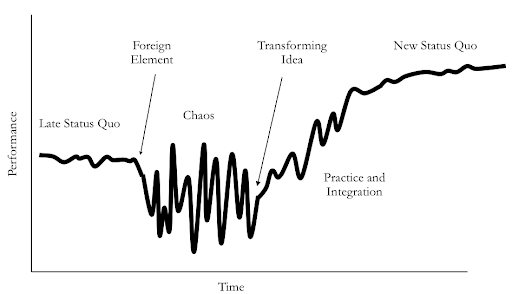
This is because of the curve of change, the J-Curve, a complex process explained by psychotherapy.

Developed by psychotherapist Virginia Satir, the model is described in 5 stages, which have an effect on feelings. acts, thoughts, performance and philosophy.

By going through these effects you can improve the way you process change and help others process it.

When it comes to organizational agility, you can also use the J-turn as a road to be traversed.

In many ways, agility helps reduce risk.

But when we’re talking about organizational change, this agility, most of the time, will first express itself in a slight decline in performance.

Therefore, it is important to say that this is totally normal, and is directly linked to changes in the organization’s status quo, which shortly after this decline will start to increase its results and performance of the teams.
 

4 simple practices for you raise your Agile Maturity stage


In general, this process happens when a person or a small team seeks to better understand agile concepts and starts small initiatives.

Seeing the benefits, she feels she needs to go through this transformation (even though she’s not sure what it means to be agile).

Because of this shallow perception of the meaning of “being agile”, some method mechanically implanted in this organization and without strategy, be it Scrum, Kanban, among others, will cause the team’s productivity to drop. This is exactly what the J Curve says.

To prevent the above errors from continuing to happen, you need to have the right people to go through this change process.

And they should start by understanding the scenario you’re in first.

After many studies, we identified that there are four stages, in which it is possible to understand how far behind companies are in developing digital products or how much they are really being agile and creating products from the best way possible.

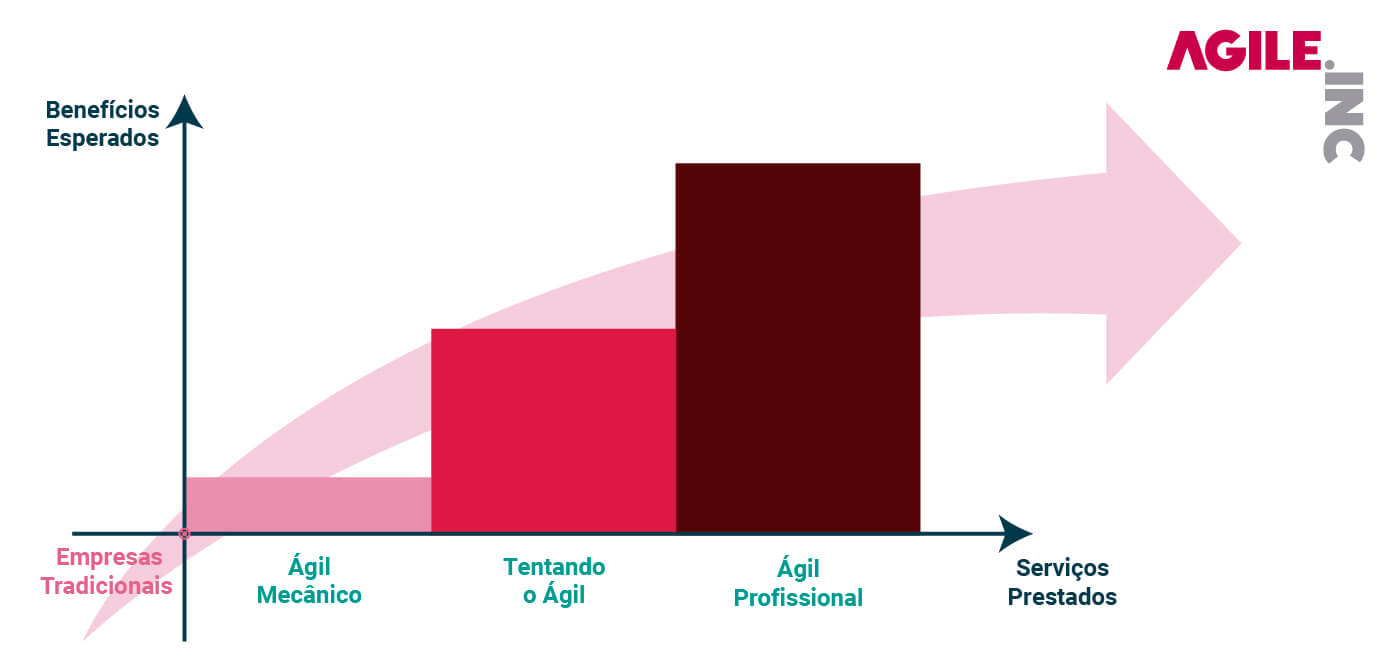
We can classify them as agile maturity stages and they are divided into 4 levels: traditional companies; agile mechanic; trying to be agile and agile professional.

  • Traditional companies are those who understand a little about agility and try to implement some concepts and practices in a shallow way;
  • Most organizations are already practicing what we call mechanical agile</b >>
  • On the second level are companies that are trying to be agile, in a transitional phase in which they are not really agile yet, but they are well on their way to doing so;

And in the third stage, we have the organizations that run the Agile Professional , which are those that are ahead in the market and develop digital products with the right professionals, with the best engineering processes and practices, with the correct product vision.
 

4 praticas simples para você elevar o seu estágio de Maturidade Ágil


The more mature, it is clear that greater benefits will be reaped, and thus the company will have greater productivity, performance, greater connection with the customer, and will thus have an advantage over competitors .


Knowing the 4 stages of agile maturity, looking for high performance


Stage 0 – Traditional Companies

These are those companies where the employee or manager has heard about agile transformation but hasn’t put it into practice yet.

Usually, these are companies that, a person who has read a book or article on agile methodology, understands the importance of this process as a whole and will start looking for a consultancy to in order to have help the professional in transformation.

It is that company that is starting in the world of digital transformation and is afraid of the changes that need to be made.

Despite trying to implement some concepts and practices, it still hasn’t been able to incorporate the agile mentality in the company’s skeleton, causing the results not to arrive.


Stage 1 – Mechanical Agile

This is the stage where most companies are!

At this point, the concept of agile transformation is already known, but not the complete process.

Normally, the company already uses methods such as Kanban, they have daily alignments, change area names to squads, use post-its to organize tasks and some other organizational methods…< /span>

Nevertheless, it still can’t really be considered an agile company.

  • It is not yet a transparent organization with clear objectives</li >
  • There is no transparency of information, with a lot of visual management</li >
  • It still does not have short cycle deliveries, with a focus on value generation</i >
  • There is a need for more visibility, improvement in processes and more collaborative areas</ read>

 

4 simple practices for you to raise your Agile Maturity stage


This is Mechanical Agile! A stage in which one already knows and uses some agile concepts and practices, but the culture, the mindset, is still completely traditional and Taylorist.

Is it possible to change the behavior of this company and reach another level of agile maturity?

Yes, with training, consulting and building high performance teams – which is what we do with the help of Agile School – our educational area – and in Agile Inc, developing corporate solutions.

This stage is also known as Agile Zombie.

  • Zombie is a person, isn’t he? He has arms, legs, a piece of his head. But we know that the zombie is not a real person because it has neither a thinking brain nor a beating heart.
  • Making a parallel, many companies are mature Agile Zumbi: they even run an agile process, they even have an agilist and a certified product owner, but in the end, they don’t have an agilist who removes impediments, they don’t have a product owner with authority over the product, they don’t have a leader who understands what it means to be a leader, they only have kanban tables but they don’t analyze the flow. In other words, they are more like Zombie!


Stage 2 – Trying Agile

These companies are at an intermediate level, right in the middle of the road. Despite having already passed the mechanical agile phase, it still does not have a continuous workflow to be considered a professional agile company.

Processes still need to be improved and employees still need to develop skills, knowledge and experience.

This is a process stage where companies are starting the agile journey. It is a transitional period, where companies stay for a short time, as they are in the race for agile and digital transformation.

At this point, companies are transforming themselves into an agile organization with each passing day, they are in the process of adapting and implementing new cultures and methodologies.


Stage 3 – Professional Agile

The company is already reaping the fruits of the agile transformation and has already completed the entire transformation process, it managed to complete the previous step.

The areas now connect when working together, mainly supporting the business areas, and really put the customer at the center of decision making.

They have more transparency and are concerned with giving visibility to what is happening to everyone.

In addition, they prioritize deliveries and always ask themselves “are we doing the right thing?”

Companies that are running an Agile Professional, have the Agile mindset on a daily basis within teams and decentralize decisions, but always have a high alignment between all sectors.</span >

Not only the leadership, but the teams already understand the importance of having clear and well-defined goals, as well as alignment in the execution of processes.

The teams are empowered, each one has a certain freedom of decision, not being all centralized in a single manager.

In addition, innovations happen all the time, as there is complete freedom of adaptation in all areas of the company.


Employees work motivated and therefore produce more solutions.


In agile leadership, goals are determined, the company knows its customer in depth, promoting the delivery of value and removing impediments.

We at Agile Inc. can help you get to that point. Our goal is to shorten the agile transformation journey by delivering value to you.

At the end of the process, when your company is professionally agile, that is, truly agile, you will have conquered:

better operational efficiency, better value for your customer and risk management (agile governance that will reduce your internal risks).


How to build this journey of evolution?

For you to evolve and become a company in stage 3 – Professional, you need to assemble your development plan, looking at some perspectives.
 

4 simple practices for you raise your Agile Maturity stage


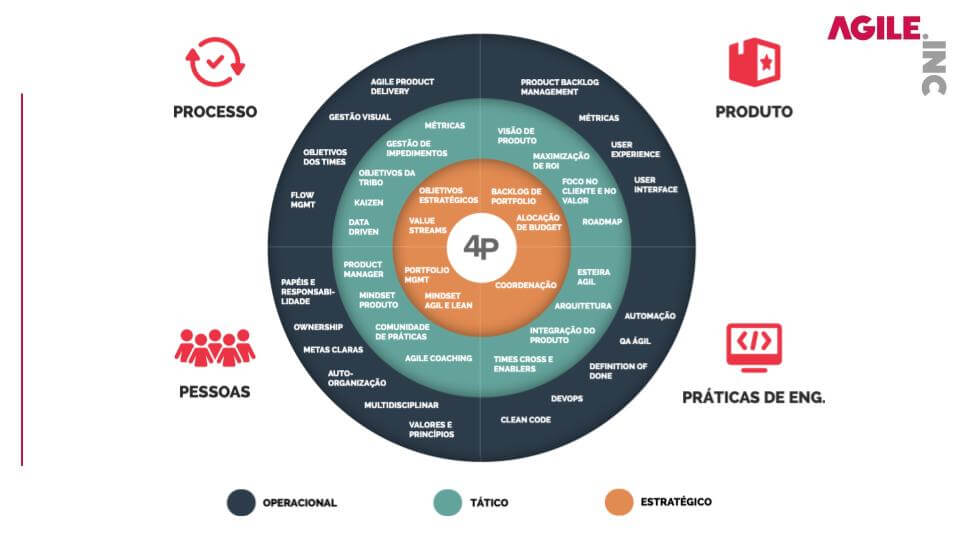
Here at Agile.Inc we classify organizations into 4 pillars, after creating a radar with perspectives that mix operational, tactical, strategic eyes.

Let’s better understand each one of them so that you can identify which stage your company is at and, thus, make improvements until reaching professional agile, that is, developing truly digital products innovative.

These four pillars are Process, People, Product and</span > Engineering Practices.


Process: refers to how we create digital products. They involve issues such as strategic objectives, metrics, visual management, impediments management, agile product delivery, flow management, data driven, kaizen;


People: It is important to understand if you have the right people, in the right place, and with the right motivation. In this pillar we look at roles and responsibilities, sense of ownership, clear goals, self-organization, multidisciplinarity, values ​​and principles, community of practice, product mindset, product manager;


Product: what product do we want to create, what vision do we want to reach? In this pillar we pull subjects such as product backlog management, metrics, UX, UI, product vision, ROI maximization, customer and value focus, roadmap, portfolio backlog;


Engineering Practices: only with the right engineering practices will we be able to be really agile, so some subjects are extremely vital, like Automation, Agile QA, DevOps, Definition of Done, Clean code, Agile treadmill, architecture, product integration, teams cross and enablers.


Based on these pillars, and now looking more from an operational point of view, now from the tactical perspective and now from a strategic perspective, we set up an evolution plan for the company’s journey.

This plan must be constantly revised, as if it were a Product Backlog of a product, but in this case, a Change Backlog, to bring your company closer to Professional Agile.< /span>

Looking at the 4Ps and maturity levels, we found some interesting features. santes, which can be useful for you to analyze if you are closer to the traditional or closer to the professional.


Characteristics of these pillars of a company at the Mechanical Agility:</ span>

  • Development team falling out
  • Product owner proxy: just take orders without caring too much
  • It’s a team that doesn’t think about valuing the product
  • No integrated view
  • No portfolio
  • Many decisions are made based on guesswork, 
  • Metrics, based on data are missing
  • Scrum Master/Agilist is that person who is in his or her first experience of agility. It still doesn’t have much expertise
  • Areas divided by people who think and people who do.
  • Efficiency-oriented teams/tasks
  • It is not clear where your responsibilities begin and end
  • Predictive leadership, which monitors your collaborators
  • The team serves the leader
  • Long flow, each area has its task and priorities
  • Documents are unclear
  • Tests are done manually
  • Team is seen as coders
  • Ignore or hide technical problems


Characteristics of these pillars of a company at the level Professional Agile:</ span>

  • Customer focus as a basic principle
  • The team understands each other and works together
  • Have a fully integrated view of processes
  • Have an overview of what’s going on, as an organization coach
  • Processes collaborate with the delivery of product value
  • People expose problems
  • Contributors bring new insights
  • Mistakes are accepted and are part of learning
  • It is necessary to use self-organization, using the wisdom and intelligence of the whole team.
  • The team is engaged, motivated and with purpose
  • Leadership changes its profile, being a culture of delivering value, avoiding waste.
  • The leader serves the team
  • Teams work together with the same goal, making deliveries run quickly</ read>
  • Multidisciplinary teams organized not by area, but by product view
  • Team is a co-author, knows the best solution for a given problem
  • They give transparency to technical problems, because they understand that they represent a risk to delivery and take time to resolve them</span >


Create a digital product that really it’s agile it’s complex, so there’s no way things can be done separately (as is done in traditional companies).

For everything to work correctly, operations and professionals need to be integrated so that everything is done quickly, yet efficiently, and with a focus on delivering value.


Identifying my company’s maturity stage

There are some perspectives that can be analyzed and taken into consideration to identify how agile your company is considered.

Check out what these areas are and what can be analyzed:


Practices and Roles

The aim is to understand if the organization is using processes efficiently and also if everyone knows their respective roles within the company.

If you still don’t know how to identify this, there are a few questions you should ask:

  • Is it clear what the responsibilities of the roles currently available in the company are?
  • Is the teams workflow visible?
  • Do teams have explicit policies (eg definition of ready to work, definition of done etc.)?</ span>
  • Are bottlenecks and queues visible in the teams workflow?
  • Do the teams have clarity on the main sources of rework?
  • Are software engineering practices being used to keep code healthy?
  • Is the publishing process automated?
  • Are there automated tests?


Metrics

The intention here is to understand if your company has been using business and process metrics.

And if so, at what level? You need to stress the importance of developing benchmark metrics that will help improve your product.

To analyze this, ask yourself:

  • Are business metrics being used in the decision-making process?
  • Are the business metrics visible for everyone in the company to review?
  • Business metrics are used as a reference in the process of defining an initiative (ex: which business indicators will be leveraged by project X)?
  • Do teams use process metrics to project lead times?
  • Do teams use process metrics to analyze process health?


Business-oriented prioritization

Does your organization set priorities?

It’s important to consider that when everything is a priority, nothing really matters.

After all, everything is on the same level, needing attention and urgency.

Therefore, it is necessary to understand if there is a structured prioritization process.

Ask yourself:

  • Are there clear prioritization criteria?
  • Has prioritization taken into account customer needs?
  • Are business metrics used in the prioritization process of initiatives?
  • Is an analysis of dependencies between initiatives carried out before finalizing the prioritization process?</li >


Financial result

Your company measures financial results of your initiatives?

This is something very important in an agile journey.

To find out if they are already doing this or not, ask yourself:

  • Is the organization’s leadership clear about the business objectives of each initiative?
  • Are the teams measuring the financial result of deliveries?
  • The organization is able to classify the initiatives according to the expected result (ex: this initiative will generate greater efficiency in the business, will help to conquer market share, will it be an innovation, will it anticipate the cost of delay?)


These analyzes will help you diagnose what stage of agility your company is at and where you need to improve.


Ok, I know my stage, how can I improve?

Now that you’ve identified what stage your company is at – and we can say that 85% of companies are closer to Mechanical Agility – there are some solutions that can be done for your company move forward on the change curve faster and reach the desired status quo.

In this case, some questions will be analyzed, namely:

  • what is the company’s maturity problem?
  • what is the executive level mindset?
  • how is your team, is it lined up?
  • how have agile methods been implemented so far?


After these reviews, it’s important to know that if you don’t have a good product vision, clear and organized processes, people with a different culture and mindset, engaged with the organization’s purpose , you will probably not be able to reach another status quo, nor advance through the agile maturity stages effectively.

For this you need the right professionals and suppliers.

This is the best way to have a radar for your organization, which will show you where the flaws are, where improvement is needed, so that you can build an effective and optimized strategy to your reality.


And you can do this in three ways: with training, consulting and building high-performance teams.


Trains

It is necessary to raise the level of knowledge of people and incorporate the true agile mindset, according to the needs of the company and its employees.

All training offered by us, for example, is certified by international organizations – such as Scrum.org, and performed by Agile School – our education arm.


Consulting

With the help of consultants, it is possible to break the traditional mindset to understand the way in which your company can create and develop digital products that generate greater competitive advantage.</ span>


Squads

A team of people with the right skills, the right knowledge and market experience to carry out this entire journey of change, the SQUADs. As each client is unique, it is necessary to analyze the working conditions in order to assemble a multidisciplinary team adapted to your type of business and needs.

Now that you know your agility stage and what you must do to get to professional agile, contact our consultants and transform your company forever.


by Rodrigo Pinto Rodrigo Pinto No Comments

Find out if your company is Mechanical Agile and learn how to change


Businesses want and need to create better digital products. What’s the point of having a great business model if you don’t have a digital product that can deliver all the benefits?

This has become a matter of survival!

That’s why this article is part of a series where we talk about the maturity stages of companies, and how organizations can take great advantage of leaving a low agile maturity level and reach a professional internship.


Let’s talk in more detail what are the characteristics of companies that are in Mechanical Agility and how this can “kill” your product.

If you already use agile concepts and practices, but don’t have people with the right skills to build digital products; lack of product vision on a daily basis; you don’t have good engineering practices or really agile leadership, you’re either wasting money on agile transformation or doing something just a front that won’t bring you concrete results.

Now understand the 7 characteristics of companies and people who are using Agility mechanically and are not changing the way they create digital products.


Agile culture

In organizations where Agility is being used mechanically, agile actions are more reactive, with the objective of “putting out fires”, than strategic or proactive actions.</span >

This happens a lot because companies don’t have a clear vision of what high performance teams are – who dominate all areas of creating great digital products.

And this lack of vision makes them think everything is fine, and doesn’t show the need to create a clear plan for improvement and evolution.

In companies with professional agile maturity, everyone works with customer focus as a basic principle, guided by clear goals and strategic objectives.


Method only

These teams are more arguing over whether the Scrum framework is better or worse than Kanban; Whether the role name will be Agile Master, Scrum Master or Agile Coach; That is, they are wasting time discussing this, instead of answering the question “What is preventing us as an area from delivering better products to our customers?”


Stakeholder centric

In these mechanical teams, much is said about customer centric, but little is known or really applies. Basically, they are still stakeholder centric – one business manager looks at the customer and thinks “what do I do with my product for this customer?”.

Following this question, the hypotheses are raised and become items for the implementation to be done by the Development team.

This generates a lot of waste of time, money, and increases the complexity of the development, because you are developing something that didn’t need to be developed.

It’s hard to make it clear to leaders that personal requests are not an acceptance criteria for developing something.


Leadership that “stood in time”

Leadership does not evolve in terms of agile knowledge and trends in the development of digital products.

The company still exists to serve the C-level, with heavy annual budgets and a fight between areas.

The leaders think they have the most knowledge and that they should chew it up for teams to just execute.

In this type of situation, self-organization is still something to be desired, but very poorly applied.

Leadership still demands a lot of increase in productivity, more delivery of tasks, but cannot act as a true leader, generating clearer objectives and metrics, removing obstacles and managing of motivation and people.

In truly digital companies, leadership propagates a culture of delivering value, avoiding waste, serving teams, toworking with the same purpose.

This way, the teams’ productivity ends up being MUCH higher!


Unified Product View Low

Given the world we are living in, in constant transformation, there is a lack of strategic planning in organizations.

Lacks product vision, a unified business vision. This is not to say that the company has nothing strategically planned.

It has good ideas and visions yes, but it is not shared and unified between teams.

This makes the people who build the product stay away from the necessary results.

The team ends up being seen as just a factory to build something, and not a team that solves a user’s problem and really adds value to the business.


Business X IT

In companies that use agile concepts and practices in a mechanical way, the areas of Business and IT are still very distant.

Distant in the sense that they don’t work together on a daily basis. In high-performance professional teams, some IT and Business goals are shared and professionals work together daily to resolve issues.

In the mechanical agile area, the IT area is still seen as a support area to deliver the roadmaps promised.

This also reflects a company structure with many silos, where each one works to solve their problem and remove any focus of delay in their area, for example.


Can’t tell Agile from Digital Transformation

You think Agile isn’t such a nice thing to talk about anymore and now is the time to talk about Digital Transformation. But when you ask what is one and the other, you can’t answer.

Digital Transformation, so talked about lately, is a movement that requires a much broader adoption of technology and is anchored in a cultural shift.

It’s more about people than digital technology.

Requires customer-centric organizational change, supported by servant leadership, driven by radical challenges to corporate culture and the leverage of technologies that empower and empower employees.

Among the various pillars of this journey is the adoption of agile practices and concepts, which are part of several stages of the Digital Transformation.


Agile is not helping

Overall, we see that agile concepts and the digital mindset were applied mechanically, just discussing processes and that the culture is still Taylorist.

This structure with low maturity already generates some gain, but it is still far from being considered a structure of truly digital companies.

Fact is, truly digital organizations (for example, banking institutions and payment methods) are gaining a lot of market, being able to hire the best professionals, they are being more productive…

All this thanks to a different model of working and creating your services and products.

Traditional companies really want these benefits and results, but they still don’t know what it really takes to start this journey of change.

The professionals who are managing to solve these problems in these types of companies are gaining a lot of space and visibility in the market, becoming scarce.


So what to do?

Stop reading this article for a minute and review your organization.

Has the introduction of that simple Kanban method alone been able to accomplish all these changes in your company?

Starting using Scrum, having daily meetings, having deliveries made by Sprints brought you expressive results?

I can say no.

And that’s the big danger of the first transformation step, that agile mechanic phase…

When you start a process as big as this, you, as a leader, see changes and believe in them.

But culturally, note how traditional your company is still.

Your collaborator is still afraid to expose himself; delivery cycles still last weeks and even months; each one works for himself, does his job and no one is sure how to collaborate with each other…

A clear purpose, an organized process is still missing!

Being agile is having collaborative teams, teams that see the processes as a whole, that focus on the customer for and that want to evolve and grow with the company.

Being agile is having a team that wears the shirt, but as long as you’re in a mechanical agile stage, that won’t happen.

Are you going to stand there, claiming to be agile, when you really aren’t?

Or are you going to go ahead, get your hands dirty and take the necessary step towards transformation?


Now what? How to change internship?

It’s simple to explain, but very difficult to apply.

One ​​of the best solutions is to raise the level of knowledge of some areas and/or teams, when it comes to creating digital products.

Here at Agile.Inc we’ve divided this increase in knowledge into four areas: Processes, Products, People and Culture, and Engineering Practices.

There are more than 20 sub-areas, forming the necessary framework of knowledge and application for teams to be truly digital, create products that delight, are productive, and give advantage to companies.

That’s how we did it in Sem Parar – one of the largest toll and parking services companies – generating a 315% increase in its Sem Parar app user base.


Being more digital has become a matter of survival for companies these days. And our mission is to help more and more people get there!

Talk to one of our consultants now to understand how we can help you.

by Rodrigo Pinto Rodrigo Pinto No Comments

7 Top Antipatterns of Digital Product Development

We talk to companies on a daily basis and we see, in most of them, a common pattern regarding errors in the transformation process (whether digital or agile).

Some of these failures are committed systematically in the areas of Technology and Business, generating products that often do not please or do not generate as much value for customers.

Time is scarce for everyone. Costs are decreasing more and more and the “less has to be more” for real. However, actually delivering more is a big challenge.

If the company doesn’t really have agility built in, it won’t be able to stand out. If delivering value is still a difficulty, the area will be left behind.

However, professionals who are developing digital products that really add value, are standing out in the market and being hunted by companies, as they are really able to do more with less and help create products that, in fact, delight customers and generate value for companies.

With that, I ask you: are you completely satisfied with your digital products or work models of your team? Are you happy with the productivity and results?

You know you can do more and better, but you don’t know how or where to start? If these issues bothered you, probably some of these errors must be present on your team.

Check out the most common:


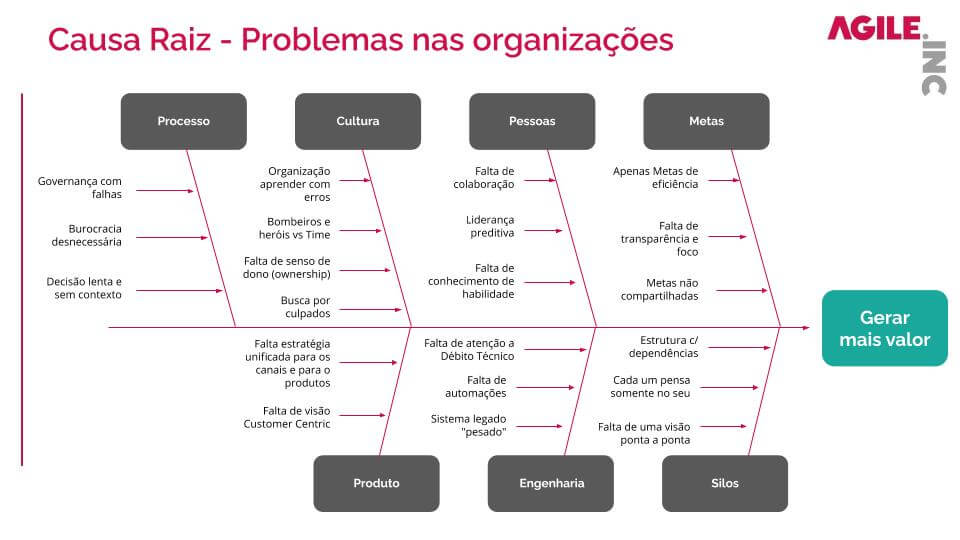
1) Traditional processes that look agile

The company has some people certified in some work models, does some events/ceremonies very mechanically, discusses a lot if Scrum or Kanban should be used…< /span>

But at heart, the organization is still in the traditional development paradigm.

Often you end up making a water-scrum-fall</i >, that is, products are only released after months of creation. A lot of unnecessary bureaucracy still exists! We usually say that this company is at a maturity level 1, doing an Agile Mechanic.

Many teams think being agile is:

  • “I have a flow in azure, I am agile”
  • “I started doing some ceremonies, daily planning, I’m agile…”
  • “I have a certified Scrum Master and a part-time Product Owner allocated, I am agile”</li >


They understand that they do some processes in an agile way, because they use a framework (in a superficial way, sometimes), but they don’t know how to distinguish the difference between doing agile or being agile.

The process has the face of agile, it seems that a transformation is starting, but, deep down, the culture is still traditional.


2) Culture of control, not value

Another very common mistake refers to the cultural part. I like to say that deep down, the base for creating great digital products is a cultural shift.

If the development area is mainly focused on having control; in finding blame for mistakes; in centralizing decisions on specific people; if you are too focused on the process and deliverables, rather than focusing on value…

It is definitely an area that is wasting time and money.

If these aspects are present, I have to tell you that you still have a culture that will hinder you from having high-performance teams.

Companies that create good digital products have their main focus on delivering constant value to the customer, strengthening a culture that delegates decisions, has clear goals, a culture in which people are fundamental .

When the team is focused on delivering value, interesting aspects appear, such as:

  • culture of learning from mistakes;
  • team culture instead of boasting r the heroes that are indispensable;
  • culture of ownership< /span> instead of people hiding from responsibilities;


Creating great products mostly starts with attitude! It’s no use having several tools and processes, it’s necessary to foster a strong product culture within the company. In your company, what is the real culture like, not the one hanging on the wall?


3) Not paying enough attention to people and treating them as resources

Leaders are not satisfied with the productivity of teams. Teams are not happy with the leaders’ management model.

And one of the main mistakes that cause this type of situation is hiring people looking for cheaper profiles, with low qualifications.

For example, many consultancies when providing a service, mainly in the IT area, offer a senior professional, but in the end, in practice, is a junior level.</ span>

This happens a lot because the company already starts from the idea that it is necessary to have many teams and with many people to increase efficiency, and for that it needs to lower the cost.< /span>

Another very common point is still the low collaboration between teams. The leadership is still in the traditional model and teams with gaps key knowledge for the development of systems, for example.

With this, people end up working more reactively, putting out fires, than proactively.

These are some of the characteristics found when a company cannot handle people correctly.

Find the right people, put them in the right place and with the right processes and models – only then will there be a team capable of creating products and services that truly delight the customer.</span >


4) Traditional goals that sink teams

In your company, do you have visibility into peer goals or other areas? Does your goal only measure efficiency issues or does it measure results?

Do you feel that the team’s goals are shared between them in some way? And are they clearly linked to the area’s or company’s goal?

Have you ever noticed situations in which you needed someone’s help, but the area’s goal was not the same as yours, so there was no collaboration?

These questions help you to understand if this problem exists in your company, of goals that only sink teams.

Just efficiency goals, lack of transparency and focus, unshared goals, and goals that are too long and unclear can kill off the development of exceptional products.

Even more if people’s bonuses are linked to these goals. That’s because, at the end of the day, teams and people behave according to how they are measured – “tell me how you measure me and I’ll tell you how I behave”.

In truly digital companies, it’s easy to find shared goals between Business and IT, for example. Goals need to be transparent using templates such as OKRs , short quarterly goals that help teams be agile and allow them to readjust as they learn more.

I heard a phrase from a customer that translates this problem very well: “The problem is not the quantity of delivery, but the quality of these deliveries, in the sense of: we are delivering a lot, but delivering what?

The pressure of the deliveries that teams are suffering, the changes in priorities, make the teams deliver a lot, but we are not able to move the pointer, we are not really impacting the end customer.< /span>

The deliveries come from personal desires, from somewhere that doesn’t have a very clear direction.

The quantity of delivery has increased, but the overall quality, focused on value, is still a gray area” and I completely agree with all that.


5) There is no correct Product View

Another very flaw What often impedes the creation of good digital products is when teams are still focused on a project culture, in which success is meeting the scope and deadline or the focus is getting more tasks done in less time.

People don’t know the customers! Sometimes they even have a persona, a shopping journey designed, but it’s not what guides their day-to-day development.

Product Owners are just “order takers” who care about writing user stories. They take requests from managers or stakeholders – who are the people who define what the customer needs.

In other words, the company is still “stakeholder centric”.

There is talk about being customer centric, that is, putting the customer at the center of the entire chain of creating and developing a product or feature, but at the end of the day, people don’t really know what it is. .

When someone is asked: what is customer value? The vast majority do not know how to answer or we get non-cohesive answers between people.

A key point in creating high value products, which give competitive advantage to any company, is to have a correct Product management.

It’s moving from a Project culture to a Product culture, where we stop fulfilling stakeholder desires and focus much more on solving customer problems< /em>.

“We are obsessed with the customer. We start with the customer and work backwards.” (Jeff Bezos)


6) Low maturity in software engineering

During a consultation, in an interview with a team, after several questions to the members, we identified an interesting pattern – this pattern was later found in other teams: low engineering maturity of software.

Perhaps due to the aforementioned points, the teams are charged for productivity and deliveries, linked to the low professional maturity of some “resources”, teams with low software engineering maturity are created .

These teams even create masked productivity in the short term, generating low development standards and flawed architectures.

But the bill comes one day and the team starts to slow down, as everything in development starts to get complex.

Development standards do not exist and items like Agile Quality and Devops are desired by teams but not applied correctly.

Managers are mistaken and think they are already experts on the subject, presenting sophisticated reports showing how agile their team is with agile engineering.

But in reality, everyone knows that there is still a lot to be done!

A complicating factor for this situation as a whole is the existing legacy systems and the large technical debts.

Companies that were able to truly transform themselves put these problems visible, put the “elephant on the table” really, so that the problems could be addressed and discussed.

After all, if a team needs a new API, for example, to display a value on the screen and needs to wait months to create this interface, it can’t be really agile .

Probably, the company will model the product according to the capabilities of the internal systems, and not because of the customer – putting the focus on development to really meet their needs.

In this scenario the Business area wants something done one way, but IT says “this is not possible because of our system, so let’s do it another way” .


7) Organizational silos

Last but not least, a pattern that can kill off great digital product creation is silos within the organization.

A structure with dependencies between areas ends up creating a scenario in which everyone thinks only about their own, and no one can have an end-to-end view.

Companies are trying to reduce silos by creating tribes and squads, but we’ve already seen places where:

  • The tribe was nothing but the same area from before, just with a different name;
  • The squad is assembled seeking operational efficiency and member occupation (that all collaborators are allocated and busy for a long time). Thus, technical squads are created and not multidisciplinary teams, losing agility in deliveries;
  • Having someone from the Business area on the team is impossible, as you cannot give transparency of “problems” to the other areas, for example;
  • The areas are still competing with each other, rather than exchanging information – the area has started some interesting initiative, but it is kept as a secret, with the expectation that someday someone will give this recognition and they will get the merit.


When we talk about setting up tribes by customer journey, people’s minds literally “fry” and you end up not making the change as that would be too much work.

If the company is still full of silos, the products definitely lose quality and the team cannot deliver real value.

Now you might be asking yourself: what are the biggest problems that occur with these silos? We have already listed some:


Know Top 7 antipatterns of digital product development


Finally, it is time for companies to realize that they need to build in the present, the future that is already there! Doing what’s important, at the right time and in the right way – that’s what you should strive for daily.

To be truly digital is not in the way products and services are presented to the end consumer, but in the model in which they are created and developed. And that’s not the future anymore! It is an increasingly urgent gift.

A study by IBM shows that 59% of organizations have accelerated their digital transformation processes during the Covid-19 pandemic.

This is because executives have come to trust more in the benefits that these new processes and formats bring to the organization, making it much more prepared for this new normal.

Both the risks and opportunities are too great. The stakes are too high and there’s no way to be left behind. You must act!

And the solution to all this is 100% linked to the correct hiring of people and suppliers. It’s normal to find shallow concepts, even with a lot of desire to do it differently, but there’s a lot of technique to do it correctly< span style=”font-weight: 400;”>.

The proper knowledge and willingness to do different and better is an attribute of people. I love to say that “any junior team makes a system with 50 screens – but to make a product with very few screens, which solves maybe 80% of the problems, you need a very capable, engaged team with the right incentives.”


We can’t run away from this! As long as companies do not have the right people and suppliers, the products will still be made with low quality as a whole and a lot of money will be lost.

See how we help transform a of the main digital products of the largest automatic toll and parking payment company, Sem Parar.

by Rodrigo Pinto Rodrigo Pinto No Comments

The importance of the Test Pyramid for software quality

The leftover risotto is a great analogy to explain in a didactic way the relevance of the test pyramid to stakeholders

By Rodrigo Matola
It is sometimes difficult for a non-technical stakeholder to understand the importance of testing a functionality well before putting the application into production. I always heard: “I understand the importance of the Test Pyramid, but I need to release this at the end of the next Sprint. If unit tests are going to take longer to deliver, they are not a priority”. With that, I thought of some analogies to explain the test pyramid and its importance during the development of a digital product. Let’s talk now about the “leftover risotto”!

How to make a leftover risotto

I remember very well the risotto that my mother and aunts prepared the day after some party, especially at the end of the year, at my deceased grandmother’s house, with the leftovers. I liked it even more when the risotto was in the oven. However, making this risotto is quite simple. With the help of at least two more people to form a team of 3 and optimize the process. You can call more if you want, but it is recommended that the team does not exceed 9 people. Follow these instructions: – Make a new rice cooker and mix it with the leftover rice (which is not enough for everyone to eat); – Take leftover pork, turkey, chester, tender and all other available. Shred and mix in rice; – Take all other leftovers, chop into small pieces. Mix in the previous mixture; – Place grated Parmesan cheese on top and bake until browned. Now let’s start the analogies…

Putting into production

When serving the risotto, each person at the table “downloads” for their plate. Then the complaints begin: “It tastes sour”; “This is ruined!”; “I found it sweet”; “Candy? My part was extremely salty!”. Each person reports a different bug . You will have to throw the risotto away and you took a big loss, since you will have to order food for the whole family now it will be expensive… But first, as a stakeholder, you want to find out what went wrong. But how do you find out what’s wrong with this whole mix?

Applying the Test Pyramid

Returning to the development of digital products, after the analogy mentioned above, we can understand how important the testing process is to guarantee the quality of the final product. For this, we can list:

Unit tests

Going back in time, to the moment of the team’s assembly, in order to prevent the previously mentioned occurrence from happening, each member of your team should taste the ingredient before putting it in the risotto. The unit test of each item must be performed first. These tests would show that the rice that was left out of the fridge would be sour and that the pork was spoiled, for example. The unit tests serve precisely to test the smallest part of a system. In risotto, I would test if each ingredient was good to add. In a code, each unit (function, object, among others) is tested and is behaving and responding as it should in various scenarios.

Integration Tests

Even if each unit is ready and according to the specifications passed, it is also necessary to check if, when placed together, they match, that is, integrate. Returning to the leftover risotto analogy, let’s first take the complaint that “the risotto was too salty”. It is necessary to go testing the amount of salt until it is ideal. Although the salt passed the unit validity testand the integration testit returned a value much higher than expected, which “broke” the risotto. As for the very sweet complaint, it was asked to add black olives. But, the person who was in charge of this part did not know the business well and added raisins. The unit test passed, although it was developed wrongly, but the integration test would not pass. In this case, the unit test must be redone.

Functional and exploratory tests

Even if black olives integrate well with rice, for example, it might not “work” if you mix another ingredient together. At each increment of the risotto (software) it is necessary to test if it is “working” as expected. If someone decides to put nuts or peanuts in the risotto simply because they like it, even though it works and looks good, other guests may not like it or have allergies. In the software world, it may be that someone has made an implementation different from what was in the specification or even invents one. With the functional tests it is possible to identify this. As an extension, if someone missed a piece of bone, only an exploratory test would detect it. In this case, the error would be in a specific part of the risotto (code) that only a user at the table (production) would find.

Regression Tests

We must also “test” (prove) the risotto with each implementation. When adding salt, test to see if it is salty. Test the consistency of the rice to see if you need more water and cook more. And add the salt and water little by little. If you add a fixed amount of these ingredients, it can get salty, turn into soup or go raw. Bringing this example to software development, test it thoroughly with each new implementation. And don’t do gigantic implementations, like putting the final amount of salt and water together, for example. Make small and constant releases, of only one feature, because if something goes wrong, it’s easier to fix.

Acceptance Tests

Finally, tests must be carried out on the complete product before serving. It is not advisable for a single person to test, even if they have detailed specifications, as the final product will be consumed by several people. The more people taste (test), the more quality your final product will have! In the case of risotto, it is not feasible to carry out an automated test (using a chemical analysis, for example). Tests have to be manual and exploratory, but in the case of software, tests can (and should) be automated, leaving manuals for scenarios that aren’t worth the automation effort.

Conclusion

This leftover risotto example is a different way we used to explain the test pyramid to people without a programming background, the importance of splitting and, most importantly, testing during the development cycle and not just at the end. Testing every element of a digital product before offering it to the public can actually take a little longer. However, it ensures that the product has a better quality and that the end customers are more satisfied. Did you like the text? Have questions about the test automation process? Leave your comment here! You still have questions about how to implement these tests, make a chat with us, we can help you!   Why are Agile processes not helping in Digital Transformation?
by Rodrigo Pinto Rodrigo Pinto No Comments

Do you know what are the pillars for a correct Digital Transformation?

Understand now the five bases necessary to succeed and competitive advantage in this Digital Transformation process

Every day we can see how the world is changing and how it is happening faster and faster. “We are on the cusp of a technological revolution that will fundamentally transform the way we live, work and interact. In its scale, scope and complexity, the transformation will be unlike anything human beings have experienced before,” said Klaus Schwab, Founder and Executive President of the World Economic Forum, on the unfathomable, ambiguous and open future of the Fourth Revolution Industrial. In this scenario, Digital Transformation ended up becoming a new buzzword in the market, in which many say they make this journey of change, but few actually do it efficiently, with a holistic view of the subject. It is noteworthy that some companies were born in the Digital age and in a Digital way, while other companies were born Traditional and are only now trying to migrate to a Digital world. With this, it is not uncommon to see people who have tried to transform traditional companies without success, break away from these corporations and create a new company, now with the digital culture ingrained, since its birth. Therefore, we currently classify companies into two groups:
  • Companies that were born in the traditional way and are now trying to migrate;
  • Companies that were born with digital culture.
As we have already explained more deeply in a another text here on the blog, we mean by Digital Transformation as a fundamental change in the way the company is organized, using technology, people, processes and business models, in order to be adapted to the a more complex and dynamic universe, where it is essential to focus on generating customer value. This will be decisive in the life of companies: the more digital mindset the organization has, the greater competitive advantage in the market it will have in this new world VUCA. For this change to happen, that is, for the company to leave Traditional and become more Digital, we at Agile.Inc created a model that helps in this migration process. This concept was developed by our team after many studies and daily practice. So we have five pillars for a correct Digital Transformation:
Pillars for a correct Digital Transformation

CULTURE

The culture change is the first pillar for the true Digital Transformation to happen, not by chance. After all, it all boils down to a change of culture and mindset. Among the various changes in culture, we can highlight:
  • Really put the customer at the center of your business;
  • Having a culture of applied innovation;
  • Empower teams, but with high alignment;
  • Create a culture of “not being afraid of failure” and
  • be more transparent in actions, decisions and plans
These are some examples of how cultural change is the primary point of transformation. “You make a lot of mistakes along the way, but that’s okay. It’s okay to make mistakes as long as you learn from them. (My father and CEO) Vince has an expression: ‘It’s OK to make mistakes, but never make the same mistake twice.’” – Stephanie McMahon, WWE Brand Director during debate, 2018. – https:/ /www.istoedinheiro.com.br/confira-10-frases-inspiradoras-do-forum-economico-mundial-de-davos/

INTERNAL CAPACITIES

In addition to culture, companies need new internal capabilities, that is, teams need to have new skills to solve more complex problems. Among these skills, we can highlight some such as:
  • Working with new technologies (Big Data, Blockchain, Machine Learning, among others);
  • Agility in product development,
  • Lean management in product design;
  • Use Design Strategically.
These are just a few examples of internal capabilities that need to be developed depending on the context of each business.

STRUCTURE AND GOVERNANCE

This pillar consists of rethinking the way the company is organized. Companies that are already digital organize themselves differently from traditional ones:
  • How are the areas of the company structured?
  • How to break the organization’s silos?
  • How is the budget defined?
  • How are initiatives prioritized?
  • How is work tracking done transparently?
  • How to create greater operational efficiency, for example with automation?
Again, these are some examples of questions that are addressed during this transition from Traditional companies to the Digital age, in terms of structure and governance, which vary greatly for each type of business.

PEOPLE

Having the right people, in the right places and with the right direction is critical. In this pillar of true Digital Transformation, we look at:
  • Roles and responsibilities (noting that, it’s no use just being defined, but must be followed and monitored in a natural way by everyone),
  • How is people’s motivation?
  • And which leadership model to apply.
As we think here at Agile.Inc – at the end of the day, it’s always people working with people to create products to other people. But, unfortunately, we still see many companies treating people as resources, in a very “commoditized” way, in which it is enough to just hire employees from the consultancy that is cheaper,for example.

BUSINESS MODELS

The fifth pillar of Digital Transformation is to think of new business models for the VUCA world. The way people buy and consume services is changing and companies need to adapt as quickly as possible. For example, the typical case of a bank that starts charging something without you seeing it and knowing it, is no longer accepted by everyone. If this happens, people will soon go to social networks or complaint sites to talk about it, creating problems for the institution’s image. Thus, new service models appear more frequently, such as Subscription, Freemium, OnDemand, among others, always aiming at the user experience. The work then consists of developing these five pillars for a correct Digital Transformation in organizations. We feel that each company has one of the pillars more or less developed, or with the need to develop a pillar first, etc. However, we strongly believe that some points are levers for transformation, meaning that not everything will happen at the same time. The levers are:
  • Developing leadership
  • Enabling teams
  • Applying Agility Concepts
If we start with these three points, everything else ends up being positively encouraged. Count on us in this transformation process – we increasingly want to bring true digital transformation to companies and people.
Top