Understand now the five bases necessary to succeed and competitive advantage in this Digital Transformation process
Every day we can see how the world is changing and how it is happening faster and faster. “We are on the cusp of a technological revolution that will fundamentally transform the way we live, work and interact. In its scale, scope and complexity, the transformation will be unlike anything human beings have experienced before,” said Klaus Schwab, Founder and Executive President of the World Economic Forum, on the unfathomable, ambiguous and open future of the Fourth Revolution Industrial. In this scenario, Digital Transformation ended up becoming a new buzzword in the market, in which many say they make this journey of change, but few actually do it efficiently, with a holistic view of the subject. It is noteworthy that some companies were born in the Digital age and in a Digital way, while other companies were born Traditional and are only now trying to migrate to a Digital world. With this, it is not uncommon to see people who have tried to transform traditional companies without success, break away from these corporations and create a new company, now with the digital culture ingrained, since its birth. Therefore, we currently classify companies into two groups:- Companies that were born in the traditional way and are now trying to migrate;
- Companies that were born with digital culture.
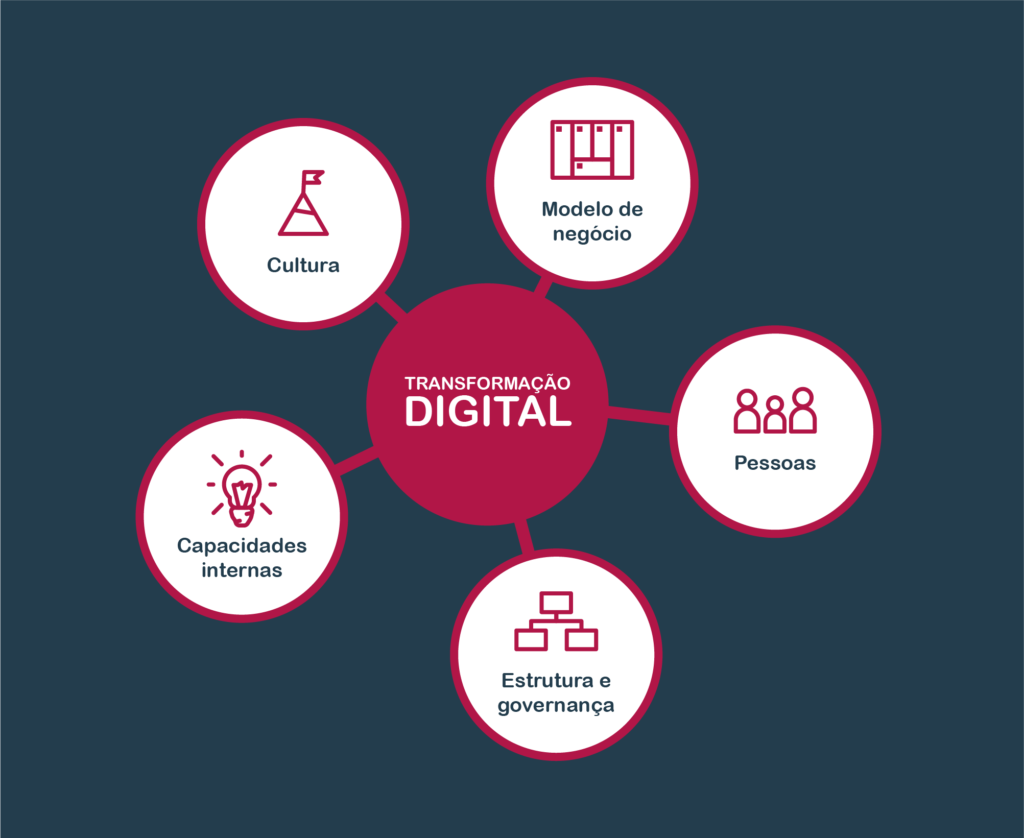
CULTURE
The culture change is the first pillar for the true Digital Transformation to happen, not by chance. After all, it all boils down to a change of culture and mindset. Among the various changes in culture, we can highlight:- Really put the customer at the center of your business;
- Having a culture of applied innovation;
- Empower teams, but with high alignment;
- Create a culture of “not being afraid of failure” and
- be more transparent in actions, decisions and plans
INTERNAL CAPACITIES
In addition to culture, companies need new internal capabilities, that is, teams need to have new skills to solve more complex problems. Among these skills, we can highlight some such as:- Working with new technologies (Big Data, Blockchain, Machine Learning, among others);
- Agility in product development,
- Lean management in product design;
- Use Design Strategically.
STRUCTURE AND GOVERNANCE
This pillar consists of rethinking the way the company is organized. Companies that are already digital organize themselves differently from traditional ones:- How are the areas of the company structured?
- How to break the organization’s silos?
- How is the budget defined?
- How are initiatives prioritized?
- How is work tracking done transparently?
- How to create greater operational efficiency, for example with automation?
PEOPLE
Having the right people, in the right places and with the right direction is critical. In this pillar of true Digital Transformation, we look at:- Roles and responsibilities (noting that, it’s no use just being defined, but must be followed and monitored in a natural way by everyone),
- How is people’s motivation?
- And which leadership model to apply.
BUSINESS MODELS
The fifth pillar of Digital Transformation is to think of new business models for the VUCA world. The way people buy and consume services is changing and companies need to adapt as quickly as possible. For example, the typical case of a bank that starts charging something without you seeing it and knowing it, is no longer accepted by everyone. If this happens, people will soon go to social networks or complaint sites to talk about it, creating problems for the institution’s image. Thus, new service models appear more frequently, such as Subscription, Freemium, OnDemand, among others, always aiming at the user experience. The work then consists of developing these five pillars for a correct Digital Transformation in organizations. We feel that each company has one of the pillars more or less developed, or with the need to develop a pillar first, etc. However, we strongly believe that some points are levers for transformation, meaning that not everything will happen at the same time. The levers are:- Developing leadership
- Enabling teams
- Applying Agility Concepts