Agile Teams

by Rodrigo Pinto Rodrigo Pinto No Comments

What does Data Culture and High Performance Teams have to do?

In an increasingly competitive market, having a strategy that makes you outperform your competitors is amazing, isn’t it?

The data culture together with high performance teams can help you in the organization’s strategies as a whole, promoting exponential results.

When collecting information, the objective of many companies is to convert raw material into useful data, especially in this scenario of constant changes in consumption behavior.

Thus, the data can be used for decision making, strategic planning and even the reformulation of work models.


What is Data Culture?

The data driven culture, that is, data oriented, is one of the examples of a process or tool that helps teams to be more analytical and focused on always putting the user at the center of decisions, making the work to be focused on generating more value for the customer and, consequently, for the organization.

To be data driven is to work with a set of actions, decision making, strategy improvements based on data and not on general guesses or studies.

It is a process made by detailed analysis of the information collected in different ways, such as website and application forms, events, landing pages, mkt email, chatbots, etc.

All user-generated data can be used for analysis, as the purpose of this verification is to acquire references that will help in planning actions and strategies.

According to global data from Gartner, 86% of executives at the world’s largest companies place data and analytics strategy as a priority in their business for the coming years.

Companies that start acting through data responses have a much better chance of increasing their results and achieving good quality delivery to their customers.

For this management to happen efficiently, it is necessary to monitor the most important indicators, and not just collect random data, in addition to having multidisciplinary teams that work from end to end in the initiative, increasing performance and results much more.


How can high performance teams help?

High performance teams are already composed of people who work with the data culture, since it is through metrics that the team can see the results of its team, improving strategies, deliveries and increasing results for the company as a whole.

To learn more about this topic, click here and read our blog post< /a> about high performance team.

What the data culture and high performance teams can bring benefits to your company:

  1. Continuous improvement of company processes: every business always wants to evolve for the better, through the metrics and data collected it is possible to improve and automate processes.
  2. Growth in company profits: teams that deliver good deliveries ensure better results and make the company able to increase its profits.
  3. Identify customer needs in advance: using the right data and analytics will make it easier and faster to see when there is a demand from your customers and understand what their needs are.
  4. Improve process management: Every area can improve its processes and deliver value to its customers, but it is necessary to change the mindset first. With the correct analysis of data – whether from the customer and/or the employee, it is possible to understand what is going wrong and outline a plan of action and improvements.
  5. Evaluate goals for operation management: with captured and filtered data, it is possible to direct new processes and strategies and define new goals so that the company’s objective is achieved.

Therefore, we saw how the data driven culture is essential within an agile and digital work model, turning data into important and essential information for the performance and strategic growth of an organization.

How to do it here at Agile.Inc

If you are already going through a digital transformation process, it is much easier to implement the data culture in your company and stay ahead of your competitors.

For this change to happen, it is necessary to have a multidisciplinary team of high performance that will help you achieve good results with correct metrics, tools, roles and tools.

In our focus, we focus on the characteristics of each company, analyze the conditions and context, and offer all our expertise to build multidisciplinary teams, adapted to each type of product.

Made up of several specialists, our high-performance team assesses – always four-handedly – ​​the current state of the company, analyzes the results prior to changes, implements new methods. to be analyzed, it creates a transformation backlog, which will be implemented and adapted throughout the process, aiming at various changes, such as:

  • Change the mindset and paradigm from a Traditional model (prescriptive and ordered) to an Agile model (adaptive and interactive);
  • Break the status quo, seeking greater productivity;
  • Create a better form of communication and promote full integration between areas, for better decision making;
  • Place the client at the center of all settings and choices;
  • Transforming opportunities and ideas into successful products.

Our team is supported by Scrum.org and will help your company to be more innovative, desirable, viable and feasible for the creation of products and project development. Count on Agile Inc. consulting and assemble a squad that will elevate your company.

by Rodrigo Pinto Rodrigo Pinto No Comments

Why do high performance teams generate more results?

Having a self-managed team is every area leader’s dream, isn’t it? But we know that developing collaborators with different profiles to achieve the product objective is even more challenging.

Thinking about it, companies from different segments have started to look for high-performance employees, but it would be even more interesting if this were developed already in the employees who are part of your company, no and even?

To understand how high performance teams work and how they can help your company generate more results just keep reading this article.


After all, what is a high team performance?

High performance teams have high competence, expertise and commitment to goals – which are very clear to everyone involved. Generally, this type of team shares the same vision, values ​​and purpose, in addition they are always engaged and aligned with strategic objectives.

In this case, high performance is more than achieving good results, it is going beyond what is expected. High performance is directly linked to attitudes, sense of ownership and focus on delivering value.

A high performance team is motivated, has a very strong culture and is willing to improve, always looking for new challenges.

In truly digital and innovative organizations, we can call a high-performance team the Squad. In other words, a team composed of people of different abilities, united to create products or initiatives that generate value, from their ideation, through all development, to delivery and usage monitoring.


High Performance Team: Squad

Basically, the Squad is an organizational structure composed of people of different abilities, who have a very clear objective: to have more value delivery, working from end to end on that product.

Different from the traditional model of software creation and project management, Squads are multidisciplinary teams, with fewer silos, less hierarchy, more autonomy, focused on their principles and objectives, and who work to solve a problem or challenge within an organization.

O Spotify created this template to solve a challenge they had at the time and, as it became popular, many people started copying this one. people organization format.

If you really want to understand how this model of Spotify Squads came about, click here and see this great explanation from Rodrigo Pinto, our Agile Chapter Lead.

So a Squad is a High Performance team that many companies have already adopted along with the Scrum work model.


What are the characteristics of high performance teams

Well, when thinking about developing a high-performance team, you need to analyze what characteristics are needed for your challenge.

In other words, there is no standard model, but the one that best suits your company and the results that need to be achieved. Check out some characteristics that a Squad needs to have: 


Leadership

Having a well-defined leadership is essential for a high performance team, this need is due to the fact that team members can have no doubts about who to turn to when necessary nor who is the final decision.

It is also very important that the leaders are always not only encouraging but also inspiring the entire team.


Self-Management

Despite the very present leadership, self-management is also very important. The focus here is on each team member taking full responsibility for their roles.

It is important to emphasize that despite the leader, each person can manage their time, decisions and the way in which they carry out the tasks.


Multidisciplinarity

High performance teams are nothing less than a group of people with knowledge, cultures and backgrounds in different areas working in synergy towards a common result.

Having said that, multidisciplinarity is very important, as here the individual skills complement each other making everyone collaborate to achieve the best results.


Anticipation

Projecting what’s to come and thinking ahead is a strong characteristic of high-performance teams. This behavior helps to prevent problems and situations that could compromise the performance of the team as a whole.


Assertive Communication

Knowing how to communicate is extremely important. High performance team members understand that assertive and efficient communication impacts the bottom line.

In this type of team, periodic meetings are held to monitor, encourage the exchange of experiences and feedback. Internal communication is valued!


Collaboration

For a team to achieve high performance, it is essential that there is collaboration between members.

Instead of each one closing in and focusing only on their tasks, here the members help each other and, in a collaborative and integrated way, they are able to deliver more consistent work.

Once you have verified which of these characteristics need improvement in your team, develop a training plan.


Differentiated Mindset

As already said, to create a high-performance team you need to change the mindset of your company, managers and team.


Structuring the work environment for an innovative atmosphere does not mean taking inspiration from trends in Silicon Valley companies and putting ping pong in your company’s common area.

We need to focus on a more physical aspect, such as the structure of the tables, making employees work closer, encouraging people to leave the physical space of the company to focus on resolution of the problem.

But yes, the focus remains on innovation!

And for that, you need to change your mindset and forget about the idea that directors are in separate and isolated rooms, you need to have these people always in an easily accessible place for all collaborators.

Important: In addition to these characteristics, the manager or area leader needs to understand the employee and encourage them to be a high-performance person. But how to do this? Here are some tips.

  • Provide courses and certifications so that everyone can learn about all the techniques your team needs;
  • Encourage teamwork, hold meetings, dynamics, etc;
  • Create challenging goals, make your collaborators step out of self-indulgence and face new everyday challenges;
  • Trust the professional and give them autonomy to resolve and bring solutions to conflicts;


How to build a High Performance team?

At Agile.Inc we listen to our employees and give them full autonomy to bring ideas and new concepts so that the company’s objective is achieved.

Our High Performance teams are divided by clients and modulated according to the client’s needs. We listen to our customers and with that we bring the best qualities of different people so that the customer’s pains are resolved.

We have also developed knowledge trails consisting of training and certifications so that employees can follow with new work tools and thus achieve their goals.

Count on us at Agile.Inc and talk to one of our professionals so we can help you build your High Performance team

by Rodrigo Pinto Rodrigo Pinto No Comments

Because people are NOT doing twice as much in half the time with Scrum

The world is changing at a very high speed, organizations are increasingly trying to meet market needs and differentiate themselves in a competitive landscape. For this, projects and more projects are executed in order to achieve the sole objective of meeting the needs of the market and/or people. And Scrum can help you.


Scrum: the art of doubling up in half the time.

In the mid-1990s, Jeff Sutherland and Ken Schwaber created the Scrum method, with the objective of solving common problems in organizations, ensuring a focus on what really generates results.

In order to explain the benefits of Scrum, its application for greater productivity, Jeff wrote a book called “Scrum: The Art of Doing Double the Job in Half of time”.

In this book, he tells how he used Scrum in his personal experiences to clarify problems and act on them, in order to help people and companies to plan better, to focus on the customer and on continuous improvement.


How did the term agile method come about?

The term agile method came up with the Agile Manifesto, created in 2001. This small document was known for its 4 values:

  • Individuals and interaction between them more than processes and tools;
  • Software at work more than comprehensive documentation;
  • Client collaboration more than contract negotiation;
  • Responding to changes is more than following a plan.


All agile methods from Scrum and XP (the best known) are based on these 4 values.

The main goal of agile methods is to satisfy the customer through small, recurring deliveries of value, through short, continuous development cycles.


How to apply the agile methodology?

To implement agile methods in companies, it is very likely that a change in organizational culture will be necessary.

This methodology uses the principles of constant adaptation. They also aim to eliminate and reduce waste and inefficiencies caused by communication noise, bureaucracy and technical obstacles.

The agile methodology works in companies that work with a high level of collaboration, where members contribute to the development of projects/products through small teams. Let’s take a look at some changes that are often needed to make companies more agile:

  • The company’s objective must be to please the customer and deliver the best product for the established demand, with total efficiency.</ read>
  • The work should be done in self-organizing teams, where management takes place in order to enable employees to contribute as much as possible.
  • The work must be coordinated by agile methodologies based on iterative cycles and customer and stakeholder feedback.
  • Transparency and continuous improvement need to be predominant values.
  • The decision-making in the company must occur predominantly horizontally.


Why aren’t people producing?

Now that we are familiar with Scrum and know a little bit of principles for implementing agile methods, let’s better understand about common mistakes in applying agile methodologies, especially Scrum. The big challenge here is for people to understand that it is not simply by changing names, roles and meetings that results will happen. A deeper understanding of Agility and its true application is needed.


Mistake #1: Thinking that doing a daily scrum does with that you are agile

Daily Scrum is a vital part of Scrum, but just doing it for the sake of it doesn’t help at all.

The goal of the Daily Scrum is for developers to review and plan their progress toward the Sprint Goal. It is also a forum to allow you to identify potential issues and deal with them quickly or later.

It is designed to be a short meeting, to resolve issues and ensure (at a minimum) an ongoing level of communication and team planning as the Sprint progresses.</ span>


Mistake #2: Thinking a Scrum Master is a Project Manager

The Scrum Master has the role of supporting the implementation of Scrum in their work practices.

Some people assume that a Scrum Master is the same as a project manager, but the Scrum Master is probably a new role, perhaps never seen by some, so it is flawed to do. any kind of parallels.

In the practice of acting as an SM, it is common to act as a teacher, facilitator, coach and mentor. Technically, he doesn’t manage the team. The Scrum Master provides guidance and advice to Scrum Team members, especially on issues related to the rules of execution framework and role fulfillment.


Mistake #3: Making Scrum Team Too Big

Ideally, a Scrum Team should be a small dedicated unit working closely together and self-organizing. For this to happen efficiently, it cannot be too big. The maximum size should not exceed 10 people, ideally around 8 members.

Jeff Bezos makes a joke of this theme by saying that the ideal size for a team is a number of people that can be fed by two pizzas. It’s up to you to determine the hunger level and therefore the size of the pizza. 🙂


Error #4: Pin Product Backlog

Product Backlogs are what we call live artifacts. This means that they are being created and changed all the time, during the creation of the product and execution of the Sprints.

Some people who came from the traditional paradigm, well known for the waterfall model, have some difficulty in understanding this concept. They associate the Product Backlog with the closed scope of a project and that is completely incorrect!

The Backlog’s premise is to be flexible, that is, with the learning acquired at each Sprint, the team (in the person of the Product Owner) will adapt the Product Backlog so that it be more and more adherent to what the customer needs.


Error #5: Not having the patience to follow the process

It is necessary to understand that in Agility there is no one-size-fits-all solution and there is no ready-made recipe for how it should work. and others not.

Each team and company should seek to follow its own learning path. A basic principle that closes all our theoretical conceptual is continuous improvement. A team cannot say that it is agile if it does the same things, in the same way, for a long time.

Once applying the first tools, some teams don’t have the patience to correct mistakes, learn, train people better, and allow the principles of improvement to take effect.


Completion

Finally, it is hoped that a true understanding of agile principles will suffice for teams to generally reap the benefits that Agility aims to deliver. As the days go by, agile teams must grow in this understanding (which is new to many) by finding, testing and validating better ways to work. This promotes team productivity growth and maximizes value delivery.

by Rodrigo Pinto Rodrigo Pinto No Comments

Raise your agile maturity level with 4 simple practices

One ​​of the great needs of companies these days is to have better results, more productivity, and to really be able to connect more and more with their customers.

The point is that the race to have more competitive advantage in the market is only increasing and many organizations are still failing to develop digital products that put you ahead of the competition, and that delight your customers. real users.

Many companies claim to be digital or agile, but deep down we see that they are still traditional, with a change, most of the time, of facade.

Every day many questions come to us. They are requests for help, for people who want to change this scenario in their teams. The main questions that arrive are:

  • How do I create better digital products?
  • How do I do a real agile makeover?
  • Where does agile end and digital begin?
  • But why do all these problems happen?
  • Is all this normal?


Starting with the last question: yes, this is all normal. This is a common process in the market, and normal for your company.

However, it is necessary that companies take the next steps as soon as possible, that they manage to avoid mistakes and basic flaws in order to really be agile and digital.

The companies that make it through this phase will be able to stand out a lot, and will really have a competitive advantage.

And the professionals who manage to make this evolution in companies, will certainly stand out from the average person.


Really Agile Transformation

True agile transformation, which is the foundation of digital transformation, is a long journey and not just an installation of some ready-made model.

It’s not enough to “buy agile” from a traditional consultancy, train everyone, change method names, and presto, think you’re agile.

You will only be agile when you get:

  • People with more skills for building digital products;
  • Better and more agile processes for this creation;
  • A true vision of digital products;
  • Good engineering practice;
  • Really agile leadership, among others.


However, to achieve this goal, there is a journey, there are stages, there are stages that the company goes through, to be able to create really better digital products.

You don’t measure whether the company is agile or not, but how agile or not it is.


Stages of Change

Imagine this situation: there is a problem, you realize that the organization is losing money, you know you can have better processes, you need high performance teams and deliverables that really add value, but it doesn’t know how or where to start to change.

Currently, organizations want to be agile, but in most cases, they don’t even know why they want to…

They just decide that and believe that agility will solve these situations mentioned above.

And, because of this aimless decision, it is common to implement some agile method in a mechanical way, without learning deeply and incorporating the concepts and principles into everyday life, without changing the status quo.

And as a result, team productivity can drop!

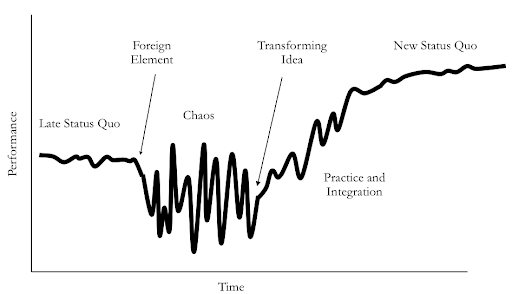
This is because of the curve of change, the J-Curve, a complex process explained by psychotherapy.

Developed by psychotherapist Virginia Satir, the model is described in 5 stages, which have an effect on feelings. acts, thoughts, performance and philosophy.

By going through these effects you can improve the way you process change and help others process it.

When it comes to organizational agility, you can also use the J-turn as a road to be traversed.

In many ways, agility helps reduce risk.

But when we’re talking about organizational change, this agility, most of the time, will first express itself in a slight decline in performance.

Therefore, it is important to say that this is totally normal, and is directly linked to changes in the organization’s status quo, which shortly after this decline will start to increase its results and performance of the teams.
 

4 simple practices for you raise your Agile Maturity stage


In general, this process happens when a person or a small team seeks to better understand agile concepts and starts small initiatives.

Seeing the benefits, she feels she needs to go through this transformation (even though she’s not sure what it means to be agile).

Because of this shallow perception of the meaning of “being agile”, some method mechanically implanted in this organization and without strategy, be it Scrum, Kanban, among others, will cause the team’s productivity to drop. This is exactly what the J Curve says.

To prevent the above errors from continuing to happen, you need to have the right people to go through this change process.

And they should start by understanding the scenario you’re in first.

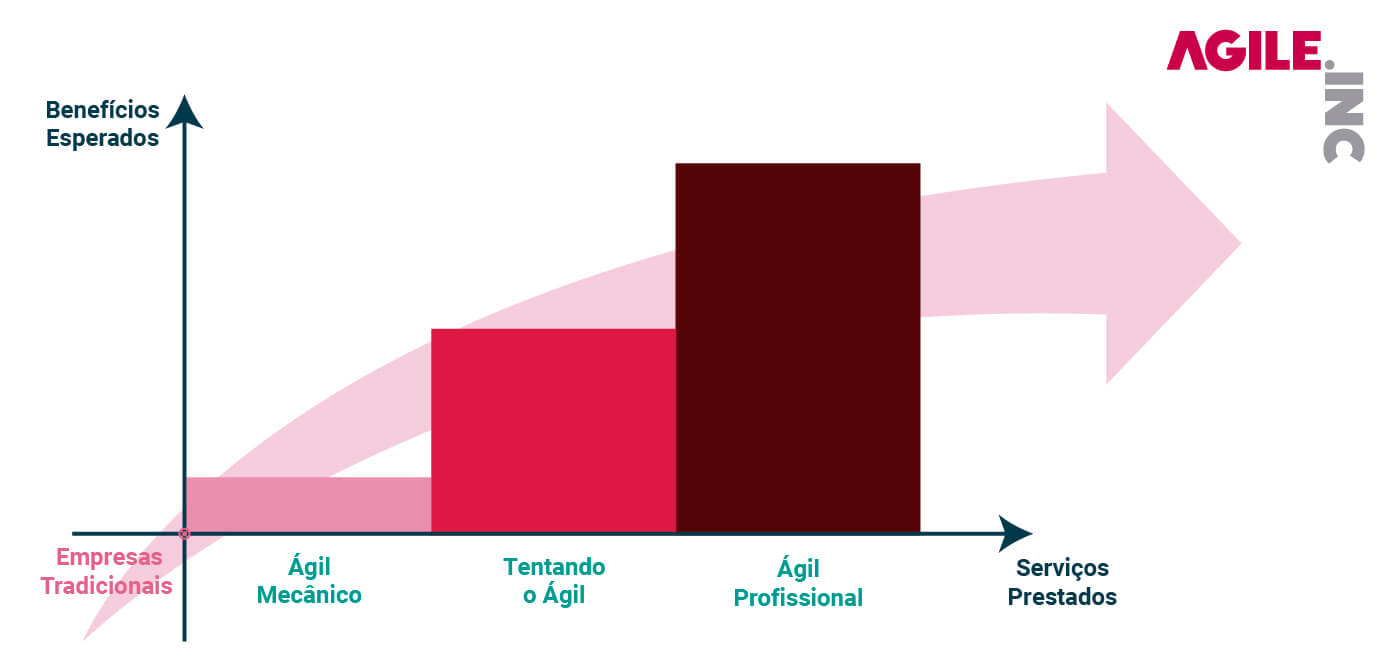
After many studies, we identified that there are four stages, in which it is possible to understand how far behind companies are in developing digital products or how much they are really being agile and creating products from the best way possible.

We can classify them as agile maturity stages and they are divided into 4 levels: traditional companies; agile mechanic; trying to be agile and agile professional.

  • Traditional companies are those who understand a little about agility and try to implement some concepts and practices in a shallow way;
  • Most organizations are already practicing what we call mechanical agile</b >>
  • On the second level are companies that are trying to be agile, in a transitional phase in which they are not really agile yet, but they are well on their way to doing so;

And in the third stage, we have the organizations that run the Agile Professional , which are those that are ahead in the market and develop digital products with the right professionals, with the best engineering processes and practices, with the correct product vision.
 

4 praticas simples para você elevar o seu estágio de Maturidade Ágil


The more mature, it is clear that greater benefits will be reaped, and thus the company will have greater productivity, performance, greater connection with the customer, and will thus have an advantage over competitors .


Knowing the 4 stages of agile maturity, looking for high performance


Stage 0 – Traditional Companies

These are those companies where the employee or manager has heard about agile transformation but hasn’t put it into practice yet.

Usually, these are companies that, a person who has read a book or article on agile methodology, understands the importance of this process as a whole and will start looking for a consultancy to in order to have help the professional in transformation.

It is that company that is starting in the world of digital transformation and is afraid of the changes that need to be made.

Despite trying to implement some concepts and practices, it still hasn’t been able to incorporate the agile mentality in the company’s skeleton, causing the results not to arrive.


Stage 1 – Mechanical Agile

This is the stage where most companies are!

At this point, the concept of agile transformation is already known, but not the complete process.

Normally, the company already uses methods such as Kanban, they have daily alignments, change area names to squads, use post-its to organize tasks and some other organizational methods…< /span>

Nevertheless, it still can’t really be considered an agile company.

  • It is not yet a transparent organization with clear objectives</li >
  • There is no transparency of information, with a lot of visual management</li >
  • It still does not have short cycle deliveries, with a focus on value generation</i >
  • There is a need for more visibility, improvement in processes and more collaborative areas</ read>

 

4 simple practices for you to raise your Agile Maturity stage


This is Mechanical Agile! A stage in which one already knows and uses some agile concepts and practices, but the culture, the mindset, is still completely traditional and Taylorist.

Is it possible to change the behavior of this company and reach another level of agile maturity?

Yes, with training, consulting and building high performance teams – which is what we do with the help of Agile School – our educational area – and in Agile Inc, developing corporate solutions.

This stage is also known as Agile Zombie.

  • Zombie is a person, isn’t he? He has arms, legs, a piece of his head. But we know that the zombie is not a real person because it has neither a thinking brain nor a beating heart.
  • Making a parallel, many companies are mature Agile Zumbi: they even run an agile process, they even have an agilist and a certified product owner, but in the end, they don’t have an agilist who removes impediments, they don’t have a product owner with authority over the product, they don’t have a leader who understands what it means to be a leader, they only have kanban tables but they don’t analyze the flow. In other words, they are more like Zombie!


Stage 2 – Trying Agile

These companies are at an intermediate level, right in the middle of the road. Despite having already passed the mechanical agile phase, it still does not have a continuous workflow to be considered a professional agile company.

Processes still need to be improved and employees still need to develop skills, knowledge and experience.

This is a process stage where companies are starting the agile journey. It is a transitional period, where companies stay for a short time, as they are in the race for agile and digital transformation.

At this point, companies are transforming themselves into an agile organization with each passing day, they are in the process of adapting and implementing new cultures and methodologies.


Stage 3 – Professional Agile

The company is already reaping the fruits of the agile transformation and has already completed the entire transformation process, it managed to complete the previous step.

The areas now connect when working together, mainly supporting the business areas, and really put the customer at the center of decision making.

They have more transparency and are concerned with giving visibility to what is happening to everyone.

In addition, they prioritize deliveries and always ask themselves “are we doing the right thing?”

Companies that are running an Agile Professional, have the Agile mindset on a daily basis within teams and decentralize decisions, but always have a high alignment between all sectors.</span >

Not only the leadership, but the teams already understand the importance of having clear and well-defined goals, as well as alignment in the execution of processes.

The teams are empowered, each one has a certain freedom of decision, not being all centralized in a single manager.

In addition, innovations happen all the time, as there is complete freedom of adaptation in all areas of the company.


Employees work motivated and therefore produce more solutions.


In agile leadership, goals are determined, the company knows its customer in depth, promoting the delivery of value and removing impediments.

We at Agile Inc. can help you get to that point. Our goal is to shorten the agile transformation journey by delivering value to you.

At the end of the process, when your company is professionally agile, that is, truly agile, you will have conquered:

better operational efficiency, better value for your customer and risk management (agile governance that will reduce your internal risks).


How to build this journey of evolution?

For you to evolve and become a company in stage 3 – Professional, you need to assemble your development plan, looking at some perspectives.
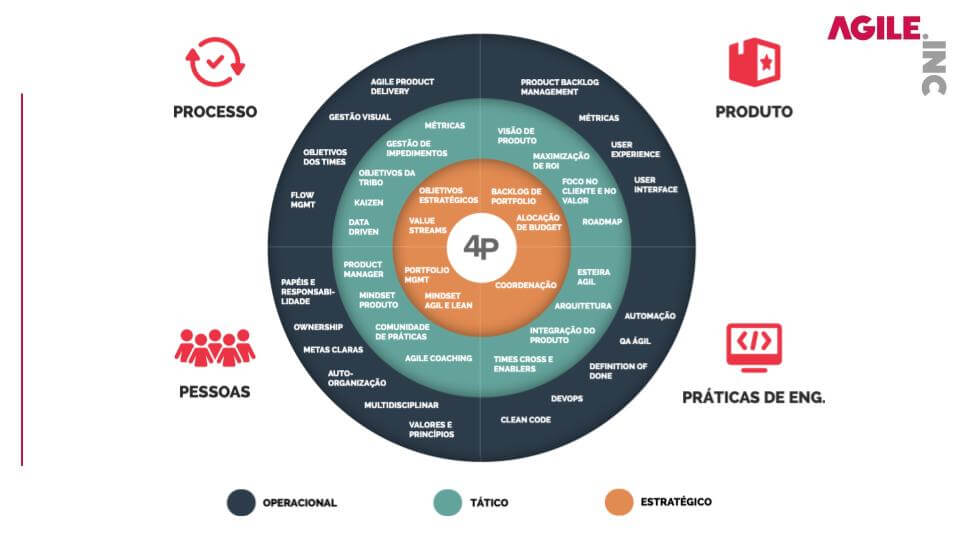
 

4 simple practices for you raise your Agile Maturity stage


Here at Agile.Inc we classify organizations into 4 pillars, after creating a radar with perspectives that mix operational, tactical, strategic eyes.

Let’s better understand each one of them so that you can identify which stage your company is at and, thus, make improvements until reaching professional agile, that is, developing truly digital products innovative.

These four pillars are Process, People, Product and</span > Engineering Practices.


Process: refers to how we create digital products. They involve issues such as strategic objectives, metrics, visual management, impediments management, agile product delivery, flow management, data driven, kaizen;


People: It is important to understand if you have the right people, in the right place, and with the right motivation. In this pillar we look at roles and responsibilities, sense of ownership, clear goals, self-organization, multidisciplinarity, values ​​and principles, community of practice, product mindset, product manager;


Product: what product do we want to create, what vision do we want to reach? In this pillar we pull subjects such as product backlog management, metrics, UX, UI, product vision, ROI maximization, customer and value focus, roadmap, portfolio backlog;


Engineering Practices: only with the right engineering practices will we be able to be really agile, so some subjects are extremely vital, like Automation, Agile QA, DevOps, Definition of Done, Clean code, Agile treadmill, architecture, product integration, teams cross and enablers.


Based on these pillars, and now looking more from an operational point of view, now from the tactical perspective and now from a strategic perspective, we set up an evolution plan for the company’s journey.

This plan must be constantly revised, as if it were a Product Backlog of a product, but in this case, a Change Backlog, to bring your company closer to Professional Agile.< /span>

Looking at the 4Ps and maturity levels, we found some interesting features. santes, which can be useful for you to analyze if you are closer to the traditional or closer to the professional.


Characteristics of these pillars of a company at the Mechanical Agility:</ span>

  • Development team falling out
  • Product owner proxy: just take orders without caring too much
  • It’s a team that doesn’t think about valuing the product
  • No integrated view
  • No portfolio
  • Many decisions are made based on guesswork, 
  • Metrics, based on data are missing
  • Scrum Master/Agilist is that person who is in his or her first experience of agility. It still doesn’t have much expertise
  • Areas divided by people who think and people who do.
  • Efficiency-oriented teams/tasks
  • It is not clear where your responsibilities begin and end
  • Predictive leadership, which monitors your collaborators
  • The team serves the leader
  • Long flow, each area has its task and priorities
  • Documents are unclear
  • Tests are done manually
  • Team is seen as coders
  • Ignore or hide technical problems


Characteristics of these pillars of a company at the level Professional Agile:</ span>

  • Customer focus as a basic principle
  • The team understands each other and works together
  • Have a fully integrated view of processes
  • Have an overview of what’s going on, as an organization coach
  • Processes collaborate with the delivery of product value
  • People expose problems
  • Contributors bring new insights
  • Mistakes are accepted and are part of learning
  • It is necessary to use self-organization, using the wisdom and intelligence of the whole team.
  • The team is engaged, motivated and with purpose
  • Leadership changes its profile, being a culture of delivering value, avoiding waste.
  • The leader serves the team
  • Teams work together with the same goal, making deliveries run quickly</ read>
  • Multidisciplinary teams organized not by area, but by product view
  • Team is a co-author, knows the best solution for a given problem
  • They give transparency to technical problems, because they understand that they represent a risk to delivery and take time to resolve them</span >


Create a digital product that really it’s agile it’s complex, so there’s no way things can be done separately (as is done in traditional companies).

For everything to work correctly, operations and professionals need to be integrated so that everything is done quickly, yet efficiently, and with a focus on delivering value.


Identifying my company’s maturity stage

There are some perspectives that can be analyzed and taken into consideration to identify how agile your company is considered.

Check out what these areas are and what can be analyzed:


Practices and Roles

The aim is to understand if the organization is using processes efficiently and also if everyone knows their respective roles within the company.

If you still don’t know how to identify this, there are a few questions you should ask:

  • Is it clear what the responsibilities of the roles currently available in the company are?
  • Is the teams workflow visible?
  • Do teams have explicit policies (eg definition of ready to work, definition of done etc.)?</ span>
  • Are bottlenecks and queues visible in the teams workflow?
  • Do the teams have clarity on the main sources of rework?
  • Are software engineering practices being used to keep code healthy?
  • Is the publishing process automated?
  • Are there automated tests?


Metrics

The intention here is to understand if your company has been using business and process metrics.

And if so, at what level? You need to stress the importance of developing benchmark metrics that will help improve your product.

To analyze this, ask yourself:

  • Are business metrics being used in the decision-making process?
  • Are the business metrics visible for everyone in the company to review?
  • Business metrics are used as a reference in the process of defining an initiative (ex: which business indicators will be leveraged by project X)?
  • Do teams use process metrics to project lead times?
  • Do teams use process metrics to analyze process health?


Business-oriented prioritization

Does your organization set priorities?

It’s important to consider that when everything is a priority, nothing really matters.

After all, everything is on the same level, needing attention and urgency.

Therefore, it is necessary to understand if there is a structured prioritization process.

Ask yourself:

  • Are there clear prioritization criteria?
  • Has prioritization taken into account customer needs?
  • Are business metrics used in the prioritization process of initiatives?
  • Is an analysis of dependencies between initiatives carried out before finalizing the prioritization process?</li >


Financial result

Your company measures financial results of your initiatives?

This is something very important in an agile journey.

To find out if they are already doing this or not, ask yourself:

  • Is the organization’s leadership clear about the business objectives of each initiative?
  • Are the teams measuring the financial result of deliveries?
  • The organization is able to classify the initiatives according to the expected result (ex: this initiative will generate greater efficiency in the business, will help to conquer market share, will it be an innovation, will it anticipate the cost of delay?)


These analyzes will help you diagnose what stage of agility your company is at and where you need to improve.


Ok, I know my stage, how can I improve?

Now that you’ve identified what stage your company is at – and we can say that 85% of companies are closer to Mechanical Agility – there are some solutions that can be done for your company move forward on the change curve faster and reach the desired status quo.

In this case, some questions will be analyzed, namely:

  • what is the company’s maturity problem?
  • what is the executive level mindset?
  • how is your team, is it lined up?
  • how have agile methods been implemented so far?


After these reviews, it’s important to know that if you don’t have a good product vision, clear and organized processes, people with a different culture and mindset, engaged with the organization’s purpose , you will probably not be able to reach another status quo, nor advance through the agile maturity stages effectively.

For this you need the right professionals and suppliers.

This is the best way to have a radar for your organization, which will show you where the flaws are, where improvement is needed, so that you can build an effective and optimized strategy to your reality.


And you can do this in three ways: with training, consulting and building high-performance teams.


Trains

It is necessary to raise the level of knowledge of people and incorporate the true agile mindset, according to the needs of the company and its employees.

All training offered by us, for example, is certified by international organizations – such as Scrum.org, and performed by Agile School – our education arm.


Consulting

With the help of consultants, it is possible to break the traditional mindset to understand the way in which your company can create and develop digital products that generate greater competitive advantage.</ span>


Squads

A team of people with the right skills, the right knowledge and market experience to carry out this entire journey of change, the SQUADs. As each client is unique, it is necessary to analyze the working conditions in order to assemble a multidisciplinary team adapted to your type of business and needs.

Now that you know your agility stage and what you must do to get to professional agile, contact our consultants and transform your company forever.


by Rodrigo Pinto Rodrigo Pinto No Comments

Find out if your company is Mechanical Agile and learn how to change


Businesses want and need to create better digital products. What’s the point of having a great business model if you don’t have a digital product that can deliver all the benefits?

This has become a matter of survival!

That’s why this article is part of a series where we talk about the maturity stages of companies, and how organizations can take great advantage of leaving a low agile maturity level and reach a professional internship.


Let’s talk in more detail what are the characteristics of companies that are in Mechanical Agility and how this can “kill” your product.

If you already use agile concepts and practices, but don’t have people with the right skills to build digital products; lack of product vision on a daily basis; you don’t have good engineering practices or really agile leadership, you’re either wasting money on agile transformation or doing something just a front that won’t bring you concrete results.

Now understand the 7 characteristics of companies and people who are using Agility mechanically and are not changing the way they create digital products.


Agile culture

In organizations where Agility is being used mechanically, agile actions are more reactive, with the objective of “putting out fires”, than strategic or proactive actions.</span >

This happens a lot because companies don’t have a clear vision of what high performance teams are – who dominate all areas of creating great digital products.

And this lack of vision makes them think everything is fine, and doesn’t show the need to create a clear plan for improvement and evolution.

In companies with professional agile maturity, everyone works with customer focus as a basic principle, guided by clear goals and strategic objectives.


Method only

These teams are more arguing over whether the Scrum framework is better or worse than Kanban; Whether the role name will be Agile Master, Scrum Master or Agile Coach; That is, they are wasting time discussing this, instead of answering the question “What is preventing us as an area from delivering better products to our customers?”


Stakeholder centric

In these mechanical teams, much is said about customer centric, but little is known or really applies. Basically, they are still stakeholder centric – one business manager looks at the customer and thinks “what do I do with my product for this customer?”.

Following this question, the hypotheses are raised and become items for the implementation to be done by the Development team.

This generates a lot of waste of time, money, and increases the complexity of the development, because you are developing something that didn’t need to be developed.

It’s hard to make it clear to leaders that personal requests are not an acceptance criteria for developing something.


Leadership that “stood in time”

Leadership does not evolve in terms of agile knowledge and trends in the development of digital products.

The company still exists to serve the C-level, with heavy annual budgets and a fight between areas.

The leaders think they have the most knowledge and that they should chew it up for teams to just execute.

In this type of situation, self-organization is still something to be desired, but very poorly applied.

Leadership still demands a lot of increase in productivity, more delivery of tasks, but cannot act as a true leader, generating clearer objectives and metrics, removing obstacles and managing of motivation and people.

In truly digital companies, leadership propagates a culture of delivering value, avoiding waste, serving teams, toworking with the same purpose.

This way, the teams’ productivity ends up being MUCH higher!


Unified Product View Low

Given the world we are living in, in constant transformation, there is a lack of strategic planning in organizations.

Lacks product vision, a unified business vision. This is not to say that the company has nothing strategically planned.

It has good ideas and visions yes, but it is not shared and unified between teams.

This makes the people who build the product stay away from the necessary results.

The team ends up being seen as just a factory to build something, and not a team that solves a user’s problem and really adds value to the business.


Business X IT

In companies that use agile concepts and practices in a mechanical way, the areas of Business and IT are still very distant.

Distant in the sense that they don’t work together on a daily basis. In high-performance professional teams, some IT and Business goals are shared and professionals work together daily to resolve issues.

In the mechanical agile area, the IT area is still seen as a support area to deliver the roadmaps promised.

This also reflects a company structure with many silos, where each one works to solve their problem and remove any focus of delay in their area, for example.


Can’t tell Agile from Digital Transformation

You think Agile isn’t such a nice thing to talk about anymore and now is the time to talk about Digital Transformation. But when you ask what is one and the other, you can’t answer.

Digital Transformation, so talked about lately, is a movement that requires a much broader adoption of technology and is anchored in a cultural shift.

It’s more about people than digital technology.

Requires customer-centric organizational change, supported by servant leadership, driven by radical challenges to corporate culture and the leverage of technologies that empower and empower employees.

Among the various pillars of this journey is the adoption of agile practices and concepts, which are part of several stages of the Digital Transformation.


Agile is not helping

Overall, we see that agile concepts and the digital mindset were applied mechanically, just discussing processes and that the culture is still Taylorist.

This structure with low maturity already generates some gain, but it is still far from being considered a structure of truly digital companies.

Fact is, truly digital organizations (for example, banking institutions and payment methods) are gaining a lot of market, being able to hire the best professionals, they are being more productive…

All this thanks to a different model of working and creating your services and products.

Traditional companies really want these benefits and results, but they still don’t know what it really takes to start this journey of change.

The professionals who are managing to solve these problems in these types of companies are gaining a lot of space and visibility in the market, becoming scarce.


So what to do?

Stop reading this article for a minute and review your organization.

Has the introduction of that simple Kanban method alone been able to accomplish all these changes in your company?

Starting using Scrum, having daily meetings, having deliveries made by Sprints brought you expressive results?

I can say no.

And that’s the big danger of the first transformation step, that agile mechanic phase…

When you start a process as big as this, you, as a leader, see changes and believe in them.

But culturally, note how traditional your company is still.

Your collaborator is still afraid to expose himself; delivery cycles still last weeks and even months; each one works for himself, does his job and no one is sure how to collaborate with each other…

A clear purpose, an organized process is still missing!

Being agile is having collaborative teams, teams that see the processes as a whole, that focus on the customer for and that want to evolve and grow with the company.

Being agile is having a team that wears the shirt, but as long as you’re in a mechanical agile stage, that won’t happen.

Are you going to stand there, claiming to be agile, when you really aren’t?

Or are you going to go ahead, get your hands dirty and take the necessary step towards transformation?


Now what? How to change internship?

It’s simple to explain, but very difficult to apply.

One ​​of the best solutions is to raise the level of knowledge of some areas and/or teams, when it comes to creating digital products.

Here at Agile.Inc we’ve divided this increase in knowledge into four areas: Processes, Products, People and Culture, and Engineering Practices.

There are more than 20 sub-areas, forming the necessary framework of knowledge and application for teams to be truly digital, create products that delight, are productive, and give advantage to companies.

That’s how we did it in Sem Parar – one of the largest toll and parking services companies – generating a 315% increase in its Sem Parar app user base.


Being more digital has become a matter of survival for companies these days. And our mission is to help more and more people get there!

Talk to one of our consultants now to understand how we can help you.

by Agile.Inc Agile.Inc No Comments

Pillars of agile transformation to develop better digital products

Continuing to talk about how you can develop digital products that truly deliver value and stand out in the market, in addition to understanding your company’s current landscape, it’s important to understand what your organization needs go through changes in structure, processes and culture.

In this article, we’ll learn more about the pillars that need to go through a journey of change to create digital services and products in a more agile and innovative way.


The pillars of agile transformation

Here at Agile.Inc, we believe there are 5 areas in organizations that need to evolve, have an agile culture, a much more digital mindset, to truly create products and services that meet the needs needs of users these days.

These 5 pillars are: Culture, Internal Capabilities, Structure and Governance, People and Business Models.

To be truly agile and digital, it’s important to ensure continuity and ownership of change processes at all levels of the company. Check out the 5 pillars of agile transformation below:


Culture

As mentioned above, it is very important that there is a change in the organization’s culture, as these are one of the main areas that show whether a company is undergoing a digital transformation. After all, it all boils down to a change of culture and mindset.

In this pillar, the main changes we noticed are:

  • Really put the customer at the center of your business;
  • Having a culture of applied innovation;
  • Empowering teams, but with high alignment;
  • Create a culture of “not being afraid of failure” and
  • be more transparent in actions, decisions and plans


Internal Capabilities

The teams in your company will start solving more complex issues, so they will need to have new skills and be able to follow the transformation.

It is important that the professionals in your organization:

  • Know how to work with new technologies (Big Data, Blockchain, Machine Learning, among others);</ read>
  • Have agility in product development,
  • Have lean management in product design;
  • Make use of design strategically.

These are some of the skills professionals need to develop to be more digital, depending on the context of each business.


Structure and Governance

How is your company organized? The way your company’s structure and governance is composed shows whether it is still in a traditional or digital paradigm.

To find this out, you need to raise some questions, such as:

  • How are the areas of the company structured?
  • How to break the organization’s silos?
  • How is the budget defined?
  • How are initiatives prioritized?
  • How is the work done in a transparent way?
  • How to create greater operational efficiency, for example with automation?


Again, these are some examples of issues that are addressed during this transition from Traditional to Digital companiesl.

That’s why it’s important to have the right experts helping you in this process of change, showing you the best way to structure your company to be more digital.


People

Do all members of your team know their roles and responsibilities? In an agile culture it is important to have these issues resolved clearly, to have more engaged people.

  • Roles and responsibilities (emphasizing that it is not enough to just be defined, but must be followed and monitored in a natural way by everyone ), 
  • How is people’s motivation;
  • And which leadership model to apply.


Here at Agile.Inc, we think at the end of the day, it’s always people working with people to create products and services for other people.

But, unfortunately, we still see many companies treating professionals as resources, in a very “commoditized” way, in which it is enough to just hire employees from the cheapest consultancy, for example.


Business Models

The fifth pillar of Digital Transformation is thinking about new business models for the VUCA world. The way people buy and consume services is changing and companies need to adapt as quickly as possible.

The work then consists of developing these five pillars for a correct Digital Transformation in organizations. We feel that each company has one of the pillars more or less developed, or with the need to develop a pillar first, etc.

However, we strongly believe that some points are levers for transformation, meaning that not everything will happen at the same time. The levers are:

  • Developing leadership
  • Enabling teams
  • Applying Agility Concepts


But how to start the transformation process?

To start the process of agile transformation, we at Agile Inc. provide several products that will accompany you along this road until the moment you start walking alone.</span >


Squad Assembly

It is important to have a team of people with adequate skills for some processes, the SQUADs. Each client is unique and specific, and it is necessary to analyze the working conditions to assemble an adapted multidisciplinary team that will help your team to improve and become more and more agile.


Consulting

We use the right concepts, methods and tools to transform the way you create products, to help you connect with your customers and generate competitive advantage.

With the help of experts, it is possible to break the traditional mindset so that agile transformation can take place. It is with this type of service that you get to the top of the pillar of structure and governance faster.


Trains

We carry out training to adapt and improve the team according to the needs of your company and your employees. All of our certificates are in partnership with Scrum.org and made by Agile School.


Now that you know the main pillars for developing better digital products, contact our consultants and transform your company forever.

by Agile.Inc Agile.Inc No Comments

Discover the stages of agile maturity

Agile transformation is something much discussed nowadays by companies that want to be aligned with the market and develop better products and services. However, being able to identify what level of agile maturity your company is at is an important part of the process, and often quite complex. Understanding how agile your company is already is a journey, sometimes quite a long one, that people need to go through to know what needs to be transformed within a team, an area or even the entire organization.

Read this article and understand all about the real agile transformation.

Knowing your maturity levels will help you get to a high stage faster and more effectively. That’s why, in this article, we’ll explain what characterizes each stage of agility  so that you can identify where your company is in this transformation process.


The stages of maturity and agile transformation

Being agile is developing capabilities that offer agility to your business. Technologies, culture and work processes create an environment where it is possible to carry out small deliveries of a product in a short cycle, in order to prove a hypothesis that will generate efficient operations and greater capacity to generate current revenues.</ span>

There are many benefits to being an agile company, and to take advantage of them, you need a systemic view of your business.

Traditional companies, for the most part, have long processes, a lot of command and control, lack of engagement and ownership among employees, areas that don’t talk to each other,  among other features. An agile company, on the other hand, focuses on short processes, with shorter delivery times and improvements in alignment between teams. Unfortunately, most companies in the market are halfway there, they want to be agile but have a traditional mindset that holds them back in the transformation process.

According to 14th State Of Agile, 95% of the companies that participated in this research use some kind of agile method in their daily lives. However, 82% of these organizations have not incorporated these concepts across the enterprise and still need to increase this level of maturity in order to expand these concepts beyond small teams and enterprise-wide initiatives.

With streamlined processes and a new mindset, agile companies have an easier means of identifying faults. Remembering that when we talk about agile transformation, we have 4 pillars:

  1. communication — individuals and interactions more than processes and tools;
  2. pragmatism — product working more than comprehensive documentation;
  3. collaboration — collaboration with the client more than contract negotiation;
  4. adaptability — responding to change rather than following a plan.


Knowing the Agile Maturity Stages

Stage 0 – Traditional Companies

These are those companies where the employee or manager has heard about agile transformation but hasn’t put it into practice yet.

Usually, these are companies that, a person who has read a book or article on agile methodology, understands the importance of this process as a whole and will start looking for a consultancy to in order to have professional help in the transformation.

She even tries to implement some concepts and practices, but because she doesn’t have all of this incorporated as a whole, she ends up failing or even giving little result.


Stage 1 – Agile Mechanical

This is the stage where most companies are!

At this point, you already know the conceffect of agile transformation, but not the complete process.

Normally, the company already uses methods such as Kanban, has daily alignments, changes area names to squads, uses post-its to organize tasks and some other organizational methods.. . Despite this, it still cannot be considered, in fact, an agile company.


  • It is not yet a transparent organization with clear objectives</li >
  • There is no transparency of information, with a lot of visual management</li >
  • It still does not have short cycle deliveries, with a focus on value generation</i >
  • There is a need for more visibility, improvement in processes and more collaborative areas</ read>


 This is Mechanical Agile! A stage in which one already knows and uses some agile concepts and practices, but the culture, the mindset is still completely traditional and Taylorist. Is it possible to change the behavior of this company and reach another level of agile maturity? Yes, with training, consulting and building high performance teams – which is what we do with the help of Agile School – our educational area and at Agile Inc, developing enterprise solutions.


Stage 2 – Trying the agile

These companies are at an intermediate level, halfway through. Despite being past the mechanical agile stage, it still lacks the continuous workflow to be at the advanced level.

Processes still need to be improved and employees still need to develop skills, knowledge and experience.

This is a process stage where companies are starting the agile journey. It is a passing stage, where companies stay for a short time, as they are in the race for agile and digital transformation.


Stage 3 – Professional Agile

The company is already reaping the fruits of agile transformation and has already completed the entire transformation process. The areas connect by working together, mainly supporting the business areas, and really put the customer at the center of decision making.

They have more transparency and give visibility to what’s happening for everyone. And they prioritize deliveries and always ask themselves “are we doing the right thing?”

Companies that are running an Agile Professional have the Agile mindset on a daily basis within teams and decentralize decisions, but with high alignment. Not only the leadership, but the teams already understand the importance of having clear and well-defined goals, as well as alignment in the execution of processes.

The teams are empowered, each one has a certain freedom of decision, not being all centralized in a single manager. Furthermore, innovations happen all the time, as there is complete freedom to adapt in all areas of the company.


Employees work motivated and therefore produce more solutions.


In agile leadership, goals are determined, the company knows its customer in depth, promoting the delivery of value and removing impediments.


The 4Ps of Agility

Here at Agile.Inc we classify companies into 4 stages, we will better understand each of them so that you can identify which stage your company is at and thus make improvements until reaching professional agile, that is, at the top of agility.

Process: teams with goals, visual management, agile product delivery, flow management

People: roles and responsibilities, clear goals, self-organization, multidisciplinarity, values ​​and principles

Product: product backlog, management, metrics, UX, UI

Engineering Practices: quality, devops, clean code, Agile QA, automation

The 4P’s at the Mechanical level:

  • development team falling out
  • product owner proxy: just take orders without caring too much</ read>
  • is a team that doesn’t think about valuing the product</ read>
  • does not have an integrated view
  • no portfolio
  • many things are done based on guesswork and not on having studied metrics
  • scrum master or agile: is one who is in his first experience of agility. It still doesn’t have much expertise, bringing something more theoretical.
  • it is not clear where your responsibilities begin and end</li >
  • predictive leadership, which monitors your collaborators.
  • the team serves the leader
  • long flow, each area has its task and priorities</ read>
  • documentation is unclear
  • tests are done manually
  • staff is seen as coders


The 4P’s at the Professional Agile level

  • the team understands each other and works together
  • has a fully integrated view of processes
  • have an overview of what’s going on
  • processes collaborate with the delivery of product value</li >
  • people expose problems
  • employees bring new insights
  • errors are accepted and are part of learning
  • it is necessary to use self-organization, using the wisdom and intelligence of the whole team.
  • the team is engaged, motivated and with purpose
  • leadership changes its profile, being a culture of delivering value, avoiding waste.< /i>
  • leader serves the team
  • teams work together with the same goal, making jobs finish quickly</span >
  • team is a co-author, they know the best solution to a given problem</i >


Creating an agile product is complex, so there’s no way things can be done separately (as is done in the traditional way). For everything to work correctly, operations, professionals need to be integrated so that everything is done quickly and with value delivery, so the company is able to identify a problem still in production, without this problem reaching the user< /span>


How it all happens…

Imagine the following.

A company manager analyzes the market and realizes that he needs to be more agile. With this idea in mind, an agile method is implemented in the company, but only that.
The organization’s culture is not modified, it has no foundation principles, that is, this minimal change is made mechanically.

This makes the team’s productivity drop, as the manager doesn’t have enough expertise to know about the status quo change, he just wanted to be more agile, but he didn’t made a strategic study about this.

This is where the famous J-Curve enters, which we’ll explain below.


J-Curve – The Curve of Change

The J-Curve was developed by psychotherapist Virginia Satir. In psychotherapy, the change model is described in 5 stages, which have an effect on feelings, thoughts, performance and philosophy. By going through these effects you would be able to improve how you process change and how you help other people process it.

When we talk about organizational agility, you can also use the J-turn as a road to be traversed. In many ways, a level of agility helps to reduce risk. But when we’re talking about organizational change, this agility, most of the time, will first express itself in a slight decline in performance.

It’s important to say that this is totally normal, and is directly linked to changes in the organization’s status quo, which shortly after the decline will start to elevate its performance.

In general, this process happens when a person in the organization reads something about agility and realizes that they need transformation (even if they don’t really know what it means to be agile). Due to this shallow perception of ‘being agile’, the method is implemented in this organization in a mechanical way, causing the team’s productivity to drop. This is exactly what the J Curve says.


Identifying the stage of maturity of my company.

There are some perspectives that can be analyzed and taken into consideration to see how agile your company is considered.


Practices and Roles

The aim is to understand if the organization is using processes efficiently and also if everyone knows their respective roles within the company.

If you don’t know how to identify this, there are a few questions you should ask:

  • Is it clear what the responsibilities of the roles currently available in the company are?
  • Is the teams workflow visible?
  • Do teams have explicit policies (eg definition of ready to work, definition of done etc.)?</ span>
  • Are bottlenecks and queues visible in the teams workflow?
  • Do the teams have clarity on the main sources of rework?
  • Are software engineering practices being used to keep code healthy?
  • Is the publishing process automated?
  • Are there automated tests?


Metrics

The intent is to understand if your company has been using business and process metrics. And if so, at what level?

We need to stress the importance of developing benchmark metrics that will help improve your business. To analyze this, ask yourself:

  • Are business metrics being used in the decision-making process?
  • Are they visible for everyone in the company to review?
  • They are used as a reference in the process of defining an initiative (ex: which business indicators will be leveraged by project X) ?
  • Do teams use process metrics to project lead times?
  • E for ansmooth the health of the process?


Business-oriented prioritization

Does your organization set priorities? Or is everything seen as a priority? When that happens, nothing is really a priority, after all, everything is on the same level.

You need to understand if there is a structured prioritization process. Ask yourself:

  • Are there clear prioritization criteria?
  • Has prioritization taken into account customer needs?
  • Are business metrics used in the prioritization process of initiatives?
  • Is an analysis of dependencies between initiatives carried out before finalizing the prioritization process?</li >


Financial result

Does your company measure the financial results of its initiatives? This is very important in the agile process and to find out if you are already doing this or not, ask yourself:

  • Is the organization’s leadership clear about the business objectives of each initiative?
  • Are the teams measuring the financial result of deliveries?
  • The organization is able to classify the initiatives according to the expected result (ex: this initiative will generate greater efficiency in the business, will help to conquer market share, will it be an innovation, will it anticipate the cost of delay?)

These 4 analyzes will help you diagnose what stage of agility your business is at and where you need to improve.


Ok, I know my stage, how can I improve?

Now that you’ve identified what stage your company is at, we at Agile Inc. have some solutions that can be done to help your company move further along the J Curve. quickly and reach the desired status quo.

In this case, some things will be analyzed, like:

  • what is the company’s maturity problem?
  • what is the executive’s mindset
  • how is your team, is it lined up?
  • how have agile methods been implemented so far?


After analyzing this pitch and the manager understands that they have a problem to be solved. We will help you accelerate the J Curve and thus move your company forward on the transformation path. These solutions consist of training, consulting and building squads.

First, we will make a radar of your organization, which consists in understanding where the flaws are, where you need to improve, so that we can build a right strategy optimized for your company.< /span>


Squad
It is important to have a team of people with adequate skills for some processes, the SQUADs. As each client is unique, it is necessary to analyze the working conditions in order to set up an adapted multidisciplinary team.


Consultancy

It uses agile methodologies to transform the way you create products, help you connect with your customers and generate competitive advantage.

With the help of a consultancy, it is possible to break the traditional mindset so that an agile transformation can take place.


Trains

Training to adapt and improve the team according to the needs of your company and your employees. All certified by Scrum.org and made by Agile School.


Now that you know your agility stage, contact our consultants and truly transform your company.

by Agile.Inc Agile.Inc No Comments

Do you know what Agile Transformation really means?

Adopting an agile methodology is what everyone wants to do. Agile companies can increase productivity, shorten the delivery cycle and still improve quality. No wonder everyone is in the race for agile transformation.


However, for many this is a big challenge that involves several redesigns. When the company works in a traditional way, the path to agile transformation is a little longer, including:

  • new values
  • differentiated mindset
  • new tools 
  • change of attitude and interaction with the world

In other words, a total renewal of the company’s organizational culture.


Because of this, the agile transformation needs to be planned and executed by experienced professionals, covering several areas of the organization. Having the mission, with a cross-functional team, of optimizing the value chain in order to fulfill the wishes and needs of customers in truly effective solutions.

But is your business transforming properly? Is your company really agile?


Agile Transformation

Agile Transformation is driving Digital Transformation. In the world of Digital Transformation, companies break down barriers with innovative products that fulfill desires that customers didn’t know they had. The products and services are made-to-measure adding value to the business.

In a world of change, it’s important to stay ahead. Stimulating knowledge, improving processes, giving visibility to people, that is, delivering solutions that will add value, this is the concept of agile transformation.

In short, the purpose of using agile concepts is to simplify the way projects are executed so that they have an increasingly positive end result.

While the more traditional models use long processes with defined objectives, in the agile methods, a proposal of shorter processes is used, with deliveries in less time that focus on improvement and in team alignment. Making the identification of faults easier and generating greater flexibility in the work methodology.

When we talk about agile transformation, we are talking about 4 pillars:

  1. communication — individuals and interactions more than processes and tools;
  2. pragmatism — product working more than comprehensive documentation;
  3. collaboration — collaboration with the client more than contract negotiation;
  4. adaptability — responding to change rather than following a plan.


But should agile transformation be part of your company or is it just for the IT area?


Agile transformation is just for IT?

When you’re running a business, it’s important to embrace risk. It is not something that is done automatically, but it is a very necessary practice in the transformation journey towards a new way of managing a business using more and more digital and integrated technologies.

Agile methodologies will help your business overcome operational, planning barriers by adopting a more flexible, change-able approach.

Businesses need to take the first step, start seeing the benefits of transforming and stop hiding behind those who say agile transformation is just for IT. Everyone can benefit and change the history of their areas.


Agile maturity stages

To help a company understand where it is at a stage of agile maturity, we use our own concept, the 4P’s:

  • Processes: how are the internal processes
  • Products: how are the products created
  • Practices: how are the practices and tools used
  • People: how are the people in this organization.


Analyzing these 4 P’s it is possible to identify which stage of maturity your company is in and see which points are needed to improve:

0. Traditional Company

It’s that company where some contributor has heard about agile transformation, read a book on the subject (like theThe art of doing twice the work in half the time”, by Jeff Sutherland) and realized that this was necessary for him and, at this point, he seeks a consultancy to help with the transformation.< /span>


1. Agile Mechanical

Most organizations are at this point, where they know the concept, they do parts of the agile transformation but not the entire process.

At this stage, normally, the company already uses kanban, post-its, and organizational methods, but it is not enough to be considered agile, since there is still a lot of plastered process .

Flaws are often frowned upon and therefore it is not a transparent organization with clear objectives.


Analyzing the 4P’s of the agile mechanic:

Processes: unscaled, no metrics, value stream… 

Product: Has no product vision, doesn’t usually know the customer well.

Practice: no agile quality, agile engineering.

People: still have traditional culture.

With consulting, training and a good squad it’s easy to elevate from this level to the level of agile professional.


2. Practicing Agile

The company that is at the “practicing agile” level is right in the middle of the road. It has already overcome most of the malfunctions of the agile mechanic but has not yet reached the continuous stream of value of the “agile professional”. It is a time where processes still need to be improved, people need to develop their skills, knowledge and experience. With the help of experts, meaning people more experienced in the journey, it’s easier to go through this stage and go to the next level.


3. Professional Agile

Here is what we all wanted from the start. When we talk about the benefits of agility, they can all be reaped at this stage. Both the team and the leadership understood the importance of clear goals and alignment in execution.

Decentralization happens, teams are empowered to make decisions (but of course, with restriction). Innovations encompass all areas, as everyone is free to adapt.

Employees and customers, that is, people are at the center of everything. Value is continuously generated as motivated employees produce user-focused solutions.

Agile leadership sets goals, knows the customer, promotes value delivery, removes impediments, knows how to support and develop team members.

This makes everything in the company run fast and, in fact, agile.

“When you have an agile and clear process, with well-defined rules, any project can be more successful.”


Agile Methods

Now that you know what agile transformation is and have identified what maturity level your company is at, let’s understand a little more about agile methods, how they work and of course, how to apply them.


Scrum

It is one of the but to use agile methods in projects. Its main objective is to assist in the management and development of products, fitting in very well in medium and long term projects.

As it is one of the most popular methods, it is often confused with the very concept of agile methodology.

To put it into practice, it is necessary to know all the positives and negatives of your team, and define for each employee the role and function.

In Scrum, there are new roles such as the Product Owner who defines the Backlog of things the team must do, as well as defining what is value for delivery, the Scrum Master who has the objective of helping the team in the delivery, and ensures that agile concepts are being applied and there is also the Development Team, which are people from different areas, with different skills, who make value deliveries. This team will deliver higher value and faster, generating innovative solutions and increasing the competitive advantage for the area or company.

The Scrum method is very important for projects with high complexity and delivery urgency. For this, cycles known as Sprints are created, which are nothing more than time intervals for the development of pieces of the solution. It all starts with planning what will be done in that cycle, followed by the development stage. At the end of each sprint there is a review of what we have done and a retrospective for improvement as a whole. This runs the product development cycles in Scrum.


eXtreme Programming (XP)

XP, together with Scrum, is one of the first agile methods and is intended to improve software quality and responsiveness to changes in what is generated for the client. This method advocates frequent deliveries in short development cycles, with the goal of improving productivity and introducing checkpoints at which new customer requirements can be adopted.

Other XP elements include: pair programming, code review, unit testing, emerging architecture, code simplicity and clarity, changing customer requirements over time, and frequent customer communication with the development team. The methodology bears in its name the idea that the beneficial elements of traditional software engineering practices should be taken to “extreme” levels.


Kanban

It is one of the newest and simplest agile methods to use. It consists of visual and practical elements to promote the flow of activities.

Kanban has gained a prominent position and can be a way to perform project management in a super adaptable way.

The main idea of ​​kanban is to seek evolution, allowing the organization of processes to be done in a visual way. In its simplest form, you need to assemble a frame and divide it as follows:

  • To Do — activities that need to be performed;
  • Doing — activities being performed;
  • Done — activities that have already been completed, evaluated and approved by the team.


Just as important as creating this to-do list is the flow management being done constantly by the team. Metrics such as number of tasks and execution time are common to be monitored in teams that use kanban.


How to do the agile transformation

Implementing the agile transformation is not just about starting to use Kanban, Scrum and the other methods. You need to do a thorough analysis of your company in order to identify the positives and negatives of the process as a whole.

To carry out this analysis, the most used method is the SWOT analysis (Strengths, Weaknesses, Opportunities, Threats), in Portuguese, SWOT (Strength, Opportunity, Weakness, Threats) . But what is this analysis for?

The purpose of the SWOT analysis is to draw a strategic plan for companies or new projects, carrying out a complete diagnosis that will identify opportunities for improvement and define action plans.


Process improvement

Agile transformation affects the entire company, it matters to analyze and see what the organization’s internal problems are, where the bottlenecks are and where the projects tend to fail. After all, this is the ultimate goal of agile transformation: to seek solutions.


Exchange of knowledge

In order to improve processes, it is necessary to encourage a culture of knowledge. Qualify your team and encourage the sharing of knowledge and communication.

For this, it is very important to always respect the differences and individualities of each person so that no space is invaded and can generate discomfort.


Communication

As stated above, it is important to improve internal communication.

Debating problems, finding solutions, qualifying, putting changes into practice, it’s all agile transformation being applied truthfully and correctly.

When there is a lack of internal information, the team is, in most cases, disunited and focused on the final product, and not on the process, so it is very difficult to see the problems.< /span>


Inside-out transformation

When you want to transform a company, you need to work in-house first. It’s something that takes work and patience, but gives great results in the end.

Some points for agile transformation to happen:

  • Encourage short cycles with measurable deliveries;
  • Promote effective communication between everyone involved in the development and delivery of the service or product;</li >
  • Give visibility to team problems and actions;
  • Deliver solutions with business value;
  • Encourage the exchange of experience in the team, seeking a culture of learning and continuous improvement.


By setting small goals and fulfilling them, agile transformation takes place fully and in accordance with the organization’s values. You don’t have to want to change an entire company all of a sudden, it’s small steps that are taken towards transformation.


Use Agile to Deploy Agile

Deploying agility in an area or company so that it reaches high maturity is very complex. Therefore, this project itself must be done in an agile way. This is how we at Agile.Inc minimize risk and increase the chance of success, in your real transformation, so that it doesn’t just stop at level 1.


Scrum Day Brazil

If you’re still unsure how Agile Transformation works and how it works for you, we talked about it at Scrum Day Brazil 2020 and you can watch everything that happened there by clicking here.

Scrum Day Brazil 2021 has a date and tickets are now on sale at special prices, get yours hereand participate!

by Agile.Inc Agile.Inc No Comments

Training or consulting? 8 Tips for Discovering the Journey to Implement Agile Methods

Learn the best solution for the scenario you are in and achieve the real benefits of being agile

By Antonio Costa Having more performance, more productivity and being more agile is one of the main goals of many people today, in any area, isn’t it? You know that you need to work differently, you want to have deliveries that really serve the customer and achieve the organization’s goals in the best possible way… But the point is: in order to get there, do you need consulting support? Do I need to train my team, and in which trainings? How do I put together this puzzle between training, consulting or hiring? And our answer is: it depends a lot on the stage you are in! In some moments it is possible to do some training and learn techniques and ways to solve these challenges. In others, it is necessary to have the support of an outside expert to help incorporate and put all this teaching into practice. To help you understand better, I’ll suggest below some very common scenarios for you to try to identify yourself in a situation and understand what step you’re in and how Agility can help you, either with training or consulting. Check out:

1 – “I still don’t know about agile methods, I just heard about it.”

If you hear a lot about Agility but don’t understand it very well, there are some literatures that can help you, such as: “The art of doing double the work in half the time“, by Jeff Sutherland and “Scrum and XP straight from the Trenches by Henrik Kniberg. These two books are indispensable for anyone starting out in this universe! Now, if you need richer material, and have the support of a person who will teach you in practice, answering more specific questions, training such as Professional Scrum Foundations will give you this quick and applicable knowledge, plus you’ll earn a voucher to take the official Scrum.org PSMI exam.

2 – “I researched it, I know a little bit, but I have doubts if it works in my reality.”

If agile methods and concepts are no longer a pain in the ass, but you still find it difficult to incorporate them into your daily life, you can unlock this opportunity with the help of an experienced professional. This is quite common to happen and can be easily resolved with a quick diagnosis. Get in touch with us, we’ve scheduled a free meeting to make this diagnosis. Another way to find out if it applies in your reality is to watch this video – we explain how to implement agile principles in any team, whether in the Marketing, Human Resources, Finance, Legal, Operations areas, among others, especially outside IT. Click here and watch!

3 – “I’ve read a lot, but I don’t know if I’m applying it in the best way.”

Have you reorganized your team to use Scrum and other agile concepts, read some books and learned some dynamics, but still realize that this hasn’t been the best way or that you have things to improve to make the team more effective? Calm down that you can improve and adjust the method much more to your daily life. It is ideal to seek this knowledge empirically, learning and improving daily, but if you need to accelerate this process to get better results, my tip is to invest in practical knowledge. And this can happen in two ways: with a Fundamentals course with practical and advanced techniques for your company, to train a group of people through trainings in company. Or have the support of a specialized consultancy to increase the agile maturity of those involved. discover the best way to implement agile methods in your day to day, having visible benefits in the short term.

4 – “I want to learn more, but I have limited money.”

Okay, if the moment is not appropriate for a large investment in training people within your company, there are several options for individual training that can be done according to each person’s area of ​​expertise. This is the time to choose some people from your team, or yourself, and seek their professionalization. In addition to the Scrum Foundations course – essential for anyone starting out in Agility, you can go a step further and specialize by taking the Product Owner or Scrum Master, for example, and replicate all this knowledge internally in your organization. If you are a leader in your organization, the PAL-E is a great way to learn more about how to make teams more agile.

5 – “I know I can have benefits and that it applies in my reality, but I don’t know which ones, I don’t even know how…”

At this stage, in order to have these results more quickly and assertively, it is essential to bet on a good diagnosis in order to have a solution focused on your reality. For these new concepts to truly generate value, they must be deeply, professionally and customized to your needs. Don’t run the risk of deploying Agility in your area mechanically! In a free diagnosis and just 2 hours, we can help you understand the best agile process for your team to have more results and more productivity.
Click here and get your quick diagnosis < /a>

6 – “I’ve tried using the practices, but I feel I still do wrong things and so I don’t get all the benefits.”

If this is your current challenge, it is important to have key people to qualify and provide training according to their area of ​​expertise and take this knowledge to other layers of the company, such as leaders, managers and directors, so that the impact of this new knowledge be much larger and provide more results in several areas.

Learn about Scrum training Master, Agile Leadership Essentials</ em> and Scaled Professional Scrum</a >.

But, if it’s still difficult for you to see how these methods help you to be more agile, have more productivity and better deliveries, look for a consultancy that will help you identify the best practices for your reality and remove ties from the system that you own today.

7 – “I already do a lot of agile practices, but I feel that my company still has ties…”

That’s it! If you can already identify the impediments that hinder team performance and deliverables, but still cannot remove them, you need to work on the culture, practices, product and people, so that the whole mindset be transformed, be really agile.

Understand how our Enterprise Consulting works</ a>

8 – “I have professionals who still need to evolve in their areas of expertise.”

Without a doubt, in this situation it is necessary to train! It is very common to see in the market, several immature Scrum Masters and/or Product Owners, acting mechanically and who needlearn the real agile. If this is the scenario you find yourself in, empowerment is the best choice. Check out the official Scrum.org trainings in Brazil and see what best fits your role and day-to-day.

But what is the best solution?

If your pain is not one of the ones described above or if you are still in doubt about this whole process, please send us send a message, we will be happy to help you. It is noteworthy that the financial factor is also decisive in these choices… And investing a little more – whether in training or consulting – helps you to have the real benefits in the short term, with much more chances of success. If you’ve found you need training – beware of courses that teach you only the basics. Learn directly from those who work with creators and learn the true agile. If your case needs consulting support, we can chat about how to help you in this process! In a macro way, you can invest in individual training, in company training, have a quick diagnosis to understand more, have a more in-depth diagnosis to know how it will be applied in your case, or already have support of the consultancy on this journey. These are the tools you can use to support you on your agile journey. Putting this puzzle together is complex and difficult… But the right things, in the right places, make you win the game more and reach a high agile maturity and a new mindset. Read too:
https://old.agile.whit.digital/how-ageis-methodologies-may-organize-work-processes/
by Agile.Inc Agile.Inc No Comments

Increase your chances of success in agile transformation with this tip

Learn with the dynamic “Why Agile” to understand the real reasons why you want to be more agile and extract the maximum benefits from this process 

By Antonio Costa
One of the techniques that we learn from Scrum.org and apply in every consulting process we do is “ Why Agile?”. This practice is the starting point of our work within an organization and you can also apply it in your day-to-day to be more successful in agile transformation. But why the answer to “Why Agile?” is that important? Because if you don’t clearly define why you’re looking for Agility for your business; if you don’t establish what the expected benefits of this initiative are, the big chance is that this work will be done only by the method and not by the results. So when we start an agile transformation process within an organization, we do a series of dynamics and this involves several steps, bringing together several stakeholders to understand the “why agile?”. At first, there is no consensus, nor much clarity of the reason, and these are one of the dynamics that help us to build this, consolidating and landing…

Five common reasons for those seeking Agility

Among the many answers we hear when we apply this dynamic of “Why Agile?”, in this text, I want to introduce you to the five most common and that can help you to be more successful in the agile transformation. Check out: “Because the market is doing this, so are other companies and I need to do it.” The “why it’s fashionable” is one of the answers we hear most when asking why you want to implement Agility in an organization. Maybe that’s not the answer we like to hear the most, but, without judgment, it’s a pretty common reason. “Because I want to be more agile.” Okay, but what is being more agile for you? This is another common response, but one in which many people don’t have a clear definition of “being more agile”. To better understand this scenario, we do a coaching process to understand the real reason behind this answer. Is being more agile to deliver more value? Is it delivering more tasks in less time? Is it to have more productivity? With these feedbacks, it is possible to better define what Agility is for that organization and for that group of leaders. Most people want to be more agile to be more productive and deliver more value. “Because I want to have better deliveries.” It is common to hear that teams work too much, work overtime, have a super exhausting routine and some even end up leaving the company. This has a huge impact on deliveries, which could be better and with less suffering. Therefore, they want to implement Agility to have a more fluid routine and deliver more quality. “With the agility I will be able to better govern teams and projects.” In many companies, the main reason Agility is being pursued is to have more transparency, more visibility, remove the impediments and be able to help unlock people’s potential and make things flow better. “I want to mitigate the risks in my area.” Finally, this is also a very common response… Many leaders want to be more agile to take control of risk. Likewise, they want to have shorter deliveries, they need a clearer definition of the product objective and good interaction between the stakeholders. These are the main reasons we see in our daily lives why companies seek agile transformation. In short, when you clearly define what it ispoint B, that is, the place where you want to go and what you expect results, it is much easier to trace the path to get there.
“If you are not clear where you want to go, any path will do.”
 
https://www.youtube.com/watch?v=lTVQ6y_wnXI&feature=youtu.be
 

Replicate this technique in your process

I hope this technique can help you start your agile transformation process. If you want a little more details about this dynamic, how we do it and how long it takes, or something related, send a message here for us! Having this answer is very important to help you not only to have a clear purpose when implementing agility in your organization, but to reach another level of productivity and get the maximum benefits from this process, in a much simpler way. Now, if you want to apply this technique in your area to really know your objective with agile – and thereby shorten the path to transformation, we provide expert advice that will help you successfully make the agile transformation, getting more value with less pain.   Read too:
https://old.agile.whit.digital/how-ageis-methodologies-may-organize-work-processes/
https://old.agile.whit.digital/7-major-erros-em-um-process-de-transformacao-agil/
   
Top