Articles

by Agile.Inc Agile.Inc No Comments

Do you know what Agile Transformation really means?

Adopting an agile methodology is what everyone wants to do. Agile companies can increase productivity, shorten the delivery cycle and still improve quality. No wonder everyone is in the race for agile transformation.


However, for many this is a big challenge that involves several redesigns. When the company works in a traditional way, the path to agile transformation is a little longer, including:

  • new values
  • differentiated mindset
  • new tools 
  • change of attitude and interaction with the world

In other words, a total renewal of the company’s organizational culture.


Because of this, the agile transformation needs to be planned and executed by experienced professionals, covering several areas of the organization. Having the mission, with a cross-functional team, of optimizing the value chain in order to fulfill the wishes and needs of customers in truly effective solutions.

But is your business transforming properly? Is your company really agile?


Agile Transformation

Agile Transformation is driving Digital Transformation. In the world of Digital Transformation, companies break down barriers with innovative products that fulfill desires that customers didn’t know they had. The products and services are made-to-measure adding value to the business.

In a world of change, it’s important to stay ahead. Stimulating knowledge, improving processes, giving visibility to people, that is, delivering solutions that will add value, this is the concept of agile transformation.

In short, the purpose of using agile concepts is to simplify the way projects are executed so that they have an increasingly positive end result.

While the more traditional models use long processes with defined objectives, in the agile methods, a proposal of shorter processes is used, with deliveries in less time that focus on improvement and in team alignment. Making the identification of faults easier and generating greater flexibility in the work methodology.

When we talk about agile transformation, we are talking about 4 pillars:

  1. communication — individuals and interactions more than processes and tools;
  2. pragmatism — product working more than comprehensive documentation;
  3. collaboration — collaboration with the client more than contract negotiation;
  4. adaptability — responding to change rather than following a plan.


But should agile transformation be part of your company or is it just for the IT area?


Agile transformation is just for IT?

When you’re running a business, it’s important to embrace risk. It is not something that is done automatically, but it is a very necessary practice in the transformation journey towards a new way of managing a business using more and more digital and integrated technologies.

Agile methodologies will help your business overcome operational, planning barriers by adopting a more flexible, change-able approach.

Businesses need to take the first step, start seeing the benefits of transforming and stop hiding behind those who say agile transformation is just for IT. Everyone can benefit and change the history of their areas.


Agile maturity stages

To help a company understand where it is at a stage of agile maturity, we use our own concept, the 4P’s:

  • Processes: how are the internal processes
  • Products: how are the products created
  • Practices: how are the practices and tools used
  • People: how are the people in this organization.


Analyzing these 4 P’s it is possible to identify which stage of maturity your company is in and see which points are needed to improve:

0. Traditional Company

It’s that company where some contributor has heard about agile transformation, read a book on the subject (like theThe art of doing twice the work in half the time”, by Jeff Sutherland) and realized that this was necessary for him and, at this point, he seeks a consultancy to help with the transformation.< /span>


1. Agile Mechanical

Most organizations are at this point, where they know the concept, they do parts of the agile transformation but not the entire process.

At this stage, normally, the company already uses kanban, post-its, and organizational methods, but it is not enough to be considered agile, since there is still a lot of plastered process .

Flaws are often frowned upon and therefore it is not a transparent organization with clear objectives.


Analyzing the 4P’s of the agile mechanic:

Processes: unscaled, no metrics, value stream… 

Product: Has no product vision, doesn’t usually know the customer well.

Practice: no agile quality, agile engineering.

People: still have traditional culture.

With consulting, training and a good squad it’s easy to elevate from this level to the level of agile professional.


2. Practicing Agile

The company that is at the “practicing agile” level is right in the middle of the road. It has already overcome most of the malfunctions of the agile mechanic but has not yet reached the continuous stream of value of the “agile professional”. It is a time where processes still need to be improved, people need to develop their skills, knowledge and experience. With the help of experts, meaning people more experienced in the journey, it’s easier to go through this stage and go to the next level.


3. Professional Agile

Here is what we all wanted from the start. When we talk about the benefits of agility, they can all be reaped at this stage. Both the team and the leadership understood the importance of clear goals and alignment in execution.

Decentralization happens, teams are empowered to make decisions (but of course, with restriction). Innovations encompass all areas, as everyone is free to adapt.

Employees and customers, that is, people are at the center of everything. Value is continuously generated as motivated employees produce user-focused solutions.

Agile leadership sets goals, knows the customer, promotes value delivery, removes impediments, knows how to support and develop team members.

This makes everything in the company run fast and, in fact, agile.

“When you have an agile and clear process, with well-defined rules, any project can be more successful.”


Agile Methods

Now that you know what agile transformation is and have identified what maturity level your company is at, let’s understand a little more about agile methods, how they work and of course, how to apply them.


Scrum

It is one of the but to use agile methods in projects. Its main objective is to assist in the management and development of products, fitting in very well in medium and long term projects.

As it is one of the most popular methods, it is often confused with the very concept of agile methodology.

To put it into practice, it is necessary to know all the positives and negatives of your team, and define for each employee the role and function.

In Scrum, there are new roles such as the Product Owner who defines the Backlog of things the team must do, as well as defining what is value for delivery, the Scrum Master who has the objective of helping the team in the delivery, and ensures that agile concepts are being applied and there is also the Development Team, which are people from different areas, with different skills, who make value deliveries. This team will deliver higher value and faster, generating innovative solutions and increasing the competitive advantage for the area or company.

The Scrum method is very important for projects with high complexity and delivery urgency. For this, cycles known as Sprints are created, which are nothing more than time intervals for the development of pieces of the solution. It all starts with planning what will be done in that cycle, followed by the development stage. At the end of each sprint there is a review of what we have done and a retrospective for improvement as a whole. This runs the product development cycles in Scrum.


eXtreme Programming (XP)

XP, together with Scrum, is one of the first agile methods and is intended to improve software quality and responsiveness to changes in what is generated for the client. This method advocates frequent deliveries in short development cycles, with the goal of improving productivity and introducing checkpoints at which new customer requirements can be adopted.

Other XP elements include: pair programming, code review, unit testing, emerging architecture, code simplicity and clarity, changing customer requirements over time, and frequent customer communication with the development team. The methodology bears in its name the idea that the beneficial elements of traditional software engineering practices should be taken to “extreme” levels.


Kanban

It is one of the newest and simplest agile methods to use. It consists of visual and practical elements to promote the flow of activities.

Kanban has gained a prominent position and can be a way to perform project management in a super adaptable way.

The main idea of ​​kanban is to seek evolution, allowing the organization of processes to be done in a visual way. In its simplest form, you need to assemble a frame and divide it as follows:

  • To Do — activities that need to be performed;
  • Doing — activities being performed;
  • Done — activities that have already been completed, evaluated and approved by the team.


Just as important as creating this to-do list is the flow management being done constantly by the team. Metrics such as number of tasks and execution time are common to be monitored in teams that use kanban.


How to do the agile transformation

Implementing the agile transformation is not just about starting to use Kanban, Scrum and the other methods. You need to do a thorough analysis of your company in order to identify the positives and negatives of the process as a whole.

To carry out this analysis, the most used method is the SWOT analysis (Strengths, Weaknesses, Opportunities, Threats), in Portuguese, SWOT (Strength, Opportunity, Weakness, Threats) . But what is this analysis for?

The purpose of the SWOT analysis is to draw a strategic plan for companies or new projects, carrying out a complete diagnosis that will identify opportunities for improvement and define action plans.


Process improvement

Agile transformation affects the entire company, it matters to analyze and see what the organization’s internal problems are, where the bottlenecks are and where the projects tend to fail. After all, this is the ultimate goal of agile transformation: to seek solutions.


Exchange of knowledge

In order to improve processes, it is necessary to encourage a culture of knowledge. Qualify your team and encourage the sharing of knowledge and communication.

For this, it is very important to always respect the differences and individualities of each person so that no space is invaded and can generate discomfort.


Communication

As stated above, it is important to improve internal communication.

Debating problems, finding solutions, qualifying, putting changes into practice, it’s all agile transformation being applied truthfully and correctly.

When there is a lack of internal information, the team is, in most cases, disunited and focused on the final product, and not on the process, so it is very difficult to see the problems.< /span>


Inside-out transformation

When you want to transform a company, you need to work in-house first. It’s something that takes work and patience, but gives great results in the end.

Some points for agile transformation to happen:

  • Encourage short cycles with measurable deliveries;
  • Promote effective communication between everyone involved in the development and delivery of the service or product;</li >
  • Give visibility to team problems and actions;
  • Deliver solutions with business value;
  • Encourage the exchange of experience in the team, seeking a culture of learning and continuous improvement.


By setting small goals and fulfilling them, agile transformation takes place fully and in accordance with the organization’s values. You don’t have to want to change an entire company all of a sudden, it’s small steps that are taken towards transformation.


Use Agile to Deploy Agile

Deploying agility in an area or company so that it reaches high maturity is very complex. Therefore, this project itself must be done in an agile way. This is how we at Agile.Inc minimize risk and increase the chance of success, in your real transformation, so that it doesn’t just stop at level 1.


Scrum Day Brazil

If you’re still unsure how Agile Transformation works and how it works for you, we talked about it at Scrum Day Brazil 2020 and you can watch everything that happened there by clicking here.

Scrum Day Brazil 2021 has a date and tickets are now on sale at special prices, get yours hereand participate!


by Agile.Inc Agile.Inc No Comments

Hire more people or review the process?

Understand how to better organize your team for more efficiency and results

By Antonio Costa
During our consulting and coaching processes, we often come across a scenario in which phrases or questions arise such as: – I want to try to change something, but I don’t know what… – The way I’m doing it I’m not as effective, but what to change? – We already consume a lot of content, but is it enough? – I think I need more people on the team, but how can I convince the board to provide a budget? – What roles are necessary for me to have a suitable team? Basically, leaders want to deliver more results, have efficient and effective teams, and there is always the hypothesis that agile methods would help in this productivity. But they don’t know how or in what order: “First contract or do I arrange the process?”; “If I have to have people, what role do I have to hire?”; “Or do I revisit the process before?”; “What comes first?”

So what to do?

There is no ready answer and I will talk in general, because each case is different. First point is that sometimes it’s pretty clear that there’s a skill missing. The problem is so big, so glaring, that it is not even necessary to review the process, but rather hire someone. See if you have any glaring cases! Otherwise, when the lack of a person is not so clear: First, we advise the company to analyze its current process – understand what is happening, if you can do more with the same people. And, only then, analyze the need to hire more people.

Why is revisiting the way you work important?

Companies often do not have a well-defined process and this, in turn, has gaps, bottlenecks, blurriness and waste. Another very common question is: “What if I hire more people and continue to have delivery difficulties?” Well, if you don’t have the correct and well-defined process, there is a chance to put more people in and amplify or “mask” the problem, for example:
  • Mask the problem: you put 160h (1 person) more, but in the end you increase your real productivity by 40h. Since the other 120h turns out to be unproductive – this ends up masking the problem
  • Amplified the problem: you put more people on the team and productivity drops in the end, as the team’s complexity increases and something that wasn’t good gets worse.
In other words, reviewing the way of working consists of having an agile journey for your area, with well-designed and defined agile processes, for your team to deliver more.

How does it normally work?

During the process review, the first point we try to answer is: “Today, is our process clear? Is it well defined?” In other words, it is necessary to be clear about the process and I’m not saying it has to be plastered, but yes, of course for everyone. Another question we ask is: “Is your process bureaucratic? Is it possible to be more Lean, that is, leaner?” With these questions, we begin the review itself in order to discover current efficiency with metrics and identify key bottlenecks. In our consultancy, we defined the AS IS model (how it works today) and the TO BE model (what a process should look like in the future, well defined and agile, with a flow more optimized). Key points during the review of a process that make a team produce more:
  • PRIORIZATION AND DEMAND MANAGEMENT
During the process review, it is common to identify, for example, that at least 50% of the requirements requested by Businesses are not necessary. The correct prioritization of requirements is essential, and then you allocate a team to develop the system. For each requirement, we must have relatively clear the business purpose, what business value is sought, for the development to create the code.
  • REFINEMENT
The requested items are not in a good granularity, where the DEV has to spend time trying to figure out what it has to do and getting more rework.
  • QUALITY
“Are there points that I need to improve in my quality policy, so that I have less rework?”; “Does the product end up having a lot of bugs and the correction and support backlog is big?”; Identifying these issues has improved the quality aspect and helps a lot in labor saving.
  • ARCHITECTURE
“I have architectural problems in my system, what makes me slow to develop something?” This is the famous technical backlog scenario, in which a refractories is so needed.
  • OPTIMIZATION
Is someone with a high rate of rework, or overloaded, or with unnecessary parts of the process? Do you have stages where the tasks are taking too long? This is also a very important point to review!

Then, look for a contract

Having more control over the process and it being optimized and agile, then the time comes for you to find out how to do more: – Hire more people, new skills During this analysis, you can identify that the team needs a non-existent competence to be more productive. For example, having a person QA Engineer or Devops. In this phase, you get to know what roles you need to have a productive multidisciplinary team, with skills that you can’t miss. – Putting in more people – even skill to gain more air It happens when you’ve optimized your process and come up with a scenario where the team manages to attack X things per month, but the Business need is more than X. In this case, you hire people with the same skills, to gain more flow.

Team building is also important

Sometimes it is even necessary to change the organizational structure of the company or change the organization of teams… But this is done gradually. “Have a component team or a feature team?”; “Organize by value stream?”; “Join or separate skills?”; “Does it separate new developments from the support team?”… If your question is any of these (how to structure your team), you need to rethink the formation of your team.

Conclusion

The decision to hire more people or review the process depends a lot from scenario to scenario, but first, we advise you to define your agile journey, revisit your process, and after this optimization, then you think about hiring people. If you want help with your agile journey, review the process or even have qualified people to have a more efficient team, we can help you! Read too:
https://old.agile.whit.digital/treinamento-ou-consultoria-8-dicas-para-descobrir-a-jornada-para-implement-os-metodos-ageis/</ div>
by Agile.Inc Agile.Inc No Comments

Training or consulting? 8 Tips for Discovering the Journey to Implement Agile Methods

Learn the best solution for the scenario you are in and achieve the real benefits of being agile

By Antonio Costa Having more performance, more productivity and being more agile is one of the main goals of many people today, in any area, isn’t it? You know that you need to work differently, you want to have deliveries that really serve the customer and achieve the organization’s goals in the best possible way… But the point is: in order to get there, do you need consulting support? Do I need to train my team, and in which trainings? How do I put together this puzzle between training, consulting or hiring? And our answer is: it depends a lot on the stage you are in! In some moments it is possible to do some training and learn techniques and ways to solve these challenges. In others, it is necessary to have the support of an outside expert to help incorporate and put all this teaching into practice. To help you understand better, I’ll suggest below some very common scenarios for you to try to identify yourself in a situation and understand what step you’re in and how Agility can help you, either with training or consulting. Check out:

1 – “I still don’t know about agile methods, I just heard about it.”

If you hear a lot about Agility but don’t understand it very well, there are some literatures that can help you, such as: “The art of doing double the work in half the time“, by Jeff Sutherland and “Scrum and XP straight from the Trenches by Henrik Kniberg. These two books are indispensable for anyone starting out in this universe! Now, if you need richer material, and have the support of a person who will teach you in practice, answering more specific questions, training such as Professional Scrum Foundations will give you this quick and applicable knowledge, plus you’ll earn a voucher to take the official Scrum.org PSMI exam.

2 – “I researched it, I know a little bit, but I have doubts if it works in my reality.”

If agile methods and concepts are no longer a pain in the ass, but you still find it difficult to incorporate them into your daily life, you can unlock this opportunity with the help of an experienced professional. This is quite common to happen and can be easily resolved with a quick diagnosis. Get in touch with us, we’ve scheduled a free meeting to make this diagnosis. Another way to find out if it applies in your reality is to watch this video – we explain how to implement agile principles in any team, whether in the Marketing, Human Resources, Finance, Legal, Operations areas, among others, especially outside IT. Click here and watch!

3 – “I’ve read a lot, but I don’t know if I’m applying it in the best way.”

Have you reorganized your team to use Scrum and other agile concepts, read some books and learned some dynamics, but still realize that this hasn’t been the best way or that you have things to improve to make the team more effective? Calm down that you can improve and adjust the method much more to your daily life. It is ideal to seek this knowledge empirically, learning and improving daily, but if you need to accelerate this process to get better results, my tip is to invest in practical knowledge. And this can happen in two ways: with a Fundamentals course with practical and advanced techniques for your company, to train a group of people through trainings in company. Or have the support of a specialized consultancy to increase the agile maturity of those involved. discover the best way to implement agile methods in your day to day, having visible benefits in the short term.

4 – “I want to learn more, but I have limited money.”

Okay, if the moment is not appropriate for a large investment in training people within your company, there are several options for individual training that can be done according to each person’s area of ​​expertise. This is the time to choose some people from your team, or yourself, and seek their professionalization. In addition to the Scrum Foundations course – essential for anyone starting out in Agility, you can go a step further and specialize by taking the Product Owner or Scrum Master, for example, and replicate all this knowledge internally in your organization. If you are a leader in your organization, the PAL-E is a great way to learn more about how to make teams more agile.

5 – “I know I can have benefits and that it applies in my reality, but I don’t know which ones, I don’t even know how…”

At this stage, in order to have these results more quickly and assertively, it is essential to bet on a good diagnosis in order to have a solution focused on your reality. For these new concepts to truly generate value, they must be deeply, professionally and customized to your needs. Don’t run the risk of deploying Agility in your area mechanically! In a free diagnosis and just 2 hours, we can help you understand the best agile process for your team to have more results and more productivity.
Click here and get your quick diagnosis < /a>

6 – “I’ve tried using the practices, but I feel I still do wrong things and so I don’t get all the benefits.”

If this is your current challenge, it is important to have key people to qualify and provide training according to their area of ​​expertise and take this knowledge to other layers of the company, such as leaders, managers and directors, so that the impact of this new knowledge be much larger and provide more results in several areas.

Learn about Scrum training Master, Agile Leadership Essentials</ em> and Scaled Professional Scrum</a >.

But, if it’s still difficult for you to see how these methods help you to be more agile, have more productivity and better deliveries, look for a consultancy that will help you identify the best practices for your reality and remove ties from the system that you own today.

7 – “I already do a lot of agile practices, but I feel that my company still has ties…”

That’s it! If you can already identify the impediments that hinder team performance and deliverables, but still cannot remove them, you need to work on the culture, practices, product and people, so that the whole mindset be transformed, be really agile.

Understand how our Enterprise Consulting works</ a>

8 – “I have professionals who still need to evolve in their areas of expertise.”

Without a doubt, in this situation it is necessary to train! It is very common to see in the market, several immature Scrum Masters and/or Product Owners, acting mechanically and who needlearn the real agile. If this is the scenario you find yourself in, empowerment is the best choice. Check out the official Scrum.org trainings in Brazil and see what best fits your role and day-to-day.

But what is the best solution?

If your pain is not one of the ones described above or if you are still in doubt about this whole process, please send us send a message, we will be happy to help you. It is noteworthy that the financial factor is also decisive in these choices… And investing a little more – whether in training or consulting – helps you to have the real benefits in the short term, with much more chances of success. If you’ve found you need training – beware of courses that teach you only the basics. Learn directly from those who work with creators and learn the true agile. If your case needs consulting support, we can chat about how to help you in this process! In a macro way, you can invest in individual training, in company training, have a quick diagnosis to understand more, have a more in-depth diagnosis to know how it will be applied in your case, or already have support of the consultancy on this journey. These are the tools you can use to support you on your agile journey. Putting this puzzle together is complex and difficult… But the right things, in the right places, make you win the game more and reach a high agile maturity and a new mindset. Read too:
https://old.agile.whit.digital/how-ageis-methodologies-may-organize-work-processes/
by Agile.Inc Agile.Inc No Comments

Increase your chances of success in agile transformation with this tip

Learn with the dynamic “Why Agile” to understand the real reasons why you want to be more agile and extract the maximum benefits from this process 

By Antonio Costa
One of the techniques that we learn from Scrum.org and apply in every consulting process we do is “ Why Agile?”. This practice is the starting point of our work within an organization and you can also apply it in your day-to-day to be more successful in agile transformation. But why the answer to “Why Agile?” is that important? Because if you don’t clearly define why you’re looking for Agility for your business; if you don’t establish what the expected benefits of this initiative are, the big chance is that this work will be done only by the method and not by the results. So when we start an agile transformation process within an organization, we do a series of dynamics and this involves several steps, bringing together several stakeholders to understand the “why agile?”. At first, there is no consensus, nor much clarity of the reason, and these are one of the dynamics that help us to build this, consolidating and landing…

Five common reasons for those seeking Agility

Among the many answers we hear when we apply this dynamic of “Why Agile?”, in this text, I want to introduce you to the five most common and that can help you to be more successful in the agile transformation. Check out: “Because the market is doing this, so are other companies and I need to do it.” The “why it’s fashionable” is one of the answers we hear most when asking why you want to implement Agility in an organization. Maybe that’s not the answer we like to hear the most, but, without judgment, it’s a pretty common reason. “Because I want to be more agile.” Okay, but what is being more agile for you? This is another common response, but one in which many people don’t have a clear definition of “being more agile”. To better understand this scenario, we do a coaching process to understand the real reason behind this answer. Is being more agile to deliver more value? Is it delivering more tasks in less time? Is it to have more productivity? With these feedbacks, it is possible to better define what Agility is for that organization and for that group of leaders. Most people want to be more agile to be more productive and deliver more value. “Because I want to have better deliveries.” It is common to hear that teams work too much, work overtime, have a super exhausting routine and some even end up leaving the company. This has a huge impact on deliveries, which could be better and with less suffering. Therefore, they want to implement Agility to have a more fluid routine and deliver more quality. “With the agility I will be able to better govern teams and projects.” In many companies, the main reason Agility is being pursued is to have more transparency, more visibility, remove the impediments and be able to help unlock people’s potential and make things flow better. “I want to mitigate the risks in my area.” Finally, this is also a very common response… Many leaders want to be more agile to take control of risk. Likewise, they want to have shorter deliveries, they need a clearer definition of the product objective and good interaction between the stakeholders. These are the main reasons we see in our daily lives why companies seek agile transformation. In short, when you clearly define what it ispoint B, that is, the place where you want to go and what you expect results, it is much easier to trace the path to get there.
“If you are not clear where you want to go, any path will do.”
 
https://www.youtube.com/watch?v=lTVQ6y_wnXI&feature=youtu.be
 

Replicate this technique in your process

I hope this technique can help you start your agile transformation process. If you want a little more details about this dynamic, how we do it and how long it takes, or something related, send a message here for us! Having this answer is very important to help you not only to have a clear purpose when implementing agility in your organization, but to reach another level of productivity and get the maximum benefits from this process, in a much simpler way. Now, if you want to apply this technique in your area to really know your objective with agile – and thereby shorten the path to transformation, we provide expert advice that will help you successfully make the agile transformation, getting more value with less pain.   Read too:
https://old.agile.whit.digital/how-ageis-methodologies-may-organize-work-processes/
https://old.agile.whit.digital/7-major-erros-em-um-process-de-transformacao-agil/
   
by Agile.Inc Agile.Inc No Comments

How agile methodologies can organize work processes

Understand now how the application of agile methodologies works in practice to have a more efficient and agile team

Much is said about the benefits of using agile methodologies, not only in the technology area, but in several others such as Marketing, HR, Sales, Finance, etc… However, one of the most frequent questions related to this subject is “as a process organized agile does it really work in practice?”. Questions like, “Okay, I want to be more agile, but how can this work for me?” Before answering this question, it is worth mentioning that, if you do not have a well-structured and well-implemented work process, your team is likely to be using waste or being very unproductive on a day-to-day basis. And this happens for several reasons:
  • Lack of clear purpose and purpose
  • Lack of clarity about roles and responsibilities
  • Uncertainties in the organization
  • A lot of rework and waste
In other words, it is no use having an organized work process, stored in a document within a network, and not implemented, that people do not live on a daily basis.

Benefits of an agile team

Furthermore, if you have a well-defined process and it is not traditional, if it has agile concepts incorporated, and it is practiced by each person, in the team’s daily routine, the benefits are immense. When implementing agile concepts and methodologies in a team, he starts to:
  • Have chances to produce much more
  • Be more assertive in tasks
  • Enter continuous improvement cycles
  • Avoid waste and rework
  • Be more coordinated and give more visibility to the leadership
  • Improve communication between everyone involved
  • Be more effective and efficient as a whole

How to implement these changes in practice

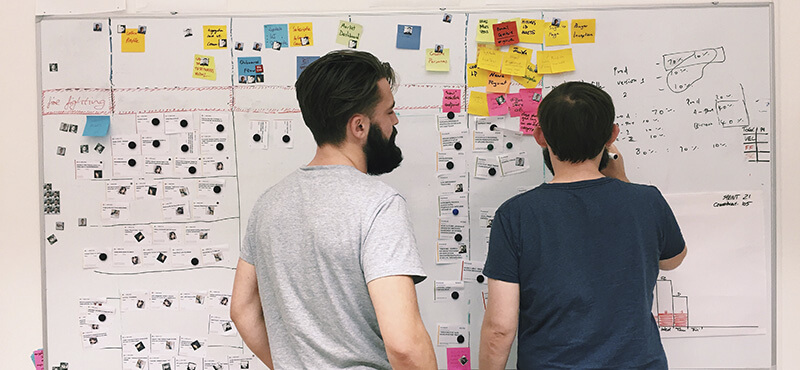
Everything looks beautiful in theory, but what about in practice? To make your team more agile and with a better structured process, it is first necessary to understand that each team and company will have a different solution. That is, there is no right or wrong, but an organized method to meet YOUR needs and help you achieve YOUR goals. This is our model for implementing an agile process for a marketing area, in this case. It’s not necessarily what will work for you, but it can already serve as a basis and help you discover your ideal format.
Foto de um modelo de Processo Ágil Organizado usado em uma área de Marketing
Photo of a model used in a Marketing area
To help you in this process, we selected the main points of an agile process implementation:
Set goals clearly 
It’s no use wanting to use new work concepts within a team if it doesn’t have a clear vision of the purpose of the initiatives. OKR techniques are ideal for defining objectives and key results to achieve goals  and get clear on what is happening in your day-to-day work. “If you don’t know where to go, your team will probably always be losing.”
Structuring the to-do list 
When we define the project or product vision, we start a backlog structuring, that is, we create an ordered list of tasks to be performed to achieve a certain goal. We used several dynamics and techniques to select these items (Design Sprint, Lean Inception, etc) and so created the Product Backlog. Next, it is very important to make the correct prioritization and ordering of this backlog, starting the work with the most important tasks, or those that have more dependency, identifying and removing the impediments, etc.
Starting Sprints
After refining the items and defining the Sprint Backlog we started working on the Sprints – which are constant cycles with pre-defined periods to develop the deliverables. In this example of the marketing campaign, as the team was very volatile, we did one-week Sprints, because in addition to the still uncertain scenario, everything was adaptation and people were being trained and working in this new format, to Same time.
Quadro Kanban para gestão visual em um time ágil em uma área de Marketing
In this first cycle, the team must work focused on the Sprint Goal (goal for that period) and, at the end of each Sprint, we call a series of stakeholders to talk about the deliverables, the results, have the moment of feedbacks and adjust any item for the next work cycle. It is noteworthy here that transparency and visual management are essential in this new work format. We use several techniques and concepts from Scrum, Kanban, Management 3.0, among others.
Enter a continuous improvement process
At the end of this new work cycle, stop and think: if we could go back in the past and do it all over again, would we do everything the same? Or would we have done something different? In this retrospectiva, it is possible to identify and select a point of improvement, and have a plan of action to work on it, along with the other backlog items, in the next Sprint … Thus initiating a process of continuous improvement.
Train people
One of the most important phases of implementing agile methodologies is acculturation. This is the moment when people go through a series of trainings, aiming not only to learn new concepts, but to really change the paradigm and reach the goals. We apply several official trainings (with certification) to raise people’s level of knowledge and practical experience.
Have metrics and data 
This new work format is useless if it is not possible to measure! Have data and metrics, both result (outcome) and task (output) metrics. They serve to understand how this initiative is being positive or needs adjustments. It’s these indicators that help guide the team to be better every Sprint! Remembering that, if you don’t have the right people to help you, this whole initiative to have an agile, more organized and structured process may fail. If you still have any questions about this transformation, speak with one of our consultantsif you request a diagnosis to find out if the methodologies Agile will work for your team.
Want your team to work in a more agile and structured way?
 
by Agile.Inc Agile.Inc No Comments

Agile Methods: How to have a more efficient and agile team as a whole

Understand how agile methods can help different areas and teams to have more productivity and organization

In 90% of cases, the answer is YES. When we talked a little more with these people, we mentioned some common situations in teams that need to be more agile. Some of these issues are:
  • Lots of external interference
  • Things that prevent you from delivering your tasks, and that would often need leadership help
  • Priority changes – sometimes you get lost not knowing what the next priority is
  • Little visibility of what is happening in the organization
  • Poor visibility of peers – sometimes some are quite overloaded, and others not so much
  • A lot of uncertainties about what the real purpose of the project is, like knowing if what I’m doing is really generating value
  • Productivity and delivery issues
  • Sometimes bureaucratic processes
And, sometimes, we even ask the leadership, in addition to the characteristics in the list above, if they have any of these problems:
  • Low visibility and team transparency;
  • Difficulty of organizing between teams;
  • Difficulty in having dates and deadlines;
  • Complex structure to lead;
  • Problems for decision making;
Basically, if any of these points above are present in your team’s day-to-day, whatever your area, our answer will be: “YES, agile methods can help you increase control and productivity” . People often spend too much time on things that don’t generate real value, neither for their deliverables nor for the organization as a whole. As a result, a very large loss of productivity is generated!

It is as if an area or a certain team were a machine, which is not being efficient and is causing various wastes…</p >

How to use Agile methods to be more efficient in any area?

Being agile is not just going through a process to be more efficient and have more results. It is going through a paradigm shift, of mindset, using not only agile methods, but several tools and techniques that make this process a true Agile Transformation. Essentially, we use the concepts of Scrum, Kanban, Management 3.0 and OKRs to define roles and responsibilities, events and details of this team’s new work processes. The principles and characteristics of a truly agile team are:
  • People who have information transparency, with a lot of visual management, escalating problems quickly;
  • Teams with clear and engaged goals, working in SQUADs;
  • customer centric product view, mapped to a single backlog;
  • Have important visible metrics;
  • They can solve complex problems;
  • They deliver in short cycles (they are iterative and incremental);
  • Promote continuous improvement;
  • Quickly identify and remove impediments.

How we apply it in practice

To help you better visualize this process of change, here are some examples of Agile Transformation in different areas:
Legal Area
A team of a project formed by specialists from the Financial, Logistics, Accountants and Lawyers area, had the challenge of changing the structure of production of consumer goods, with the goal of having fiscal gains reaching millions per year. Several months passed and this problem was not resolved. With a mini Lean Inception, they created the backlog, set up the Squad and, with visual management and indicators, started running the Sprints . In a short time, problems and impediments appeared and were escalated to the board. Little by little, the situations were resolved, focusing on the objective of that indictment and the benefits began to be achieved.
Marketing Area
Some teams in a marketing area wanted to have more control over demands and processes. With some agility concepts applied – and also agile scaled – a governance process was created, in addition to helping the teams deliver in the operation. Quickly, teams entered a stream of continuous improvement, until they reached the ideal process to really be more efficient and agile as a whole.
Human Resources Area
An HR department needed to make its deliveries more agile, but with more value to the organization. For this, the journey of employees was mapped – since when they entered the company; when they had doubts; when they use the month-to-month process and when they leave the company. For each part of this user journey – in this case, the collaborator, a Squad was assembled, with a backlog, using Kanban, working with < em>Sprints and OKRs. Week by week, the employee’s journey was improved, aiming at achieving the area’s objectives.
Company-wide training
In this case, the concepts mentioned above need to be applied to the entire company, but not in their entirety. This means that, many times, an organization will not have Squads, Sprints, etc., in every organization, but many of these practices and the paradigm shift are the main points that will help in productivity as a whole. . For this, training such as Agil Beyond IT is made for the entire company. Each employee will identify what can or cannot be applied – flow visualization techniques, mapping of impediments, daily meetings, sprints, among other topics. It is worth mentioning here that, by empowering your team, it becomes more productive! We hope that you really can make your team, your area or your company more agile and more efficient with these tips.
https://youtu.be/ucNoN-zL4oA
Read too:
https://old.agile.whit.digital/a-agility-works-for-areas-like-marketing-rh-legal-or-operation/
by Agile.Inc Agile.Inc No Comments

Do SQUADs really work for organizing teams?

Understand how these multidisciplinary teams help a company to deliver more 

By Antonio Costa< /h6> We visit several areas and companies throughout our consulting process, whether in the product development, programming, human resources, financial, sales, business area, among others, and a very common question is: Does the SQUAD format really work for organizing teams? If it works, is the way we’re doing it really effective? Is it possible to improve something? Basically, SQUADs are an organizational structure of people of different abilities, who have a very clear objective: to have more value delivery. Different from the Traditional model, SQUADS are multidisciplinary teams, with fewer silos, less hierarchy, more autonomy, focused on their principles and objectives, that work to solve a problem or challenge within an organization. Spotify created this model to solve a challenge they had in the time and, as it became popular, many people began to copy this format of organizing people. And so it became a herd, gained a giant proportion, many began to organize themselves in SQUADS, but without the slightest notion of Agility, of Product development, believing that having SQUADs already made them agile companies. As there is no body that determines and regulates this issue, in this text, we will address this issue based on our experience on this issue.

The pillars for good SQUADs

But, in fact, what is the purpose behind them? As mentioned above, SQUADs are focused on maximizing the delivery of value, and for that, they are anchored by four pillars:
– Multidisciplinary team
They are made up of people with different abilities who, together, have the mission of solving problems in a certain area of ​​the company or challenges in product development.
– Autonomy
Within a SQUAD, people have autonomy to say how they solve a given problem. It is very common to see teams in which the members only perform various actions that the boss determines. If there is still an external command with a lot of control, you are hurting this principle of autonomy inside a SQUAD. The idea is to bring people of different abilities together in a team, making it as productive and creative as possible, giving autonomy to these people to solve a problem.
– Clear objective
None of this works if the goals are not clear! That’s right. It is necessary to have the purpose of this initiative very explicit: “which problem must be solved?”.
– Restrictions
These limits should be created so that people can do what they want, as long as they don’t violate any of these restrictions. Some common restrictions are: setting a time to create and develop that product; or amount of money; or even a restriction that does not violate the organization’s principles.
Also read: The 5 dysfunctions of a team and how to avoid them to have more engaged people< /a>

In summary…

The SQUAD concept comes from squad, platoon – just like in a war room – you assemble a squad, in which “mission given is mission accomplished”. In other words, a SQUAD on the first day of work is practically a “war room”: you bring people of different abilities together, with a very clear purpose, give some restand they work to solve that problem.

But can you scale this format to every organization?

Yes! The Spotify model suggests several ways to solve a very complex problem, with several SQUADS, through other structures such as tribes, chapters and guilds. .. But that yields another article! If you want to know more about how this scaling part of the Spotify model works, leave your suggestion here in the comments that we can say yes about it! In addition to all the scaling techniques, Spotify’s SQUAD model also has a series of principles such as:
  • Waste aversion – where they continually seek improvement points to avoid wasting time or money;
  • 100% predictability equals zero percent innovation – that is, if you want to do something really innovative, you can’t be totally predictable… You have to allow people to fail, or failure to be better viewed , as long as it stops in search of solving that particular problem;
  • Among other principles…
If you want to know more about the principles, leave your suggestion here in the comments and we can talk about it too!

Don’t try to fit into a template!

The big message I want to leave to finish this text is from an error I saw in a company and that I should bring here to exemplify something you should not do:  just change the name from “team” to “squad” and do not incorporate really the principles that the model has. Aren’t you also trying to fit your area or business into a box, in a ready-made format? Do not copy Spotify! Understand the principles, purposes and learn with him to create YOUR MODEL, the one that best matches your reality. Spotify itself would not use this model today, as they learned with this format, used various techniques such as Scrum, Kanban and were adapting it to use it in the way that fits best today, always focusing on the goal of develop good products, efficiently and effectiveness. You want to achieve these results, like Spotify, be more digital and deliver more value to your organization, but you don’t know where to start, we help you!
Read more:
https://old.agile.whit.digital/7-major-erros-em-um-process-de-transformacao-agil/
Watch:
https://youtu.be/-GPItbQKp8M
by Agile.Inc Agile.Inc No Comments

7 Biggest Mistakes in an Agile Transformation Process

Understand how these failures are hindering your company’s results during the Agile Transformation process

By Antonio Costa
Many companies want to make the agile transformation so that they can better organize their teams, in order to deliver more value and ensure more competitive advantage for the organization. However, throughout this movement of change, as we went through several companies with our consulting or assembles squads, we have identified some very common behaviors. And we’ve resolved to bundle these top mistakes during an agile transformation, which are holding companies back from achieving results and getting the most benefit out of this process. Check out:

No short deliveries

Both in the transformation process (we perform the Agile Transformation process, in an Agile / incremental way – click here and learn more), as well as in the day-to-day of the teams that work in the development of the Product, it is essential to have short films delivered in order to be really agile. It is these deliveries, made with correct slicing and prioritization, that promote the inspection and adaptation mechanism – one of the main pillars of agility.

Think only about process and forget about Engineering

Another typical mistake we see within companies undergoing an agile transformation is to focus too much on the process and leave software engineering behind. To extract the maximum benefits from this journey of change, you need to pay attention to the quality of your engineering. One of the items of the Agile Manifesto is precisely having a good software architecture and an adequate design to enable teams to have more shorter deliveries that can make Agility concepts be well used within the teams routine.

Do the mechanic and think it’s okay

Another failure that happens a lot is to think that the concepts and pillars of the Agile or Digital Transformation are just more processes and not giving the correct depth they have. It is not possible to have a traditional mindset (waterfall), using only some techniques or mechanical processes of the agile frameworks and achieving the estimated results. It takes a real mindset change! Do you really want to change your organization’s mindset and have more engaged teams with more productivity? Click here and schedule a conversation with us.

Climbing too early

Still talking about depth, if you haven’t managed to make this transformation in a small cell within your company yet, don’t start scaling this initiative to the entire organization. This process of transformation, whether agile or digital, is based on a cultural change, a turning point in people’s thinking… And this change calls for the correct training to be carried out, the breaking of ties that exist in the daily lives of teams – that make them not have the necessary performance, among other characteristics, which take time to be modified. So it’s important to know the right time to start climbing!

Don’t measure and learn during transformation

The fifth mistake we most identify in companies during the agile transformation is not measuring and not learning along this process. Deliveries are being short, software engineering is getting the right attention, you’re putting agile principles into practice in the right way, you’re scaling at the right time, but do you have indicators for all of this? You need to be data driven and use the data to measure theWhat’s happening. This will help you know if you are really delivering more value to the organization with these initiatives. Is the teams’ productivity higher? Is the number of impediments decreasing? Is lead time decreasing? Are users and customers satisfied with the product? These are some questions that need answers, data and analysis to help you measure and learn from this transformation process.

Low product and customer focus

When we talk about agile transformation, we have three main pillars: processes and/or management, engineering and product/customer. When you don’t focus properly on the product and the customer, you don’t have, for example, prioritization techniques and you don’t know what is really value and what is success for a project. You can work with any method, but if you don’t give proper attention to the product and its user, you are probably generating a lot of waste in developing this business. Read more: You seem agile, but not focused on the Customer? You’re probably losing the game!

Finding that Agile is an end and not a means

The seventh mistake we see most in agile transformation processes practically consolidates all the previous failures, which is to think that Agile is an end and not a means. This is very common! During our consultations, we hear a lot of people say that they want to be more agile, they want to implement the Spotify model, etc… But what organizations should want is not these formats, but:
  • Get more results
  • Doing more with less
  • Increase Efficiency and Effectiveness
  • Competitive advantage
  • Making the technology area a protagonist within the organization
  • Delivering more value to the business
And, to achieve the above goals, Agility comes as a means! If for this you need to use other principles and concepts other than Agile, that’s fine. The important thing in this transformation initiative is to achieve the goals, that’s the end. If you have identified some of these errors in your daily life and want to correct them, contact us. We can make this diagnosis in your company and help you to have more results!
https://old.agile.whit.digital/por-que-os-processes-ageis-no-are-helping-in-digital-transformation/
by Thiago Fregni Thiago Fregni No Comments

Does agility work for areas such as Marketing, HR, Legal or Operations?

Understand how it is possible to have more productivity and effective deliveries in any area of ​​your company and make them more agile

Can I apply agility in any area of ​​the company? The answer is YES, but it depends on a few points. Being agile today is no longer a feature of IT or Digital Products. Large organizations have several projects in all departments, which seek: – Anticipation of the RoI – Innovate more – Improve existing processes – Better meet the needs and objectives of the area Projects today are surrounded by complexity and we can’t predict in advance everything we need to do to achieve our goals, nor how to make teams produce and communicate more.
Teams end up having different problems like:
  • Lots of external interference
  • Priority changes
  • Low visibility and transparencies
  • Many uncertainties regarding customer needs
The problem is not often with the professional – you have good people who work a lot (sometimes not so much), but, in the end, there is the feeling that something is stuck and that they have not been able to deliver what is necessary for the company.< /p> Traditional management models through focused micromanagement people efficiency/productivity increasingly demand more and the results go nowhere. In addition to the financial losses, this scenario directly impacts the team’s productivity and morale and this generates frustration for everyone involved.

Have you ever found yourself in this situation? If so, stay calm. There is indeed a light at the end of the tunnel.

We can rely on the scientific method for this and promote agility in any area of ​​the company. By using an empirical process, we are able, through short cycles, to validate a hypothesis, learn from the feedbacks and adapt the plan if necessary.
See how Agility was adopted at Roche
When we talk about agility in any area of ​​the company, we are actually talking about organizations that learn! The first step is to provide transparency! We make it very clear:
  • which are objectives;
  • the flaws;
  • the action plan;
  • the next deliverables.
With transparency, we start short inspection and adaptation cycles. This builds trust among all involved and paves the way for continuous improvement.

We often have a very good team, but without the tools to deliver more.

Agility provides the tools to support these teams to shine. Problems increasingly become visible and actions are taken to improve this.

In many cases we have problems with lack of focus, each person on the team has different goals, and in periods of close cycle each one starts looking exclusively at their goal and leaves the team in the background. Through the Transparency, Inspection and Adaptation cycles we are able to understand what is happening and make the necessary adaptations Often the organization itself creates these barriers that prevent the team from focusing on generating value. On one of the projects I went through one of the directors said: “No one in this company imagined we could do all of this in three months!” In this case it was a CRM initiative, no there were software developers, in the mamost were people from business areas such as marketing and sales. The team had to learn to say no, we helped them set a clear, short-term goal and the whole team worked focused on that goal. And you know the coolest thing about all this? The team worked at a sustainable pace, without the need for overtime. Want to understand more about how this process works and how we can help you become an agile organization? Click here and get in touch! We would be delighted to share more details in a chat. A hug!
Click here and see how we can help you to be more agile! READ ALSO:
https://old.agile.whit.digital/o-que-de-fato-e-a-transformacao-digital/
 
by Agile.Inc Agile.Inc No Comments

Do you know the difference between Traditional QA and Agile QA?

Understand how the role of the Test Analyst or QA is decisive for the quality of digital products

By Rodrigo Matola
The way we develop products is constantly changing. Currently, companies around the world are adopting agile product development, using some of its frameworks (Scrum, Kanban, Lean…). This new way of working affects all traditional roles, including Test Analysts, or QA (Quality Assurance). In this article, we’ll talk in a basic way about the differences between traditional QAs and Agile QAs, as well as a brief concept about agility and the Scrum framework.

Traditional context vs. Agile context

In a traditional context, project steps are planned in advance, before the start. The scope is defined and cannot be changed once development has started. Any change requires an approval and a new contract between the parties. The delivery date is also defined. Moving from one stage to the next requires inspection and approval. This context is also called a waterfall (waterfall), and generally follows the model in the figure below:
In the agile model, the software is delivered in small pieces, usually already functional, within a period that varies from one week to one month, in the case of Scrum framework. With these small functional increments, you can quickly adapt to changes. Being agile is not being fast, but being adaptive!

Traditional QA

Based on the figure above, we see that testing only happens in the fourth stage of the project. At this stage, the software is practically ready. Generally, in the traditional context, QAs do not have direct contact with developers. In this situation, QAs practically hunt bugs, sometimes the number of bugs found being a measure of performance. Under these circumstances, only QAs are responsible for the quality of the product. It is they  who ensure that the requirements have been met correctly. Any error in the software, or non-compliance with the requirements, is the sole responsibility of the QA person.

The Testing Manifest

The Agile Manifesto was created by a group of people who wanted to change the way software was developed. A few years later, following in the footsteps of the Agile Manifesto, the Testing Manifesto was created :
  • Test through all steps MORE test at the end;
  • Prevent bugs MORE find bugs;
  • Test understanding MORE THAN check functionality;
  • Build the best system MORE THAN break the system;
  • Team responsible for quality MORE THAN QAs sole responsibility.

Agile QA

Taking the Test Manifestos as a reference, we will describe here a little bit of how Agile QAs should behave. As in the Agile Manifesto, the item on the left is more valued than the item on the right – it’s not a replacement, you’ll keep doing what’s on the right, however, you’ll prioritize the left (not to be confused with politics ok!?) . Therefore, Agile QA must:

Test through all steps [more than] test at the end

Testing should start at the planning meeting. Based on the defined acceptance criteria, it is already possible to think about the test cases/scenarios that will be carried out. If the team already has a test-oriented mindset and performs TDD, BDD or another technique, it’s time to combine the division of tests (application of the pyramid or another strategy); define what is worth being automated; how will the continuous integration be, etc. It is also recommended that QAs do code review and pair programming. Many bugs and inconsistencies can be caught during development just by looking at the code, which leads to the next topic…

Preventing bugs [more than] finding bugs

With testing being done during development, the chance of a bug going into production is much smaller. At this stage the bug fix can be immediate, as the development team is working on the functionality. Depending on knowledge, the moment the bug is discovered, the QA person can fix it himself.

Test understanding [more than] checking functionality

Quality goes beyond verifying that the software works as described. This can be done by a robot. Quality also encompasses understanding the user’s need and ensuring that the need is really what the user needs. For this, the user must also participate together with the team in the development, as much as possible.

Build the best system [more than] break the system

As part of a team, pinpointing bugs and finding ways to break the system goes against the goal of delivering the best software possible. We have to keep in mind that flawless software does not always mean quality software. The best system is the one that solves the pains of its users. Work for it.
Also read: What really is Digital Transformation?</ h5>

Team responsible for quality [more than] QAs sole responsibility

Placing quality responsibility on just one person or area is to exempt other people involved in the process from any problems that will be identified. Everyone who takes part, directly or indirectly, in developing a solution must be responsible for delivering the best possible within their role. QAs may not be developers in the sense of being the person who codes the application, but they develop tests and are part of the development team. Everyone who contributes to product development, including designers/UX, is a developer and must be responsible for the quality of what will be delivered.

Working together

As the team is responsible for quality, QAs must be present at all stages of development, helping the team to deliver the best product. The figure below shows how, at each stage of the Sprint, QAs can contribute their own responsibilities and help team members.

Also, as part of the team:

  • help you find the right product;
  • collaborate to specify;
  • think of examples;
  • refine the specifications created by the team;
  • automate the specifications;
  • help maintain Continuous Integration;
  • help keep the Living Documentation up-to-date and accessible.

Traditional QAs vs. Agile QAs

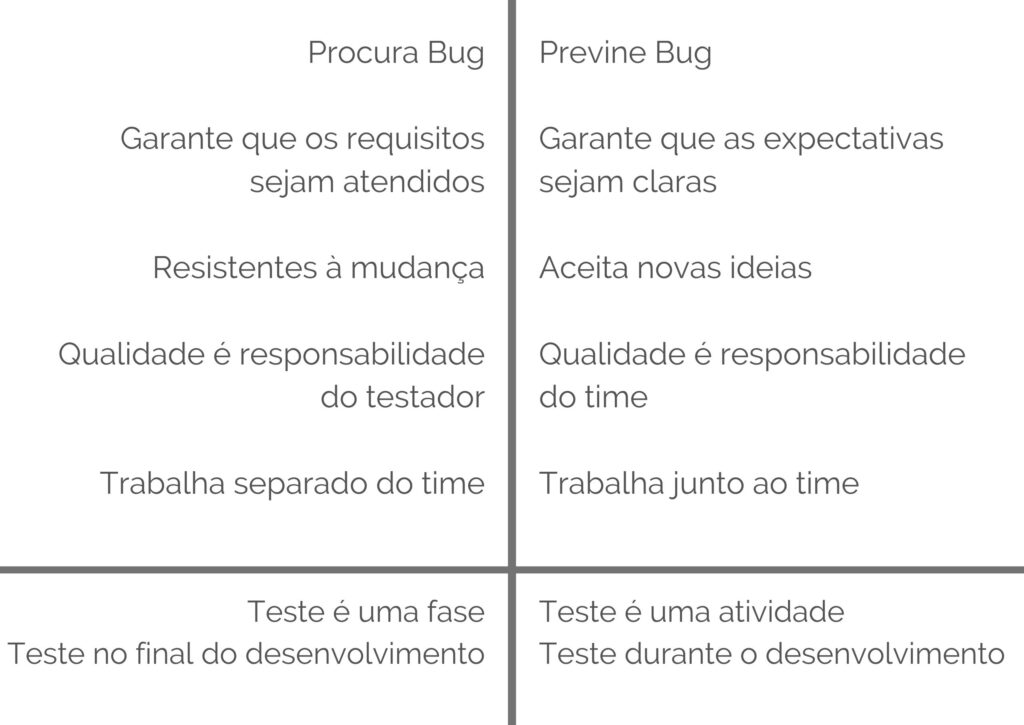
Summarizing in topics the differences between traditional QAs and Agile QAs are:

Also, Agile QAs:

  • they are always learning new skills and technologies, adapting to change;
  • practice clear and effective communication, collaborating with technical and non-technical people;
  • understand the business, defend the product and collaborate with the customer;
  • disseminate the culture of quality and take care of the team’s health;
  • promote and get feedback, having the courage to expose what is wrong and praising what is right;
  • keeps simple and self-organized, not depending on instructions to carry out its activities;
  • like what they do 🙂
Are you in the traditional or agile context? If in traditional, would you like to go to agile? If in agile, does it do what was described in the text or is it already beyond? Leave a comment here!
https://old.agile.whit.digital/por-que-os-processos-ageis-nao-estao-ajudando-na-transformacao-digital/
Top