During the day-to-day work, a team can present some dysfunctions, whether due to internal fights, mistrust, lack of commitment or even dispute of position. These problems are common, but they can become impediments for the team to act in an engaged way and with high performance.
But if you’re reading this text, you might be thinking: how to demand that a team composed of people with different backgrounds, personalities and motivations work together towards the same goal?
It was under this perspective that Patrick Lencioni wrote the book “The 5 Dysfunctions of a Team“, which brings a pyramidal model with these five dysfunctions: Lack of Trust, Fear of Conflict, Lack of Commitment, Lack of Liability and Lack of Result.
Trust
Lack of trust is the base of the pyramid of the 5 dysfunctions of a team. Without trust between members there is no way to sustain the other 4 dysfunctions. When a team is in formation, individuals protect themselves inside a shell so they don’t become vulnerable. They are unable to demonstrate their weaknesses and open up to each other. They are reluctant to ask for help or be willing to help each other. Lack of trust is a huge waste of energy and time for team members.
However, to have confidence it is necessary to break this shell and show your deficiencies, weaknesses, needs… Not every day is perfect and team members need to trust each other to expose and understand such situations. A good deal of empathy goes a long way toward building a solid foundation of trust. In addition, the team needs to have the necessary skills and trust that they are capable of solving a certain business problem.
Conflicts
Teams without trust are unable to face conflicts the way they need to be faced, causing a certain artificial harmony. Fear of conflict creates intrigue and thinly veiled discussions that are unhealthy when the team should be committed and focused toward a single purpose. After all, when it comes to the team, everyone wins and everyone loses. For this reason, conflicts must be faced head-on, with transparency and respect.
Commitment
When conflicts are faced head-on, the team starts to demand more internal commitment so that everyone can speak and be heard. It is necessary that team members are open to express their ideas and that everyone has respect for each other. However, not everything that is said will be accepted.
It is necessary to find a point where a decision is made so that everyone is in agreement, that the purpose is clear to everyone. In this way, everyone will be engaged and committed to the same goal.
No Liability
Teams that are not committed have no responsibility. Once the team is committed, it needs to be aware and not hide from its responsibilities. Responsibility is more about action than reaction, that is, in a responsible team, moving in the same direction, there should be no delegations.
Preferably, members should be auto-organized and proactive in creating solutions. A responsible team does not find the culprits, on the contrary, it seeks solutions together because they know that they are involved in the same objective and that success or failure depends on everyone.
Lack of Result
When individuals are not held accountable, team members naturally tend to pursue their own interests and not the interests of the team. However, when there is responsibilityity and commitment, conflicts are faced openly and trust is full, team members naturally focus their efforts in favor of results, thinking of the collective good at the expense of personal achievements.
Removing these flaws
In order for a team to reach high performance and deliver more and more, For better results, effectively and efficiently, you will naturally need to treat these 5 dysfunctions.
The benefits of this process for the team are:
Recognize your weaknesses and limitations and feel more comfortable asking for help;
Sharing skills;
Focus on problem solving, thinking collectively;
Make decisions faster;
Tackling critical issues head-on;
Always be aligned and focused on the same goal;
Increase people engagement.
Finally, understand that all dysfunctions are connected. The key is to start by building a solid foundation of trust and then encourage healthy conflict, maintain accountability, and set clear goals, ensuring the team communicates clearly at all times.
Need help on this subject? We have some essential tools for solving situations like these! Click here and get to know.
Initiatives resulted in a 315% growth in the app’s user base
CHALLENGE
In the Brazilian market for over 18 years, Sem Parar is one of the main payment services for tolls, parking lots, drive-thruses, gas stations and other accredited establishments.
The company, which is part of the FLEETCOR group (an American multinational with operations in North America, Latin America, Europe, Australia and New Zealand), had a great challenge: to develop products faster and adding more value to the end user.
SOLUTIONS
For this, we set up a multidisciplinary team to transform the way these deliveries were made.
An agile cell was created with the objective of changing the entire process, from creation, through development, to final delivery, promoting deliveries that generate more added value to the business.
Our role was to create a new way to make these deliveries, developing a different process.
We generate a proximity between the teams, always aiming at the demands and needs of the user (user centric);
Among the various initiatives, we highlight the reformulation of the company’s application, which was re-launched with the brand’s new visual identity – much more modern and focused on its consumer.
For this, a survey was conducted with 600 customers, identifying the main pains of users in the app. Giving more prominence to the most used functions, according to the data in this study.
RESULT
With the application of the knowledge acquired in a new interface that is more current, friendly and intuitive for users, the result was a growth of 315% in the Sem Parar app user base.
Obtaining results above expectations, the digital transformation has infected the company, causing an impact on the organization’s culture – which seeks continuous changes. As such, one-off initiatives in the technology areas are expanding to the entire company, such as the tactical and strategic layer, for example, creating an official agile treadmill.
400 trained and certified employees and monitoring of 28 agile projects
CHALLENGE
In early 2018, the Roche </strong >- one of the world’s leading pharmaceutical companies, globally launched a guideline in which all its IT teams should start working on the agile model by the middle of that year. At the same time, they released a guideline of all the practices teams should follow.
However, in the pharmaceutical division of Roche in Brazil – the sixth largest affiliate of the group in the world, there was resistance on two main points: the practices were not completely in line with the Brazilian reality and there was a lack of actions to make the transition between the traditional model and the framework < em>Agile.
SOLUTIONS
Together with the Human Resources department, we identified the need to certify professionals in the roles of Product Owner, Scrum Master and Agilista, in addition to Management 3.0 for leaders.
For this, we ran small interviews to define a model that would help them achieve the goals. And we came to the conclusion that the plan would be:
Run dynamics with managers and directors to determine priority projects and teams to change models;
Perform customized training to give these teams technical capacity to perform the work in the agile model;
Follow these teams, in the hands-on model, in person in their routines.
RESULTS
The “Roche way” of adopting Agile in practice was born;
Creating easy routines for hiring training and certifications;
Greater engagement of teams in the new work model;
Independence of the organization to create its own teams.
Every week I visit different companies and I have been closely following two “fashionable” themes that have somehow become interdependent: agility and digital transformation. It is clear that many companies are failing to understand agility, and this in turn is contributing little to the digital transformation, so relevant in the current scenario. This is because some did not understand that “Agile” does not mean a new process, but rather a cultural change, a paradigm shift…
Basically, at the beginning of the last century, more efficient production lines were needed. And Taylor was a great revolutionary for his time, implementing ideas like:
Separation between thinkers and doers. Phrases like “I have you for your strength and mechanical ability. We have other men paid for thinking” (“I have you for your strength and mechanical ability. We have other men paid to think”), were part of their concepts;
Each worker was busy solving a small portion of the problem;
There was no need for creativity or judgment, just discipline to follow rules;
What made each person a resource, replaceable, and often automated (exchanged by machines);
The solution for the user was already pre-conceived from the beginning, just being efficient in the execution of the process;
For greater worker productivity, give more money, bonuses and benefits – this is your main motivation;
Command and control structure was used to manage. In other words, if everything is under control, it is the best model of leadership;
Large prescriptive and prescriptive planning;
Among other points.
Now read the above text again, but looking at the digital product development context. Are all these topics not being applied today, but to solve a different problem?
It so happens that we are currently in a scenario of the fourth industrial revolution, which is the Digital Revolution. The advancement of technology has given us a new universe, new rules in society and business, innovations that are merging the physical and virtual world, changing all the time areas such as:
– The way people relate and live is changing;
– New businesses are being created;
– There is more and more global connectivity, that is, something happens in a part of the planet, you have the information almost instantaneous through your cell phone;
– People of the digital generation are no longer satisfied with any product/solution.
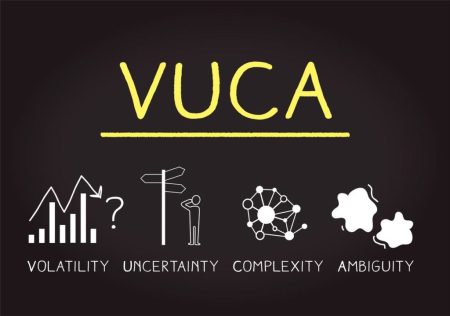
This makes the world more complex by creating an environment called VUCA – acronym for: Volatility (Volatile), Uncertainty (Uncertain), < em>Complexity and Ambiguity, (Ambiguous). As some say, “this is the new normal”. For example, a digital company (Airbnb, Uber, among others) achieving high market values, displacing giants and big players of the past is an effect of this VUCA world.
Basically, companies that try to solve the current problems of the VUCA world with the Taylorist approach, even if using an “Agile garb”, will fail. And, in this race for digital transformation, that’s what many are doing: just wearing the agile outfit, but with the same mindset as before, without a cultural shift, without a paradigm shift.
It is important to note that Frederick Winslow Taylor created Scientific Management in 1882 – he was revolutionary for the era. What we questioned is using these same concepts that were beneficial for that era, in creating today’s complex, digital products. This is like using the wrong tool, the old hammer metaphor to tighten a screw.
Traditional vs. Agile Thinking
In an approach where the “Traditional” (Taylorist) thinking prevails in the creation of products and services, but which is “said Agile”, problems usually occur such as:
The success of a project is to solve the defined scope, within the stipulated time and without breaking the budget. Even if the customer does not buy the product, the project was a success;
People who are developing the project are light years disconnected from the client and the service to be provided to that user;
Often, these companies end up just being a “software factory” (factory = taylorista);
People’s motivations and engagement are done with remuneration or dismissal;
Complex problems are solved with more planning. That is, it increases the prescription;
The team is Agile but management is imposed, it needs someone in charge.
In an Agile approach, the mindset establishes a product vision, a delivery value vision:
Customer-related business objectives are often defined in hypotheses, and as little as possible is tried to validate them before scaling the solution;
Teams are created with high alignment and autonomy to solve complex problems;
The team’s success is to solve the problem with the smallest (or best) solution possible;
The company structure is customer centric and not just siled areas, running through agile processes;
Complex problems are solved with more experiments, which generate more learning (empiricism);
The best leadership style is the servant leader;
And this list is huge! The points above are just a few examples… In other words, many companies are running a process with Agile guise, but with the same Traditional mindset (Taylorist) as usual. This is so ingrained that many consultancies that think they are executing a digital transformation deploy agility in a very traditional way. They teach your company to establish personas, for example, but they don’t use this technique in their own business.
As much as adopting agile processes is an advance, even if mechanically, it is important to know that there is still a long way to go before the so-called digital transformation. Don’t settle for just a nimble outfit, look for the true mindset of agility to reap the full benefits of digital transformation.
If you are going through a digital transformation process and are seeing some of these situations going on, talk here with us! We will be happy to help.
Maturity, product vision and correct skills are three of some of the main failures that happen in this process of change and innovation of digital transformation
Digital Transformation is no longer an option and companies that have not yet started this process are lagging behind. However, in the race to change, some crucial mistakes happen, either for lack of objective or maturity, of strategy and business vision or even for lack of basic tools to structure this revolution.
Are we really ready for Digital Transformation?
This is a question that every company must ask itself first and foremost. We are living in a moment when everything is for yesterday and, as a result, some corporations do not dedicate enough time to understand what is really necessary when it comes to digital transformation. We see many people wanting ready-made solutions, such as a “cake recipe”, but the descriptive solution does not always meet the existing needs.
To know if you are really ready for the Digital Transformation, it is necessary to have a transparent purpose to go through this change, as it is a delicate moment, in which it will be necessary to involve all employees and have clear goals for everyone to follow to the same direction.
The lack of strategy alignment within a company can generate several failures, such as a lot of effort dedicated to tasks or initiatives that do not generate any value for the digital transformation; misunderstandings or unfounded discussions between business areas or product teams; in addition to disconnected deliveries or postponement thereof.
Does this product really solve the customer’s problem?
Before you invest in an idea it is extremely important that the purpose and value your product will generate for your customer is clear. In other words, what problem for your customer will this product solve? When a product does not have a defined purpose, any idea can be good, but with that the focus is lost and investments become losses.
One of the characteristics of this digital transformation is that the customer is really at the center, that is, the company must be customer centric and no longer stakeholder centric.< /p>
Knowing your user/customer, your competitors and having a defined goal for your product often avoids the above scenario. But, this depends a lot on the dedication to data analysis and research for you to really have autonomy over your product.
Another very common situation is when the strategy is linked to a personal objective – which may or may not be aligned with the company’s – in which the achievements are focused on delivering only functionalities, without knowing how useful they are for the customer. In this case, the focus is quantitative, leaving the qualitative aside and causing the product to lose quality and reliability for the customer. Most of the time, these goals are disconnected with the company’s strategy and the digital transformation.
Do we have the right people for this journey of transformation?
To make a big change within a company it is necessary that everyone is really involved with the goal of this transformation. People need to keep in mind why the company chose this initiative, what benefits will be generated, risks mitigated, etc. But unfortunately that’s not what happens. In some cases, the news reaches employees in a “distorted” way or as an order and then chaos reigns in the company. All kidding aside, but that’s almost it!
The lack of training and the knowledge needed to implement new initiatives can generate a lot of frustration, due to the time spent in this process and the delay in get the return on investment. As a result, the pressure on employees will increase in a way in which they will feel overwhelmed and demotivated, causing them to decrease their productivity or decide to quit.
Every change creates discomfort, as people will have to leave their status quo both to perform tasks in a different way and to seek knowledge.
At this moment, the company needs to encourage people and provide them with more training, showing how impactful and important the digital transformation process is, in addition to aligning and leveling the knowledge of everyone involved.
These are the three mistakes we usually find within a company undergoing digital transformation: the company is not ready and does not have the necessary foundation to start, not having the right product vision and not investing in the right people to start the process. By investing in these points as you begin your journey of change, we believe your chances of success will increase exponentially.
If you are going through a process of digital transformation and are seeing some of these situations going on, talk with us here</a >! We will be happy to help.
A hug!
How the Marista Group has incorporated a new culture of delivery and more adaptive and agile projects
CHALLENGE
Promoting a better world through Marist values in the areas of Health and Education since 1817, the Marist Group </strong >needed be more agile and adaptive in their engineering works and projects, together with HR, with more focus on customer value.
Some departments were already running some agile techniques, but in an isolated and not-so-incorporated way, culturally. There was no concrete basis between all the teams and a more refined culture was lacking.
SOLUTIONS
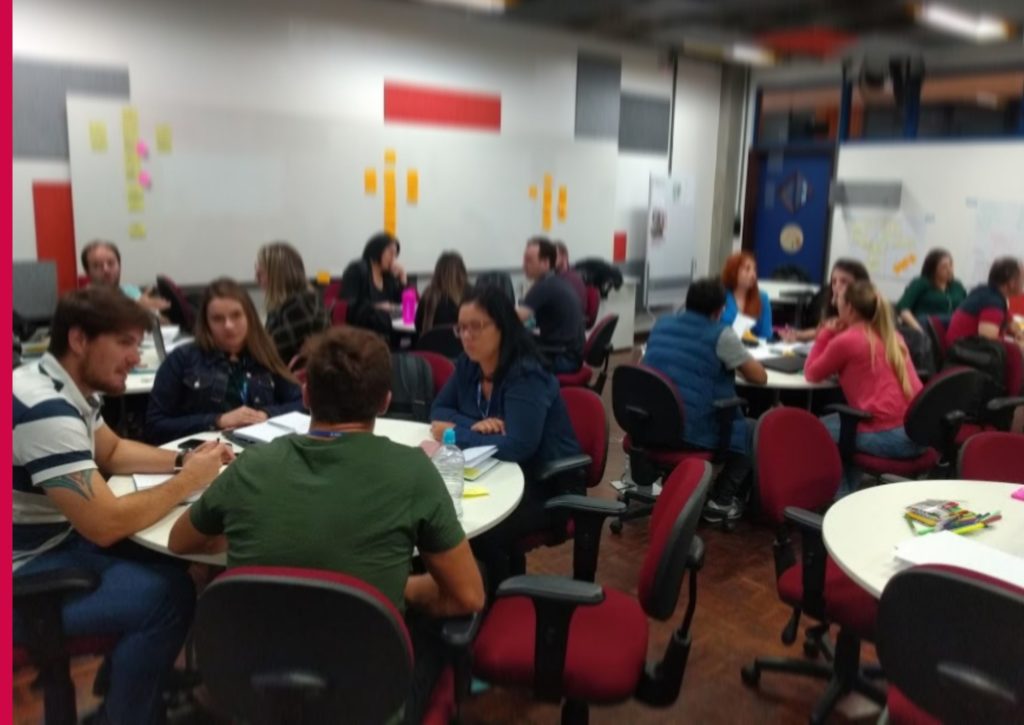
For this, we decided together with the organization that it was necessary to apply exclusive training, based on the company’s needs. The focus was to train corporate areas (coordinators of works and projects, engineers and HR) focusing on the effectiveness of the content for the day-to-day, and not aiming at certifications.
We made a previous alignment to adapt the training to the reality of the areas, through interviews with people from the organization, seeking to identify what would be the success criterion of the initiative;
We explain the methodology for leaders apply in their daily lives (pragmatically) to be more agile, adaptable to change, and generate more value for their customer;
Based on the interviews, we adapted the training “Agile – In addition to IT”;
</div >
The focus of the training was on passing on knowledge and jointly creating real scenarios, during the class, so that the team could incorporate the model well.
RESULTS
We applied the training “Agile – Beyond IT” in two days of the course, for 25 leaders;
NPS form, with the question: How much training will help you apply agile concepts in a practical way, in your daily life?Result 9.2 out of 10
Understand how to have more dynamism and less bureaucracy to launch your products faster and have exponential growths
I hear the question a lot from managers and business administrators: “How can I launch a product in a short time if my company is slow?” or “Is it possible for my organization to quickly launch a product and get ahead?”
Currently startups play a very different game than big or traditional companies. They have much more dynamism, less bureaucracy and, therefore, are able to launch a product in a short time, faster and have exponential growth, even threatening the big players.
Often the wish of the board is to have a project that already gives some kind of short-term feedback (maybe in 3 months for example), but the project will usually take from 1 year to 1 year and a half. You end up losing time-to-market and don’t get ahead. This even when you manage to launch a good product.
Companies even have great professionals, but they can’t play the game and launch the product good and fast. What happens?
Generally, the company is in a culture, a traditional status quo, and changing that is difficult and often time-consuming. Some signs of a traditional status quo:
Many projects in parallel, taking people’s focus away
Low transparency of what’s happening in the projects
Team used to the current status quo and want to make a product 100% perfect to cast, with absurd technical perfection
Fear of challenges. “What if something goes wrong on the way?” many think, and end up not even moving.
Some companies start the process of hiring people, but until they find it in the market, do the onboarding, and then start to change the < em>mindset of the team, it’s been a long time.
We talk to companies on a daily basis, how do we see that people are breaking these barriers and launching a product fast?
Basically we see two great models of success:
1) Create a separate cell within the organization.
This cell can be more or less coupled in the organization. – A more coupled cell can be like an area of innovation. – A less coupled cell ends up being a spin-off, sometimes even with another brand. In both cases it is vital to have professionals who can lead this team with agility. Having an Agile Coach who can help with tools and agile mindset can define the success or failure of the initiative. Otherwise, the team won’t do much different.
2) Hire an expert team, a SQUAD, who is already used to these challenges and solves this type of problem faster. It is important to choose the right supplier and merge the external team with some internal people, especially senior business and IT people.
In both cases, launching a product in little can range from a few months, up to 1 year. It all depends on how well you know the market. In projects with less knowledge of the market, in the beginning the team will be composed of more research people (Research). If the team already knows the market well, the launch ends up being in a shorter period of time. But regardless, it is essential to validate the hypothesis of the problem with potential customers, with MVP solutions. Only after that, make the product more robust and more scalable.
agile.inc is an expert in both cases, helping companies to launch better products that give them a competitive advantage in this complex market.