Every week I visit different companies and I have been closely following two “fashionable” themes that have somehow become interdependent: agility and digital transformation. It is clear that many companies are failing to understand agility, and this in turn is contributing little to the digital transformation, so relevant in the current scenario. This is because some did not understand that “Agile” does not mean a new process, but rather a cultural change, a paradigm shift…

But what is the paradigm shift?
I really like the way the partners of Scrum.org</a > describe such a paradigm shift, which consists of moving away from a Taylorist way of thinking, to a more results-focused approach, or a Agile way of thinking.</ p>
Taylorist Model
Basically, at the beginning of the last century, more efficient production lines were needed. And Taylor was a great revolutionary for his time, implementing ideas like:
- Separation between thinkers and doers. Phrases like “I have you for your strength and mechanical ability. We have other men paid for thinking” (“I have you for your strength and mechanical ability. We have other men paid to think”), were part of their concepts;
- Each worker was busy solving a small portion of the problem;
- There was no need for creativity or judgment, just discipline to follow rules;
- What made each person a resource, replaceable, and often automated (exchanged by machines);
- The solution for the user was already pre-conceived from the beginning, just being efficient in the execution of the process;
- For greater worker productivity, give more money, bonuses and benefits – this is your main motivation;
- Command and control structure was used to manage. In other words, if everything is under control, it is the best model of leadership;
- Large prescriptive and prescriptive planning;
- Among other points.
Now read the above text again, but looking at the digital product development context. Are all these topics not being applied today, but to solve a different problem?
It so happens that we are currently in a scenario of the fourth industrial revolution, which is the Digital Revolution. The advancement of technology has given us a new universe, new rules in society and business, innovations that are merging the physical and virtual world, changing all the time areas such as:
– The way people relate and live is changing;
– New businesses are being created;
– There is more and more global connectivity, that is, something happens in a part of the planet, you have the information almost instantaneous through your cell phone;
– People of the digital generation are no longer satisfied with any product/solution.
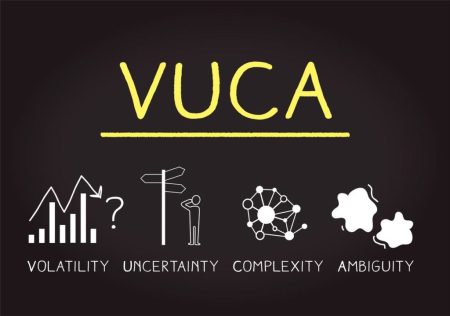
This makes the world more complex by creating an environment called VUCA – acronym for: Volatility (Volatile), Uncertainty (Uncertain), < em>Complexity and Ambiguity, (Ambiguous). As some say, “this is the new normal”. For example, a digital company (Airbnb, Uber, among others) achieving high market values, displacing giants and big players of the past is an effect of this VUCA world.
Basically, companies that try to solve the current problems of the VUCA world with the Taylorist approach, even if using an “Agile garb”, will fail. And, in this race for digital transformation, that’s what many are doing: just wearing the agile outfit, but with the same mindset as before, without a cultural shift, without a paradigm shift.
It is important to note that Frederick Winslow Taylor created Scientific Management in 1882 – he was revolutionary for the era. What we questioned is using these same concepts that were beneficial for that era, in creating today’s complex, digital products. This is like using the wrong tool, the old hammer metaphor to tighten a screw.
Traditional vs. Agile Thinking
In an approach where the “Traditional” (Taylorist) thinking prevails in the creation of products and services, but which is “said Agile”, problems usually occur such as:
- The success of a project is to solve the defined scope, within the stipulated time and without breaking the budget. Even if the customer does not buy the product, the project was a success;
- People who are developing the project are light years disconnected from the client and the service to be provided to that user;
- Often, these companies end up just being a “software factory” (factory = taylorista);
- People’s motivations and engagement are done with remuneration or dismissal;
- Complex problems are solved with more planning. That is, it increases the prescription;
- The team is Agile but management is imposed, it needs someone in charge.
In an Agile approach, the mindset establishes a product vision, a delivery value vision:
- Customer-related business objectives are often defined in hypotheses, and as little as possible is tried to validate them before scaling the solution;
- Teams are created with high alignment and autonomy to solve complex problems;
- The team’s success is to solve the problem with the smallest (or best) solution possible;
- The company structure is customer centric and not just siled areas, running through agile processes;
- Complex problems are solved with more experiments, which generate more learning (empiricism);
- The best leadership style is the servant leader;
And this list is huge! The points above are just a few examples… In other words, many companies are running a process with Agile guise, but with the same Traditional mindset (Taylorist) as usual. This is so ingrained that many consultancies that think they are executing a digital transformation deploy agility in a very traditional way. They teach your company to establish personas, for example, but they don’t use this technique in their own business.
As much as adopting agile processes is an advance, even if mechanically, it is important to know that there is still a long way to go before the so-called digital transformation. Don’t settle for just a nimble outfit, look for the true mindset of agility to reap the full benefits of digital transformation.
If you are going through a digital transformation process and are seeing some of these situations going on, talk here with us! We will be happy to help.