Digital Transformation

by Agile.Inc Agile.Inc No Comments

Customer Centric: The Importance of the User Experience in Retail

How user experience and customer focus help you truly satisfy the consumer in an increasingly volatile and uncertain era

If there is something that is constantly desired by any business these days it is to achieve customer satisfaction, whether in a product or service. And do you know what the real reason for this great dispute is? It is that a satisfied and happy customer, with a good shopping experience, is much more likely to become a loyal customer – and this is one of the most valuable types of consumers for any company, especially in the digital world.

Retail is no different! As mentioned in another post here on the blog, according to a study by the Brazilian Electronic Commerce Association (Abcomm), in this period of pandemic caused by Covid-19, 150 thousand new online sales channels were created, while the monthly average was 10 thousand . In other words, most potential customers throughout the retail are ready to buy in this format.

But as the use of social networks increases, with paid content and content appearing in different forms, a multitude of mobile applications, streaming for all tastes, how are you getting your customer’s attention and satisfaction? Is the experience you are providing for him positive? Has this journey been continuously improved?

If you don’t have answers to these questions or if these questions didn’t even cross your mind at some point, we’re sure this article will help you better understand this topic and rethink your future strategies.

The importance of being customer centric 

Before understanding what the term user experience is in practice, it is important to know what is customer centric and its impact on truly modern and digital businesses. The term customer centric (in free translation means customer at the center) is used to denominate the concept of putting the customer really at the center of all decisions and planning of a company/product. 

From the first moment a potential consumer has contact with the brand, through the different stages of the purchase journey, after-sales and even the way you use the product, all strategies for these processes are developed by putting the customer at the center of that plan. 

This way of thinking, which has been gaining more and more space with the digital transformation that companies have been undergoing, is directly related to user experience practices, which we will explain below. 

Also Read: You Look Agile But Not Customer Focused? You’re probably losing the game!

Practical user experience 

The term User Experience (UX), that is, User Experience is the real experience that the consumer has when having contact with a product and/or service. The objective of UX practices is to make businesses more attractive, intuitive and desirable, of course, always striving for efficiency, in order to make that user a customer, in the best possible way. 

This positive experience can be created in any user contact channels. On websites and mobile apps, for example, the focus is on making the navigation much more fluid so that the customer can quickly find the information they are looking for, without having difficulties in solving what they need in that particular channel. 

To ensure this journey focused on the customer and their needs, User Experience specialists work with functional and practical issues, but also with all the emotional side of the experience, thus promoting better results for a company, since the chances of conversion grow with these practices.

This planning, focused on the user experience, can also save effort and money, and increase your company’s profits. According to Robert Pressman’s book, “Software Engineering: A Professional Approach”, for every $1 spent in UX to solve a problem during product planning, $10.00 would be spent to solve the same problem in development and $100 or more for the issue to be resolved after the product was released.

In other words, in addition to avoiding problems, this user-focused planning can also direct and facilitate the path between the customer and your product. It’s also worth noting that a recent study by Forrester Research revealed that a well-designed user interface can increase a website’s conversion rate by up to 200%, and a good user experience can raise conversion rates by 400%.

How to make this transformation?

Being more digital and more agile is not just about being in a digitized environment and being ready to respond quickly to change. To be prepared for these constant changes, a company must, first, evolve its mentality and culture.

Okay, but what are the characteristics of organizations that are really customer centric and care about user and customer experience? These are:

  • Teams start solving situations by the customer’s need to define the best viable solution;
  • People know the journey of users and personas clearly;
  • Business and Information Technology areas, for example, work together daily in a collaborative way;
  • Deliveries are focused on actually creating value;
  • Similar experiences across all channels (omnichannel), whether digital or physical;
  • Teams work in short cycles to gather feedback from customers;
  • Data-based analytics;
  • Focus on the customer and also on their emotions;
  • Company goals focused on business or customer, that is, to generate value and not just goals for project delivery;

Get started now!

Finally, it is important to remember that any change in mindset is a long journey, but full of benefits for your company and your customers. Therefore, look for qualified specialists to co-create with you this map of the transformation of your business, to be more agile and digital in the right way.

See how we transformed the user experience of the Sem Parar app, one of the main payment services for tolls, parking, drive-thrus, gas stations and other accredited establishments, which had a 315% increase in the user base with our consultancy. Schedule a chat with one of our consultants and understand how we can help you get better results.

by Agile.Inc Agile.Inc No Comments

The future of retail is digital

The world is changing and it’s becoming more technological and digital. With this, it is already a fact that people are really adapting and adhering to new ways of consuming any type of product and/or service.

According to the Brazilian Electronic Commerce Association (Abcomm), between January and November 2020, online purchases grew 70.3% compared to 2019.

Invoicing reached R$115.32 billion, 69.6% more than the previous year.

And one of the leverage points of all this movement, caused especially by this period of pandemic (caused by Covid-19), was the closure of physical stores.

Companies had to adapt and migrate their businesses to e-commerces and those who were already selling online had to scale and expand their operations.

According to this Abcomm study, 150,000 new online sales channels were created in this pandemic period, while the monthly average was 10,000. In other words, these data indicate that the sector has undergone a major transformation.

Speaking of online commerce, if this was already a growing market, both the pandemic and the growing wave of digital transformation only accelerated this movement.

The invoicing buying and selling products online, grew 41% in 2020, with more than 194 million orders made by Brazilian consumers in the year.

According to data from the Webshoppers study (Ebit/Nielsen & Bexs Bank), this was the highest percentage increase since 2007 and sales totaled around R $87.4 billion in the period.

But if you are in this sector or have a business impacted by it, you must be asking yourself now: what’s next? What is the future of post pandemic retail?


Go digital or die!

That’s right! Regardless of what your retail business is, from fashion to supermarket, digitization is the thing!

During the first quarter of 2021, Neotrust data show that there was a continuity in the growth of online sales in Brazil.

According to the study published in Exame, digital retail had revenues of R$ 35.2 billion in the first quarter of 2021 – an increase of 72.2% over the same period of the year past.

This year alone, 78.5 million online purchases were made in the period (volume 57.4% higher than in 2020), with an average ticket of R$ 447.90, 9.4% higher than that registered in the same period of the previous year.

All this increase makes businesses increasingly digital and more secure, focused on consumer needs and with a more flexible and adaptable operating model.

And this goes far beyond adopting new and better technologies!

Being a digitized organization is using digital technologies to enhance business models . For example, new and more new service channels, services through mobile applications, updates that help to improve the relationship with the customer.

Already a process of digital transformation goes far beyond the adoption of the best technologies. It encompasses several practices, tools and, above all, a new organizational culture.

The change companies that want to have a competitive advantage today need to make is much more about people than technology. This process is guided by:

    • Customer-centric organizational changes;
    • Supported by a servant leadership;
    • Along with a new corporate culture;
    • By leveraging technologies that enable people’s autonomy.


In other words, if this whole process of digitization and digital culture is still not happening in your organization, you are losing money!


How to initiate these changes in practice

To be truly digital, it is important to understand that some pillars are the main ones to start this digital transformation process:


Culture

As mentioned before, it is very important that there is a change in the organization’s culture, as this is one of the main areas that show if a company is truly digital.

After all, it all boils down to a change of culture and mindset.

In this pillar, the main changes that we see in the day-to-day work here at Agile.Inc helping companies are:

  • Really put the customer at the center of your business;
  • Having a culture of applied innovation;
  • Empower teams, but with high alignment;
  • Create a culture of “not being afraid of failure” and
  • be more transparent in actions, decisions and plans 


Internal Capabilities

Your company teams need to start solving more complex issues, so they will need to have new skills and be able to follow the transformation.

It is important that the professionals in your organization:

  • Know how to work with new technologies (Big Data, Blockchain, Machine Learning, among others);
  • Have agility in product development,
  • Have a lean management in product design;
  • Make use of design strategically.


These are some of the skills professionals need to develop to be more digital, depending on the context of each business.

When it comes to buying and selling online, for example, there will be several other specific skills that are important to adopt.


Structure and Governance

How is your company organized? The way your company’s structure and governance is composed shows whether it is still in a traditional or digital paradigm.

To find this out, you need to raise some questions, such as:

  • How are the areas of the company structured?
  • How to break the organization’s silos?
  • How is the budget defined?
  • How are initiatives prioritized?
  • How is work tracking done transparently?
  • How to create greater operational efficiency, for example with automation?


These are just a few examples of issues that are addressed during this transition from companies that work in a traditional way, to those that are already suited for the digital age.

That’s why it’s important to have the right experts helping you in this process of change, pointing you to the best oneway of structuring your company to be more modern and technological.


People

Do all members of your teams know their roles and responsibilities? In an organization with a digital culture, it is important to have these issues resolved clearly, to have more engaged people.

  • Roles and responsibilities (noting that it’s no use just being defined, but must be followed and monitored in a natural way by everyone involved),
  • How are people motivated;
  • And which leadership model to apply.


Business Models

The fifth pillar that we believe is essential for a process of digital transformation is to think of new business models for these new forms of consumption – which are increasingly adaptable.

As we mentioned earlier in this text, the way people buy services and products is changing and companies need to adapt as quickly as possible.

Your business may already have some of these pillars already well developed, others less so…

For us at Agile.Inc, there is no rule of thumb as to which area needs to be worked on first, however, we strongly believe that some points are driving levers for a company’s transformation, such as :

  • Develop and empower leadership;
  • Develop and empower teams in a custom way;
  • Apply and implement Agility concepts to work more efficiently and effectively.


In closing, it is worth noting that the entire process of change, especially a digital transformation and the implementation of new technologies and/or a new way of working, is complex and full of uncertainties .

But it is in an environment like this where the best innovations emerge, with simple solutions that generate much more value for an organization and its customers.


Our final tip is to gather the best experts you can to help you with this digital transformation and we can help you with that! Talk to one of our consultants and understand how we help large Brazilian companies to modernize their businesses.

by Rodrigo Pinto Rodrigo Pinto No Comments

Design Thinking: How a Thinking Model Can Help Solve Problems

The search of companies for innovative solutions to complex and common problems in the day-to-day of modern business is enormous.

Therefore, most leaders and those responsible for taking certain types of decisions are formed by people who have creative, critical and quick thinking.

However, at some point the blockage arrives and the difficulty of solving problems increases more and more.

With this in mind, it is necessary to structure new working conditions and models to resolve these issues.

Among them, the Design Thinking process is essential for companies that need more innovation and competitive advantage.


What is Design Thinking?

Design Thinking is the name given to a process of critical and creative thinking that allows the organization of ideas that help in decision making.

It is important to make it clear that it is not a method to be followed, like a cake recipe, but rather a way of approach to better help with solutions.

This model can increase insights and how to apply them.

The main concept of Design Thinking is that the process is carried out in a collaborative and collective way, gathering as much information and perspectives as possible.

There are different moments and actions where companies apply Design Thinking, one of them is in solving problems independent of their size and magnitude.

Through different perspectives it is possible to have a bigger vision and a clearer solution.

Another common way to use this process is in the design and creation of new products and services.

With the participation of all areas of the organization, it is possible to add value to the items that are being created, increasing the chances of success.

Let’s make it clear that each case is different, the important thing is for the company to follow the process in the way that best suits its way of working, there is no correct formula to follow and implement Design Thinking, but there are some steps that can help you in this process.


The 4 Steps of Design Thinking

As we said before, there is no process to be faithfully followed for you to start applying Design Thinking in your company, however there are some steps that if you follow can facilitate the implementation and the results.


Immersion

This first step can be considered one of the most important because it is through it that you will go deeper into everything that happens within the company.

We suggest you carry out a SWOT analysis, which maps your business’ strengths and weaknesses, threats and opportunities, in addition to presenting an internal view referring to outside perspectives, ie, how people are seeing your business.

Thinking about having this perspective, always collect feedback from customers, employees, non-customers and prospects, delve into the company’s organizational policy.

With all this vision of your business, it will be possible to create more accurate solutions to the problems they used to face.

But don’t forget to NEVER forget to analyze behavioral scenarios in the region and in the country, this influences many aspects of the points you will analyze.


Ideation

After the immersion, you and your team will have already been able to see which points need urgent attention and change, which ones can stay longer in the future and which ones do not need to be moved.

By identifying this part, you are already able to start with the ideation that is nothing more than putting into practice the ideas you had regarding the conflicts identified in step 1.

When it comes to bringing out ideas, it is important to use techniques such as big data to increase the chances of success for ideas and reach the desired goal.


Prototyping

After joining ideas, it’s time for the team to get together and define which of these ideas can bring more results for the business.

For the main idea to have a good result, it is necessary to create prototypes and go on testing, so as the results delivered, it is possible to improve at each stage and in the delivery, there will be few or no flaws that will have to be adjusted.

If it is a service, your prototype can be something more visual and theoretical, such as graphics, images that represent the expected result of that service.


Development

The last step is the time to get everything off the paper, have done all the tests and put it into practice!

It is at this stage that you will launch your product or service and you will need to use all methods to draw the public’s attention to it, such as marketing actions, actions with existing customers, presenting to employees, and so on.

However, it is not because this stage has reached the end that the whole process has come to an end, quite the contrary, it is necessary to continue measuring and monitoring the performance of this new merchandise or service.


The benefits of investing in Design Thinking

We all know that a company evaluates its profits and investments through the return it gets for me. io of its sales, costs, and so on.

This is where Design Thinking comes in, as its implementation cost is extremely low and the result it brings to your business in the face of competition is enormous.

And this can actually be a differential for your company to put itself ahead of its main competitors, resulting in greater profit, a stronger brand.

In addition to benefits in terms of money and image in the market, design thinking manages to aggregate and engage employees from all areas and the result becomes very positive.

Because, employees will feel valued by the company and this motivates them to increasingly embrace the organization’s purpose, making the journey to the main objective even faster and more efficient.


What Design Thinking Provides for Your Company

Currently, this theme is widespread, especially among companies that have a product vision.

With this article, we now know what Design Thinking is and what it works for, but if you are still in doubt about how this process can help your company, it is worth highlighting some benefits:


Understanding customers: Design Thinking allows the business to be seen from the outside in, that is, the view of those who are being impacted from outside the company. With this, you can understand the types of customers you have and attract, in addition to being able to create a greater experience for them and deliver more value.


Understanding the business: Understanding the people inside the business/company is essential to map work processes and thus be able to understand what can or cannot be done and improved.


Co-create solutions: This is where it is possible to suggest process improvements along the company’s culture in collaboration with internal and external business teams.


3 tools that can be used in the Design Thinking process

To finish the topic, still talking about how to structure this Design Thinking process, it is important to define the tools that best suit the reality of each product to be used at this time:


Brainstorm

Brainstorming is a group dynamic that consists of sharing ideas and solutions to a problem the team is facing.

These are sessions without any kind of judgment of what is right or wrong, as the literal translation says “brainstorm”.


Mental Maps

Mind maps are very effective in organizing, developing ideas and thoughts. The goal is to make the whole creation process visibly, as clear as possible, and it can be very useful for new insights along this Design Thinking process;


Co-creation with Clients

It has become increasingly common for users and consumers to participate in the creative process of the project, whether it is a product or a service.

This is because you will have a view of your brand from the outside world of your business. In addition, your customers can bring great insights into the evolution of your project, as their vision is completely different from that formed by the organization’s stakeholders.


And if you still have difficulty finding the ideal model to improve the results of your business or digital product, make an appointment with us.

In a brief diagnosis, we help you draw up a concrete action plan to give you more results and a competitive advantage. Come and chat with us!

by Ivan Santos Ivan Santos No Comments

How is the Digital Transformation in retail

A lot has been said about digital transformation and many people don’t understand how the process is or if any company can go through this transformation.

The answer is quite simple, yes every company that believes in digital transformation can start to have good practices and start the digital process in their teams.

In retail it would be no different, even though it is a vast market, it is possible to improve your deliveries, work more quickly and even increase your company’s results with the digital transformation.

This article is based on an interview with Agile.Inc CEO, Ivan Santos for the “Varejo Vivo” YouTube channel. You can watch the full interview here


Is it correct to say that we live in the digital age?

Yes, absolutely. We have been living the Digital Era for a while and, with the pandemic, this only served to make us reflect more and more on the need for other optimization channels in the service companies have with their customers.

Nowadays we live in a very digital world, very different from what we lived in  about 10 years ago and we already knew that a big change was coming.


Why work with agility?

Agility is the new way of thinking, structuring and reflecting on how to improve your workflow. Thinking back when people used a lot of kanban, lean etc, it is doubtful that if with agility this would be thrown away. And the answer is no!

In today’s digital world, response time is much shorter than time to market, so you MUST improve your methodologies with the help of agile practices. Agility is the lever for companies to generate new value for their customers.

Agility will help you and take whatever practice you already use, understand the moment you are is and with agile practices you can deliver the best product to the most suitable audience.

For example, your company has just developed a product and it hasn’t had the expected effect on the audience, this is where agile practices and digital transformation will help you to achieve this see these challenges before launching any product or service


Agility x Efficiency 

I would say that Agility will bring a lot of efficiency and transparency to companies. There are traditional companies that invest in startups and are sure that they really know what is going on in the management of these companies.

And after putting the digital transformation project into practice, they were able to see, in a short time of execution, the transparency in all the work management that they didn’t have before and with that improve their strategies across all teams in the organization.

For traditional companies, transparency is usually much more hidden and when they start implementing agility, it is possible to clearly see how the company improves its processes and deliveries.

When we talk about agility, we talk about delivering value.

Often we feel that we are meeting the needs of our customers and we end up investing in something that at the moment should not be a priority. That’s why it’s more than important to collect Feedback, it’s essential so that the team can inspect and adapt for the team to move towards the organization’s objective.


How can Agile.Inc make the digital transformation in retail?

  • Consulting

 We help companies to be able to identify the main projects and how to execute them in an agile way to digitize their channels.


  • Make the delivery  4 hands:

When it comes to digital transformation, we have a multidisciplinary team that works directly with the client to create a new channel, product or service.


  • Awareness

Understand where the company is and help with mindset changes and improve together with the customers products and services with better quality. potential results.


Besides e-commerce, how to understand digital retail? 

It is common to think that digital transformation is only for technology companies, but there are companies that use agility to do all their strategic planning, develop their portfolio and manage projects.

There are companies in the agricultural segment that use agility to optimize their processes and obtain better results with their own customers. So not only e-commerce, applications and any other technology or startup is necessarily digital.

Today there are companies that operate in areas that are not technology and that are adopting agile and digital transformation as a great lever to leverage their business in order to sell themselves in the market and make new investments, create new products or improve existing services.


What can Agile.Inc offer to supermarkets?

The first step is to identify the real situation and main areas of expertise. In most markets there is Data Driven, which is data oriented to decision making, so let’s identify which products and behaviors can be created to improve the results of this market.

By working with multidisciplinary teams, with a more strategic vision such as aspirations and purposes, agility brings this type of benefit and can create new products.

It is important to transform the company’s culture and strategy so that it is not only reactive, but also able to explore opportunities with existing products.


How to propose digital transformation for family businesses?

This is the challenge we like because normally these companies already think they do things in an Agile way.

There is the story of the J, that when splitting they leave only his curve, we call this small curve the resistance curve and it is this that needs to be broken for traditional companies and family members can become agile.

There have been situations in which we were in training and the client commented that they were taking the course because the company director returned from abroad and imposed that everyone would be agile. And that’s not how it works.

Agile is the medium. And to overcome this resistance curve there are data and facts, they are clear and achievable goals. It starts with small practices, take an initiative, work very well what are the success criteria with this you start to monitor the issues that you brought to this initiative. Based on the results of this test, you improve your practices and action plans and, with that, increase the results.

Being agile means raising awareness and realizing the real need, generating value for your customer. Agility has to be the means based on small experiments.

To convince a company, you just need to show results. Let’s get a little piece that can make a different result and then we’ll install the rest


How can I converge the purpose of being agile with the premise of putting the customer at the center?

It is important for you as a company to identify what it means to be agile for you, based on that we will work with digital transformation strategies so that your customer is a priority for your company.

We often create products with the pains of our customers, right? Therefore, the customer at the edge is the main model for working with agility. Therefore, improving the customer experience, growing digitally will be possible


How do traditional companies transform themselves digitally and how do they manage to change their culture without competing with other companies that have already come out ahead?

A lot of people talk about innovation, but innovation doesn’t only come with new technologies or contributions, it can also come from your daily life and culture.

There are several companies that were bought for 200,300 million reais because the investor saw in it a culture that he would like to implement in his organization and that with the acquisition it will become “easy ”Of course this is part of more strategic planning.

So when we look at retail as a whole, how do we manage to integrate it all? And the digital transformation has been increasingly helping the companies to understand from a strategic point of view where to step into the market.


The cultural issue is always weighty, how does Agile.Inc act on the issue of culture?

I would say that culture is observed even when the person is not in the company. For example, here at Agile.Inc they are interested in working here because people identify that in the company they will be able to increase their mastery, as they also see Agile.Inc as one of the best companies in the Agility market.

And then when I talk about culture, in the selection process, the person already knows, he is already attracted. And the candidate understands that working at agiel will contribute to professional appreciation and recognition.

So there are some aspects that we start to work on in the organization’s culture: how do I hire? How do I retain these professionals and let them develop?
Culture will permeate all of this. So when you make this vision very clear, the work that will exist behind it so that this same culture remains and is followed will be very strong


What is Agile’s recommendation for companies that operate in the traditional retail model?

Try it out! So create experimentation scenarios with a good purpose and clear objective and metric all the results of those tests.

Be open to new technologies, new ways of thinking. Identify companies that are doing differently and understand what is driving these actions.

Perform a benchmarking of your company, understand what is happening in each sector, what needs to be improved. A survey showed that 90% of initiatives within companies already work with agility

Businesses are leaving the traditional way! We have reached a time when a startup is worth more than Petrobras with all those millionaire assets that exist. So what is going on?

Of course, there is a whole question of knowledge of insights to be generated. We live in a new economy and based on this new economy, companies value themselves. If you observe and have an opening to readapt and do small experiments, you will certainly have different results.

Maybe it’s time to be open to new opportunities.


In this moment of pandemic what has changed in the performance of Agile.Inc? And what is the perspective for 2021 post-vaccination?

We have several large clients in the organization and several of them delivering buildings who have realized that the work and the result happen whether or not the employee is present in the office..

I, Ivan, am a big believer in hybrid work within clients and with clients in their daily lives. And when I say hybrid I’m not saying 3 days a week at work and 2 at home, that’s not it.

What I’m saying is that this engineering of belonging to the company, people getting together for coffee, will continue to exist, in a smaller proportion of course. However, the Pandemic only came to show what was happening before, this issue of remote work was already something being worked on before in some companies.

Agile.Inc is coming back very well prepared to be supporting its customers on how to work remotely

And looking at the perspective for 2021, I believe this format will continue, I don’t believe it will change even because of actions that big customers and other big companies have been taking.

We see in the headlines that more and more companies are innovating and increasingly looking for ways to create products that customers can really love, really meet their needs, their pains.

We help retail and multi-segment companies to accelerate the Digital Transformation, if you want to know more about this subject please contact us over here .

by Agile.Inc Agile.Inc No Comments

Do you know the difference between Traditional QA and Agile QA?

Understand how the role of the Test Analyst or QA is decisive for the quality of digital products

By Rodrigo Matola
The way we develop products is constantly changing. Currently, companies around the world are adopting agile product development, using some of its frameworks (Scrum, Kanban, Lean…). This new way of working affects all traditional roles, including Test Analysts, or QA (Quality Assurance). In this article, we’ll talk in a basic way about the differences between traditional QAs and Agile QAs, as well as a brief concept about agility and the Scrum framework.

Traditional context vs. Agile context

In a traditional context, project steps are planned in advance, before the start. The scope is defined and cannot be changed once development has started. Any change requires an approval and a new contract between the parties. The delivery date is also defined. Moving from one stage to the next requires inspection and approval. This context is also called a waterfall (waterfall), and generally follows the model in the figure below:
In the agile model, the software is delivered in small pieces, usually already functional, within a period that varies from one week to one month, in the case of Scrum framework. With these small functional increments, you can quickly adapt to changes. Being agile is not being fast, but being adaptive!

Traditional QA

Based on the figure above, we see that testing only happens in the fourth stage of the project. At this stage, the software is practically ready. Generally, in the traditional context, QAs do not have direct contact with developers. In this situation, QAs practically hunt bugs, sometimes the number of bugs found being a measure of performance. Under these circumstances, only QAs are responsible for the quality of the product. It is they  who ensure that the requirements have been met correctly. Any error in the software, or non-compliance with the requirements, is the sole responsibility of the QA person.

The Testing Manifest

The Agile Manifesto was created by a group of people who wanted to change the way software was developed. A few years later, following in the footsteps of the Agile Manifesto, the Testing Manifesto was created :
  • Test through all steps MORE test at the end;
  • Prevent bugs MORE find bugs;
  • Test understanding MORE THAN check functionality;
  • Build the best system MORE THAN break the system;
  • Team responsible for quality MORE THAN QAs sole responsibility.

Agile QA

Taking the Test Manifestos as a reference, we will describe here a little bit of how Agile QAs should behave. As in the Agile Manifesto, the item on the left is more valued than the item on the right – it’s not a replacement, you’ll keep doing what’s on the right, however, you’ll prioritize the left (not to be confused with politics ok!?) . Therefore, Agile QA must:

Test through all steps [more than] test at the end

Testing should start at the planning meeting. Based on the defined acceptance criteria, it is already possible to think about the test cases/scenarios that will be carried out. If the team already has a test-oriented mindset and performs TDD, BDD or another technique, it’s time to combine the division of tests (application of the pyramid or another strategy); define what is worth being automated; how will the continuous integration be, etc. It is also recommended that QAs do code review and pair programming. Many bugs and inconsistencies can be caught during development just by looking at the code, which leads to the next topic…

Preventing bugs [more than] finding bugs

With testing being done during development, the chance of a bug going into production is much smaller. At this stage the bug fix can be immediate, as the development team is working on the functionality. Depending on knowledge, the moment the bug is discovered, the QA person can fix it himself.

Test understanding [more than] checking functionality

Quality goes beyond verifying that the software works as described. This can be done by a robot. Quality also encompasses understanding the user’s need and ensuring that the need is really what the user needs. For this, the user must also participate together with the team in the development, as much as possible.

Build the best system [more than] break the system

As part of a team, pinpointing bugs and finding ways to break the system goes against the goal of delivering the best software possible. We have to keep in mind that flawless software does not always mean quality software. The best system is the one that solves the pains of its users. Work for it.
Also read: What really is Digital Transformation?</ h5>

Team responsible for quality [more than] QAs sole responsibility

Placing quality responsibility on just one person or area is to exempt other people involved in the process from any problems that will be identified. Everyone who takes part, directly or indirectly, in developing a solution must be responsible for delivering the best possible within their role. QAs may not be developers in the sense of being the person who codes the application, but they develop tests and are part of the development team. Everyone who contributes to product development, including designers/UX, is a developer and must be responsible for the quality of what will be delivered.

Working together

As the team is responsible for quality, QAs must be present at all stages of development, helping the team to deliver the best product. The figure below shows how, at each stage of the Sprint, QAs can contribute their own responsibilities and help team members.

Also, as part of the team:

  • help you find the right product;
  • collaborate to specify;
  • think of examples;
  • refine the specifications created by the team;
  • automate the specifications;
  • help maintain Continuous Integration;
  • help keep the Living Documentation up-to-date and accessible.

Traditional QAs vs. Agile QAs

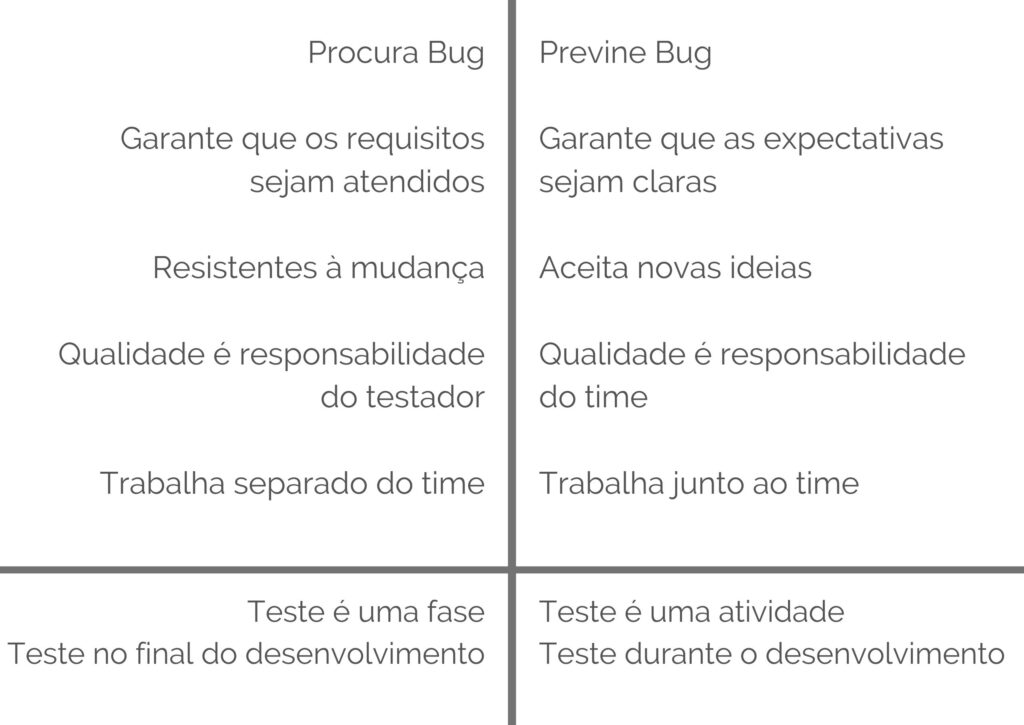
Summarizing in topics the differences between traditional QAs and Agile QAs are:

Also, Agile QAs:

  • they are always learning new skills and technologies, adapting to change;
  • practice clear and effective communication, collaborating with technical and non-technical people;
  • understand the business, defend the product and collaborate with the customer;
  • disseminate the culture of quality and take care of the team’s health;
  • promote and get feedback, having the courage to expose what is wrong and praising what is right;
  • keeps simple and self-organized, not depending on instructions to carry out its activities;
  • like what they do 🙂
Are you in the traditional or agile context? If in traditional, would you like to go to agile? If in agile, does it do what was described in the text or is it already beyond? Leave a comment here!
https://old.agile.whit.digital/por-que-os-processos-ageis-nao-estao-ajudando-na-transformacao-digital/
by Nelson Legal Nelson Legal No Comments

User Experience: Understand what is missing for your digital business success

Learn what the benefits of UX are and how this practice makes the customer become a fan of your product

By Nelson Legal
Just around the corner, he is arriving, the most desired, the most sought after, the most wanted and valuable, the customer! Also known as consumer, user, target audience and so on… All companies need it to exist, and keeping consumers loyal to their brand has been an increasingly difficult task. Gone are the days when, in order to have the consumer’s heart, it was enough to sell a good and cheap product. Much more is needed… Today, big brands compete for the chance to deliver the best consumer experience. Receiving so much attention, the customer was extremely judicious and attentive to any slip and, if that happens, he doesn’t think twice about changing the brand. With every problem that comes in the way of the consumer, there are countless companies that solve it with a hand on the back. But a company that, in addition to solving the problem, is still able to put a smile on the face and warm the heart of that customer, this is much more difficult to achieve. And it’s difficult because the company needs to create a special bond with its customer, it has to dig deep and be able to predict what he will like and dislike, and how much effort he will be willing to put in. And most importantly, ensure that everything that has been done will be clear and intuitively understood. Complex, right? That’s where the UX comes in, User Experience or User Experience, translated from English. Created by Don Norman in the 1990s while working at Apple, the definition came about because he wanted to improve the user experience with his computers. Not just when they were interacting with the computer turned on, but before and after that. A good example of this is how a restaurant has the best hamburger in town. It’s no use a perfect hamburger if you don’t think about comfort, service and menu, among other details just as important. Each of these items can make a customer decide whether to spend more or less, whether to return or not, whether to indicate or speak ill of the restaurant. Everything has to be very well planned to please and really serve you!

But how will UX practice impact my business?

This planning, focused on the user experience, can also save effort and money, and increase your company’s profits. According to Robert Pressman’s book, “Software Engineering: A Professional Approach”, for every$1.00 spent on UX to solve a problem during product planning, $10.00 would be spent on solve the same problem in development and BRL 100.00 or more for the problem to be solved after the product was released. In other words, in addition to avoiding problems, this planning can also direct and facilitate the path between the customer and their product. A recent study by Forrester Research revealed that a well-designed user interface can increase a website’s conversion rate by up to 200%, and a good user experience can raise conversion rates by 400%. No wonder that large multinational companies are advocates of UX investments. Amazon, for example, continually applies A/B tests to all aspects of the interfaces that its customers serve, constantly updating and redesigning them  based on data. Since 2015, Amazon has been the largest e-commerce store in the world and the most valuable in the United States. Here in Brazil we have the case of Nubank, the main fintech in Latin America thatwas born in 2013 and today it has more than 5 million loyal customers. Since its birth, fintech has had the user at the center of all its decisions. According to Guilherme Neumann, ex-UX Lead at Nubank, “the design or interface solution that emerges is a consequence not only of the work that the designer does, but of the concern that everyone at Nubank has with the experience of those who use the product. ” We see how UX has proved to be important for these companies, and can also help others to achieve numerous benefits, such as:
  • Increase profit and conversion: users become loyal to easy-to-use products;
  • Increase customer satisfaction ratings: users love well-designed products that give them what they need and what they don’t even know they need;
  • Decrease support contacts: user testing results in more fluid and intuitive usability for the greatest number of people;
  • Avoid rework in product development: UX focuses on understanding the user journey and applying tests, which reduces the occurrence of planning errors;
  • Reduce the risk of producing the wrong product: user surveys will look for products that add real value to them on a day-to-day basis.
To start investing in UX, the first step can be to add a Product Designer to your team, someone who is able to bring the User Experience culture into the company and engage the teams as a whole. The next step is to form teams with experts in specific areas of the UX, such as research, writing, interface (UI), prototyping and testing. The ideal is for everyone to complement each other, while individually being able to act in all areas of UX. Want to know more about this subject? Contact us to talk about how to include UX in practice. Several companies have already had positive results after including UX in their daily lives and yours could be next! Without Stop: Understand how one of the largest toll companies in the world has increased its user base on app by 315%
by Rodrigo Pinto Rodrigo Pinto No Comments

What really is Digital Transformation?

As long as you don’t understand in detail what Digital Transformation is, your team will continue to make great efforts with low results. Understand at once and get ahead! Can digital transformation help me do more with less? Can I deliver more results in my company? Working more efficiently, which generates more deliveries? What can I improve in my daily life, to be more digital? These are some of the many doubts that come to us every day about what it is and what the benefits of this digital transformation are… However, there is still a lot of nebulosity about the topic, both due to lack of consistent information and to fads of many trying to sell this type of service or make these changes, each in their own way. Like many other fashions from the past and others that will appear in the future, they can be exaggerated at some point by those who don’t understand the subject. However, the doubts mentioned above remain in people’s minds. Well, but the fact is that it is not enough for companies to follow fashion or do something just “for the English to see”, in a mechanical way… As Antonio Costa, partner at Agile.Inc: “No At the end of the day, the customer will buy your product or service, not because you use Agility or because you do Digital Transformation. The customer will buy your product because you actually generate some value in their life.

What is happening in the market?

Basically, much of the digital transformation is based on the Fourth Industrial Revolution, which is happening in the market today.
  • The First Industrial Revolution used the energy of water and steam to mechanize production.
  • The Second used electrical energy to create mass production.
  • Third used electronics and information technology to automate production.
  • Now, the Fourth Industrial Revolution is consolidating into the Third – the digital revolution that has been taking place since the middle of the last century. It is characterized by a fusion of technologies that is blurring the lines between the physical, digital and biological realms.

Fonte: https://www.weforum.org/agenda/2016/01/the-fourth-industrial-revolution-what-it-means-and-how-to-respond/

The way people are connected by cell phones, the new generations that arise from customers, from employees who were born in a digital world and behave totally different, the power of new technologies such as 3D printing, nanotechnology, IoT, IA, among others, all of this makes the world and the business much more complex and dynamic, within the VUCA scenario, as it is widely spoken. In other words, companies need to adapt to this new reality! As it says  Fernando De La Riva: “We are using 19th century management theories, with 20th century organizational and incentive structures, in a 21st century business environment. VUCA is the new normal in the business environment.”

What is actually not Digital Transformation?

Given this market scenario, let’s first understand what Digital Transformation is not: – It is not prescriptive that you buy and come in a box, you just need to install it; – It’s not a silver bullet; – It’s not just “putting on a nimble outfit” and making very common basic mistakes; – Definitely not channel scanning; – It is not about paying for training for the team, when there is a surplus budget, to follow a trend and market evolution.

But, what is this Digital Transformation?

Digital Transformation is a process of change with the objective of helping companies to obtain more results, to deliver more constant value, to work in a more responsive way, producing more and more in line with the current needs of customers and employees. We, at Agile.Inc, understand by Digital Transformation as: A fundamental change in the way the company organizes</ strong>, using technology, people</strong >, processes and business models< em>, aiming to be adapted to a more complex and dynamic universe, where it is essential to focus on generating customer value. This will be decisive in the life of companies: the more digital mindset the organization has, the greater competitive advantage in the market it will have in this new VUCA world. This concept consists of several points, such as: – Change the way the areas of a company connect when working together, mainly supporting the business areas; – Really put the customer at the center of decision making; – Have more transparency and give visibility to what is happening to everyone; – Prioritize deliveries and always ask yourself “are we doing the right thing?”; – Integrate the Agile mindset on a daily basis within teams; – Decentralize decisions, but with high alignment;

The risk of not doing it right is very latent

A lot of doubts may be going through your mind right now, especially that feeling of not doing or preparing for the digital transformation yet. And this is very risky! In recent surveys, it was identified that the risk of not doing the Digital Transformation correctly is the number 1 threat identified by directors, executives and C-levels in 2019. “Existing operations and legacy technology infrastructure pose a risk for companies that can’t transform quickly enough to compete with those that were ‘born digital,’” reveals a study by the University of Carolina’s Risk Management Initiative North and management consulting firm Protiviti Inc.

Fonte: https://blogs.wsj.com/riskandcompliance/2018/12/05/businesses-predict-digital-transformation-to-be-biggest-risk-factors-in-2019/

In other words, if the company is not able to carry out the correct Digital Transformation, it will lose market space for organizations that are managing to do the process properly. Taking into account that some companies were born digital, they are already customers centric and have conquered the preference of their customers; and they have a strong culture and a mindset of innovation and continuous improvement, from the choice of employees, internal processes, to the attitude of their leadership.

Conclusion

With all these facts and explanations on one of the most talked about issues in recent times, do you feel prepared to make this fundamental change in the way your organization works? How to make this transformation happen in the best possible way, so that the company can take the lead? How not to fall behind and be forced to react desperately in the future? These are questions that many executives have and to answer those questions that we at Agile.Inc work on. Do you have any other questions? Tell us here in the comments!

READ ALSO :

Avoid common mistakes during Digital Transformation

If you are already transforming your company, understand how Agility can be hindering this process

 
Top