We talk to companies on a daily basis and we see, in most of them, a common pattern regarding errors in the transformation process (whether digital or agile).
Some of these failures are committed systematically in the areas of Technology and Business, generating products that often do not please or do not generate as much value for customers.
Time is scarce for everyone. Costs are decreasing more and more and the “less has to be more” for real. However, actually delivering more is a big challenge.
If the company doesn’t really have agility built in, it won’t be able to stand out. If delivering value is still a difficulty, the area will be left behind.
However, professionals who are developing digital products that really add value, are standing out in the market and being hunted by companies, as they are really able to do more with less and help create products that, in fact, delight customers and generate value for companies.
With that, I ask you: are you completely satisfied with your digital products or work models of your team? Are you happy with the productivity and results?
You know you can do more and better, but you don’t know how or where to start? If these issues bothered you, probably some of these errors must be present on your team.
Check out the most common:
1) Traditional processes that look agile
The company has some people certified in some work models, does some events/ceremonies very mechanically, discusses a lot if Scrum or Kanban should be used…< /span>
But at heart, the organization is still in the traditional development paradigm.
Often you end up making a water-scrum-fall</i >, that is, products are only released after months of creation. A lot of unnecessary bureaucracy still exists! We usually say that this company is at a maturity level 1, doing an Agile Mechanic.
Many teams think being agile is:
- “I have a flow in azure, I am agile”
- “I started doing some ceremonies, daily planning, I’m agile…”
- “I have a certified Scrum Master and a part-time Product Owner allocated, I am agile”</li >
They understand that they do some processes in an agile way, because they use a framework (in a superficial way, sometimes), but they don’t know how to distinguish the difference between doing agile or being agile.
The process has the face of agile, it seems that a transformation is starting, but, deep down, the culture is still traditional.
2) Culture of control, not value
Another very common mistake refers to the cultural part. I like to say that deep down, the base for creating great digital products is a cultural shift.
If the development area is mainly focused on having control; in finding blame for mistakes; in centralizing decisions on specific people; if you are too focused on the process and deliverables, rather than focusing on value…
It is definitely an area that is wasting time and money.
If these aspects are present, I have to tell you that you still have a culture that will hinder you from having high-performance teams.
Companies that create good digital products have their main focus on delivering constant value to the customer, strengthening a culture that delegates decisions, has clear goals, a culture in which people are fundamental .
When the team is focused on delivering value, interesting aspects appear, such as:
- culture of learning from mistakes;
- team culture instead of boasting r the heroes that are indispensable;
- culture of ownership< /span> instead of people hiding from responsibilities;
Creating great products mostly starts with attitude! It’s no use having several tools and processes, it’s necessary to foster a strong product culture within the company. In your company, what is the real culture like, not the one hanging on the wall?
3) Not paying enough attention to people and treating them as resources
Leaders are not satisfied with the productivity of teams. Teams are not happy with the leaders’ management model.
And one of the main mistakes that cause this type of situation is hiring people looking for cheaper profiles, with low qualifications.
For example, many consultancies when providing a service, mainly in the IT area, offer a senior professional, but in the end, in practice, is a junior level.</ span>
This happens a lot because the company already starts from the idea that it is necessary to have many teams and with many people to increase efficiency, and for that it needs to lower the cost.< /span>
Another very common point is still the low collaboration between teams. The leadership is still in the traditional model and teams with gaps key knowledge for the development of systems, for example.
With this, people end up working more reactively, putting out fires, than proactively.
These are some of the characteristics found when a company cannot handle people correctly.
Find the right people, put them in the right place and with the right processes and models – only then will there be a team capable of creating products and services that truly delight the customer.</span >
4) Traditional goals that sink teams
In your company, do you have visibility into peer goals or other areas? Does your goal only measure efficiency issues or does it measure results?
Do you feel that the team’s goals are shared between them in some way? And are they clearly linked to the area’s or company’s goal?
Have you ever noticed situations in which you needed someone’s help, but the area’s goal was not the same as yours, so there was no collaboration?
These questions help you to understand if this problem exists in your company, of goals that only sink teams.
Just efficiency goals, lack of transparency and focus, unshared goals, and goals that are too long and unclear can kill off the development of exceptional products.
Even more if people’s bonuses are linked to these goals. That’s because, at the end of the day, teams and people behave according to how they are measured – “tell me how you measure me and I’ll tell you how I behave”.
In truly digital companies, it’s easy to find shared goals between Business and IT, for example. Goals need to be transparent using templates such as OKRs , short quarterly goals that help teams be agile and allow them to readjust as they learn more.
I heard a phrase from a customer that translates this problem very well: “The problem is not the quantity of delivery, but the quality of these deliveries, in the sense of: we are delivering a lot, but delivering what?
The pressure of the deliveries that teams are suffering, the changes in priorities, make the teams deliver a lot, but we are not able to move the pointer, we are not really impacting the end customer.< /span>
The deliveries come from personal desires, from somewhere that doesn’t have a very clear direction.
The quantity of delivery has increased, but the overall quality, focused on value, is still a gray area” and I completely agree with all that.
5) There is no correct Product View
Another very flaw What often impedes the creation of good digital products is when teams are still focused on a project culture, in which success is meeting the scope and deadline or the focus is getting more tasks done in less time.
People don’t know the customers! Sometimes they even have a persona, a shopping journey designed, but it’s not what guides their day-to-day development.
Product Owners are just “order takers” who care about writing user stories. They take requests from managers or stakeholders – who are the people who define what the customer needs.
In other words, the company is still “stakeholder centric”.
There is talk about being customer centric, that is, putting the customer at the center of the entire chain of creating and developing a product or feature, but at the end of the day, people don’t really know what it is. .
When someone is asked: what is customer value? The vast majority do not know how to answer or we get non-cohesive answers between people.
A key point in creating high value products, which give competitive advantage to any company, is to have a correct Product management.
It’s moving from a Project culture to a Product culture, where we stop fulfilling stakeholder desires and focus much more on solving customer problems< /em>.
“We are obsessed with the customer. We start with the customer and work backwards.” (Jeff Bezos)
6) Low maturity in software engineering
During a consultation, in an interview with a team, after several questions to the members, we identified an interesting pattern – this pattern was later found in other teams: low engineering maturity of software.
Perhaps due to the aforementioned points, the teams are charged for productivity and deliveries, linked to the low professional maturity of some “resources”, teams with low software engineering maturity are created .
These teams even create masked productivity in the short term, generating low development standards and flawed architectures.
But the bill comes one day and the team starts to slow down, as everything in development starts to get complex.
Development standards do not exist and items like Agile Quality and Devops are desired by teams but not applied correctly.
Managers are mistaken and think they are already experts on the subject, presenting sophisticated reports showing how agile their team is with agile engineering.
But in reality, everyone knows that there is still a lot to be done!
A complicating factor for this situation as a whole is the existing legacy systems and the large technical debts.
Companies that were able to truly transform themselves put these problems visible, put the “elephant on the table” really, so that the problems could be addressed and discussed.
After all, if a team needs a new API, for example, to display a value on the screen and needs to wait months to create this interface, it can’t be really agile .
Probably, the company will model the product according to the capabilities of the internal systems, and not because of the customer – putting the focus on development to really meet their needs.
In this scenario the Business area wants something done one way, but IT says “this is not possible because of our system, so let’s do it another way” .
7) Organizational silos
Last but not least, a pattern that can kill off great digital product creation is silos within the organization.
A structure with dependencies between areas ends up creating a scenario in which everyone thinks only about their own, and no one can have an end-to-end view.
Companies are trying to reduce silos by creating tribes and squads, but we’ve already seen places where:
- The tribe was nothing but the same area from before, just with a different name;
- The squad is assembled seeking operational efficiency and member occupation (that all collaborators are allocated and busy for a long time). Thus, technical squads are created and not multidisciplinary teams, losing agility in deliveries;
- Having someone from the Business area on the team is impossible, as you cannot give transparency of “problems” to the other areas, for example;
- The areas are still competing with each other, rather than exchanging information – the area has started some interesting initiative, but it is kept as a secret, with the expectation that someday someone will give this recognition and they will get the merit.
When we talk about setting up tribes by customer journey, people’s minds literally “fry” and you end up not making the change as that would be too much work.
If the company is still full of silos, the products definitely lose quality and the team cannot deliver real value.
Now you might be asking yourself: what are the biggest problems that occur with these silos? We have already listed some:
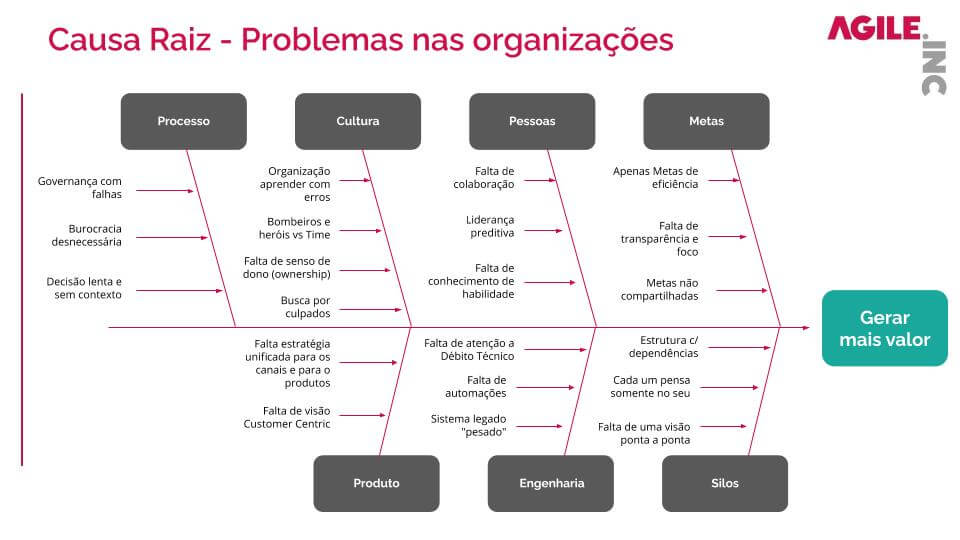
Finally, it is time for companies to realize that they need to build in the present, the future that is already there! Doing what’s important, at the right time and in the right way – that’s what you should strive for daily.
To be truly digital is not in the way products and services are presented to the end consumer, but in the model in which they are created and developed. And that’s not the future anymore! It is an increasingly urgent gift.
A study by IBM shows that 59% of organizations have accelerated their digital transformation processes during the Covid-19 pandemic.
This is because executives have come to trust more in the benefits that these new processes and formats bring to the organization, making it much more prepared for this new normal.
Both the risks and opportunities are too great. The stakes are too high and there’s no way to be left behind. You must act!
And the solution to all this is 100% linked to the correct hiring of people and suppliers. It’s normal to find shallow concepts, even with a lot of desire to do it differently, but there’s a lot of technique to do it correctly< span style=”font-weight: 400;”>.
The proper knowledge and willingness to do different and better is an attribute of people. I love to say that “any junior team makes a system with 50 screens – but to make a product with very few screens, which solves maybe 80% of the problems, you need a very capable, engaged team with the right incentives.”
We can’t run away from this! As long as companies do not have the right people and suppliers, the products will still be made with low quality as a whole and a lot of money will be lost.
See how we help transform a of the main digital products of the largest automatic toll and parking payment company, Sem Parar.