One of the great needs of companies these days is to have better results, more productivity, and to really be able to connect more and more with their customers.
The point is that the race to have more competitive advantage in the market is only increasing and many organizations are still failing to develop digital products that put you ahead of the competition, and that delight your customers. real users.
Many companies claim to be digital or agile, but deep down we see that they are still traditional, with a change, most of the time, of facade.
Every day many questions come to us. They are requests for help, for people who want to change this scenario in their teams. The main questions that arrive are:
- How do I create better digital products?
- How do I do a real agile makeover?
- Where does agile end and digital begin?
- But why do all these problems happen?
- Is all this normal?
Starting with the last question: yes, this is all normal. This is a common process in the market, and normal for your company.
However, it is necessary that companies take the next steps as soon as possible, that they manage to avoid mistakes and basic flaws in order to really be agile and digital.
The companies that make it through this phase will be able to stand out a lot, and will really have a competitive advantage.
And the professionals who manage to make this evolution in companies, will certainly stand out from the average person.
Really Agile Transformation
True agile transformation, which is the foundation of digital transformation, is a long journey and not just an installation of some ready-made model.
It’s not enough to “buy agile” from a traditional consultancy, train everyone, change method names, and presto, think you’re agile.
You will only be agile when you get:
- People with more skills for building digital products;
- Better and more agile processes for this creation;
- A true vision of digital products;
- Good engineering practice;
- Really agile leadership, among others.
However, to achieve this goal, there is a journey, there are stages, there are stages that the company goes through, to be able to create really better digital products.
You don’t measure whether the company is agile or not, but how agile or not it is.
Stages of Change
Imagine this situation: there is a problem, you realize that the organization is losing money, you know you can have better processes, you need high performance teams and deliverables that really add value, but it doesn’t know how or where to start to change.
Currently, organizations want to be agile, but in most cases, they don’t even know why they want to…
They just decide that and believe that agility will solve these situations mentioned above.
And, because of this aimless decision, it is common to implement some agile method in a mechanical way, without learning deeply and incorporating the concepts and principles into everyday life, without changing the status quo.
And as a result, team productivity can drop!
This is because of the curve of change, the J-Curve, a complex process explained by psychotherapy.
Developed by psychotherapist Virginia Satir, the model is described in 5 stages, which have an effect on feelings. acts, thoughts, performance and philosophy.
By going through these effects you can improve the way you process change and help others process it.
When it comes to organizational agility, you can also use the J-turn as a road to be traversed.
In many ways, agility helps reduce risk.
But when we’re talking about organizational change, this agility, most of the time, will first express itself in a slight decline in performance.
Therefore, it is important to say that this is totally normal, and is directly linked to changes in the organization’s status quo, which shortly after this decline will start to increase its results and performance of the teams.
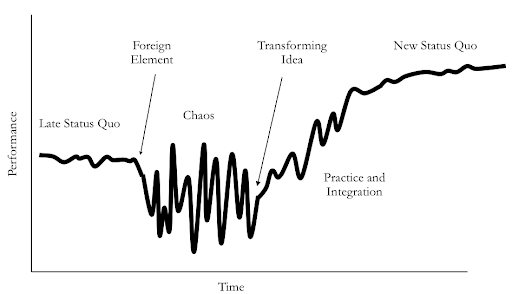
In general, this process happens when a person or a small team seeks to better understand agile concepts and starts small initiatives.
Seeing the benefits, she feels she needs to go through this transformation (even though she’s not sure what it means to be agile).
Because of this shallow perception of the meaning of “being agile”, some method mechanically implanted in this organization and without strategy, be it Scrum, Kanban, among others, will cause the team’s productivity to drop. This is exactly what the J Curve says.
To prevent the above errors from continuing to happen, you need to have the right people to go through this change process.
And they should start by understanding the scenario you’re in first.
After many studies, we identified that there are four stages, in which it is possible to understand how far behind companies are in developing digital products or how much they are really being agile and creating products from the best way possible.
We can classify them as agile maturity stages and they are divided into 4 levels: traditional companies; agile mechanic; trying to be agile and agile professional.
- Traditional companies are those who understand a little about agility and try to implement some concepts and practices in a shallow way;
- Most organizations are already practicing what we call mechanical agile</b >>
- On the second level are companies that are trying to be agile, in a transitional phase in which they are not really agile yet, but they are well on their way to doing so;
And in the third stage, we have the organizations that run the Agile Professional , which are those that are ahead in the market and develop digital products with the right professionals, with the best engineering processes and practices, with the correct product vision.
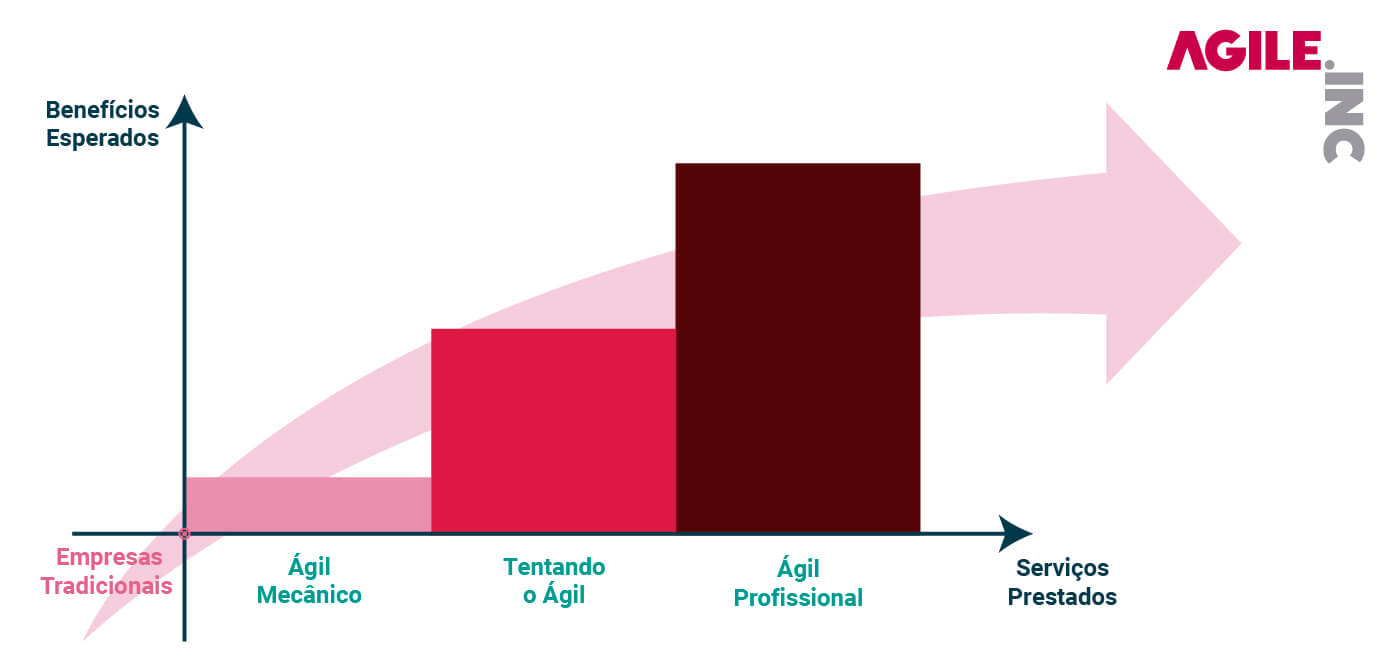
The more mature, it is clear that greater benefits will be reaped, and thus the company will have greater productivity, performance, greater connection with the customer, and will thus have an advantage over competitors .
Knowing the 4 stages of agile maturity, looking for high performance
Stage 0 – Traditional Companies
These are those companies where the employee or manager has heard about agile transformation but hasn’t put it into practice yet.
Usually, these are companies that, a person who has read a book or article on agile methodology, understands the importance of this process as a whole and will start looking for a consultancy to in order to have help the professional in transformation.
It is that company that is starting in the world of digital transformation and is afraid of the changes that need to be made.
Despite trying to implement some concepts and practices, it still hasn’t been able to incorporate the agile mentality in the company’s skeleton, causing the results not to arrive.
Stage 1 – Mechanical Agile
This is the stage where most companies are!
At this point, the concept of agile transformation is already known, but not the complete process.
Normally, the company already uses methods such as Kanban, they have daily alignments, change area names to squads, use post-its to organize tasks and some other organizational methods…< /span>
Nevertheless, it still can’t really be considered an agile company.
- It is not yet a transparent organization with clear objectives</li >
- There is no transparency of information, with a lot of visual management</li >
- It still does not have short cycle deliveries, with a focus on value generation</i >
- There is a need for more visibility, improvement in processes and more collaborative areas</ read>
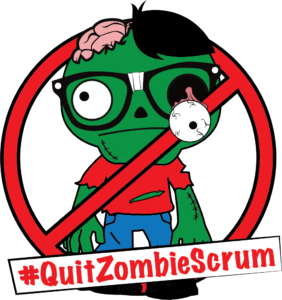
This is Mechanical Agile! A stage in which one already knows and uses some agile concepts and practices, but the culture, the mindset, is still completely traditional and Taylorist.
Is it possible to change the behavior of this company and reach another level of agile maturity?
Yes, with training, consulting and building high performance teams – which is what we do with the help of Agile School – our educational area – and in Agile Inc, developing corporate solutions.
This stage is also known as Agile Zombie.
- Zombie is a person, isn’t he? He has arms, legs, a piece of his head. But we know that the zombie is not a real person because it has neither a thinking brain nor a beating heart.
- Making a parallel, many companies are mature Agile Zumbi: they even run an agile process, they even have an agilist and a certified product owner, but in the end, they don’t have an agilist who removes impediments, they don’t have a product owner with authority over the product, they don’t have a leader who understands what it means to be a leader, they only have kanban tables but they don’t analyze the flow. In other words, they are more like Zombie!
Stage 2 – Trying Agile
These companies are at an intermediate level, right in the middle of the road. Despite having already passed the mechanical agile phase, it still does not have a continuous workflow to be considered a professional agile company.
Processes still need to be improved and employees still need to develop skills, knowledge and experience.
This is a process stage where companies are starting the agile journey. It is a transitional period, where companies stay for a short time, as they are in the race for agile and digital transformation.
At this point, companies are transforming themselves into an agile organization with each passing day, they are in the process of adapting and implementing new cultures and methodologies.
Stage 3 – Professional Agile
The company is already reaping the fruits of the agile transformation and has already completed the entire transformation process, it managed to complete the previous step.
The areas now connect when working together, mainly supporting the business areas, and really put the customer at the center of decision making.
They have more transparency and are concerned with giving visibility to what is happening to everyone.
In addition, they prioritize deliveries and always ask themselves “are we doing the right thing?”
Companies that are running an Agile Professional, have the Agile mindset on a daily basis within teams and decentralize decisions, but always have a high alignment between all sectors.</span >
Not only the leadership, but the teams already understand the importance of having clear and well-defined goals, as well as alignment in the execution of processes.
The teams are empowered, each one has a certain freedom of decision, not being all centralized in a single manager.
In addition, innovations happen all the time, as there is complete freedom of adaptation in all areas of the company.
Employees work motivated and therefore produce more solutions.
In agile leadership, goals are determined, the company knows its customer in depth, promoting the delivery of value and removing impediments.
We at Agile Inc. can help you get to that point. Our goal is to shorten the agile transformation journey by delivering value to you.
At the end of the process, when your company is professionally agile, that is, truly agile, you will have conquered:
better operational efficiency, better value for your customer and risk management (agile governance that will reduce your internal risks).
How to build this journey of evolution?
For you to evolve and become a company in stage 3 – Professional, you need to assemble your development plan, looking at some perspectives.
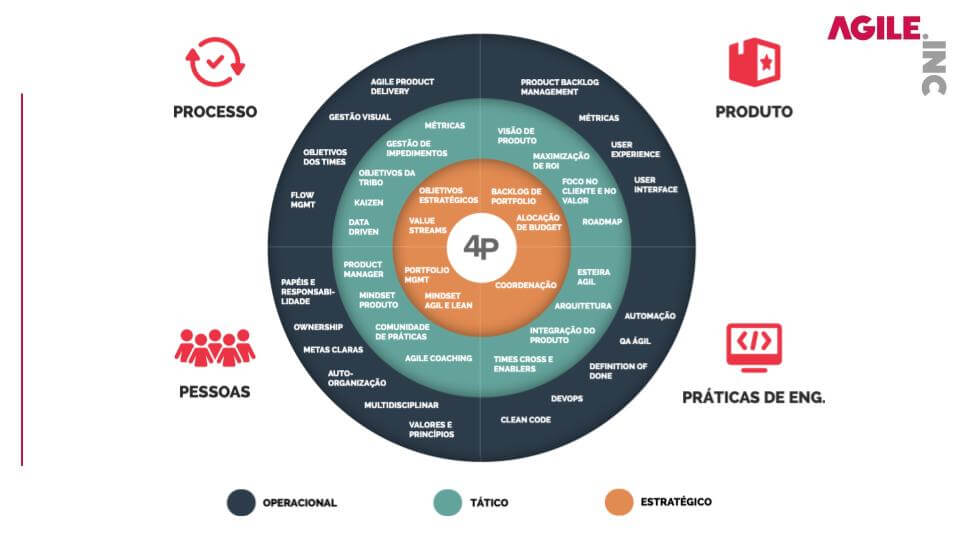
Here at Agile.Inc we classify organizations into 4 pillars, after creating a radar with perspectives that mix operational, tactical, strategic eyes.
Let’s better understand each one of them so that you can identify which stage your company is at and, thus, make improvements until reaching professional agile, that is, developing truly digital products innovative.
These four pillars are Process, People, Product and</span > Engineering Practices.
Process: refers to how we create digital products. They involve issues such as strategic objectives, metrics, visual management, impediments management, agile product delivery, flow management, data driven, kaizen;
People: It is important to understand if you have the right people, in the right place, and with the right motivation. In this pillar we look at roles and responsibilities, sense of ownership, clear goals, self-organization, multidisciplinarity, values and principles, community of practice, product mindset, product manager;
Product: what product do we want to create, what vision do we want to reach? In this pillar we pull subjects such as product backlog management, metrics, UX, UI, product vision, ROI maximization, customer and value focus, roadmap, portfolio backlog;
Engineering Practices: only with the right engineering practices will we be able to be really agile, so some subjects are extremely vital, like Automation, Agile QA, DevOps, Definition of Done, Clean code, Agile treadmill, architecture, product integration, teams cross and enablers.
Based on these pillars, and now looking more from an operational point of view, now from the tactical perspective and now from a strategic perspective, we set up an evolution plan for the company’s journey.
This plan must be constantly revised, as if it were a Product Backlog of a product, but in this case, a Change Backlog, to bring your company closer to Professional Agile.< /span>
Looking at the 4Ps and maturity levels, we found some interesting features. santes, which can be useful for you to analyze if you are closer to the traditional or closer to the professional.
Characteristics of these pillars of a company at the Mechanical Agility:</ span>
- Development team falling out
- Product owner proxy: just take orders without caring too much
- It’s a team that doesn’t think about valuing the product
- No integrated view
- No portfolio
- Many decisions are made based on guesswork,
- Metrics, based on data are missing
- Scrum Master/Agilist is that person who is in his or her first experience of agility. It still doesn’t have much expertise
- Areas divided by people who think and people who do.
- Efficiency-oriented teams/tasks
- It is not clear where your responsibilities begin and end
- Predictive leadership, which monitors your collaborators
- The team serves the leader
- Long flow, each area has its task and priorities
- Documents are unclear
- Tests are done manually
- Team is seen as coders
- Ignore or hide technical problems
Characteristics of these pillars of a company at the level Professional Agile:</ span>
- Customer focus as a basic principle
- The team understands each other and works together
- Have a fully integrated view of processes
- Have an overview of what’s going on, as an organization coach
- Processes collaborate with the delivery of product value
- People expose problems
- Contributors bring new insights
- Mistakes are accepted and are part of learning
- It is necessary to use self-organization, using the wisdom and intelligence of the whole team.
- The team is engaged, motivated and with purpose
- Leadership changes its profile, being a culture of delivering value, avoiding waste.
- The leader serves the team
- Teams work together with the same goal, making deliveries run quickly</ read>
- Multidisciplinary teams organized not by area, but by product view
- Team is a co-author, knows the best solution for a given problem
- They give transparency to technical problems, because they understand that they represent a risk to delivery and take time to resolve them</span >
Create a digital product that really it’s agile it’s complex, so there’s no way things can be done separately (as is done in traditional companies).
For everything to work correctly, operations and professionals need to be integrated so that everything is done quickly, yet efficiently, and with a focus on delivering value.
Identifying my company’s maturity stage
There are some perspectives that can be analyzed and taken into consideration to identify how agile your company is considered.
Check out what these areas are and what can be analyzed:
Practices and Roles
The aim is to understand if the organization is using processes efficiently and also if everyone knows their respective roles within the company.
If you still don’t know how to identify this, there are a few questions you should ask:
- Is it clear what the responsibilities of the roles currently available in the company are?
- Is the teams workflow visible?
- Do teams have explicit policies (eg definition of ready to work, definition of done etc.)?</ span>
- Are bottlenecks and queues visible in the teams workflow?
- Do the teams have clarity on the main sources of rework?
- Are software engineering practices being used to keep code healthy?
- Is the publishing process automated?
- Are there automated tests?
Metrics
The intention here is to understand if your company has been using business and process metrics.
And if so, at what level? You need to stress the importance of developing benchmark metrics that will help improve your product.
To analyze this, ask yourself:
- Are business metrics being used in the decision-making process?
- Are the business metrics visible for everyone in the company to review?
- Business metrics are used as a reference in the process of defining an initiative (ex: which business indicators will be leveraged by project X)?
- Do teams use process metrics to project lead times?
- Do teams use process metrics to analyze process health?
Business-oriented prioritization
Does your organization set priorities?
It’s important to consider that when everything is a priority, nothing really matters.
After all, everything is on the same level, needing attention and urgency.
Therefore, it is necessary to understand if there is a structured prioritization process.
Ask yourself:
- Are there clear prioritization criteria?
- Has prioritization taken into account customer needs?
- Are business metrics used in the prioritization process of initiatives?
- Is an analysis of dependencies between initiatives carried out before finalizing the prioritization process?</li >
Financial result
Your company measures financial results of your initiatives?
This is something very important in an agile journey.
To find out if they are already doing this or not, ask yourself:
- Is the organization’s leadership clear about the business objectives of each initiative?
- Are the teams measuring the financial result of deliveries?
- The organization is able to classify the initiatives according to the expected result (ex: this initiative will generate greater efficiency in the business, will help to conquer market share, will it be an innovation, will it anticipate the cost of delay?)
These analyzes will help you diagnose what stage of agility your company is at and where you need to improve.
Ok, I know my stage, how can I improve?
Now that you’ve identified what stage your company is at – and we can say that 85% of companies are closer to Mechanical Agility – there are some solutions that can be done for your company move forward on the change curve faster and reach the desired status quo.
In this case, some questions will be analyzed, namely:
- what is the company’s maturity problem?
- what is the executive level mindset?
- how is your team, is it lined up?
- how have agile methods been implemented so far?
After these reviews, it’s important to know that if you don’t have a good product vision, clear and organized processes, people with a different culture and mindset, engaged with the organization’s purpose , you will probably not be able to reach another status quo, nor advance through the agile maturity stages effectively.
For this you need the right professionals and suppliers.
This is the best way to have a radar for your organization, which will show you where the flaws are, where improvement is needed, so that you can build an effective and optimized strategy to your reality.
And you can do this in three ways: with training, consulting and building high-performance teams.
Trains
It is necessary to raise the level of knowledge of people and incorporate the true agile mindset, according to the needs of the company and its employees.
All training offered by us, for example, is certified by international organizations – such as Scrum.org, and performed by Agile School – our education arm.
Consulting
With the help of consultants, it is possible to break the traditional mindset to understand the way in which your company can create and develop digital products that generate greater competitive advantage.</ span>
Squads
A team of people with the right skills, the right knowledge and market experience to carry out this entire journey of change, the SQUADs. As each client is unique, it is necessary to analyze the working conditions in order to assemble a multidisciplinary team adapted to your type of business and needs.
Now that you know your agility stage and what you must do to get to professional agile, contact our consultants and transform your company forever.