Every day we see people working and working hard to achieve goals or the agreed scope for a project. I rarely see people and teams wondering why that project and delivery is important to the company.
The vision of the strategic level created with a future objective is quickly broken so that the team that executes the demands on a day-to-day basis no longer knows the reason why it was hired.
This scenario is seen in small, medium and large companies, inside and outside Brazil, of different sizes and segments. Due to these needs, the figure of a Product Owner or Product Manager is essential in some companies.
This figure, regardless of its branch or context, is responsible for bringing the company’s vision of value to the different levels of the company.
This role, even in different situations, requires techniques to help you in your daily life, as shown in the example below (figure):
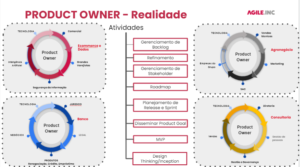
Regardless of the framework, techniques or tools that this specialist uses on a daily basis, a good Product Manager must know how to say no to people, prioritize and organize demands and have a clear view of their Product Backlog – which is visible and communicated to all as a roadmap.
Taking care of Products, above all, is communicating correctly so that stakeholders and different teams are aligned with your vision, even if they don’t agree with it.
For this there are backlog prioritization techniques, categorization, breaking your backlog, design thinking and a host of other ways to turn ideas into tangible increments for the organization.
Thus, as we see in many literatures, the product manager is largely responsible for disseminating the product’s vision and value. Added to this, this producer must constantly seek to learn about their product in order to innovate.
To innovate the PO/PM needs to be serving the market, looking for success cases and benchmarks that apply in your context, in a way you need to be someone creative, or as we can say, co-creative because in many cases it is necessary to carry out co-creative processes. – creation like design thinking to be able to suggest experiments that can generate success for your product.
In summary we can say that:
– A good product manager has a vision of what is going on with his product and is able to communicate clearly.
– Has a lot of technical knowledge and manages to prioritize according to the organization’s objectives.
– Makes the team feel engaged to collaborate, create together and constantly seek to improve the value of your product.
Product management techniques help you accomplish the above points and more. A good producer must know their backlog and have a logical solution for it.
And in your organization, how do you see your product manager?
To understand even more about this subject, contact us here.